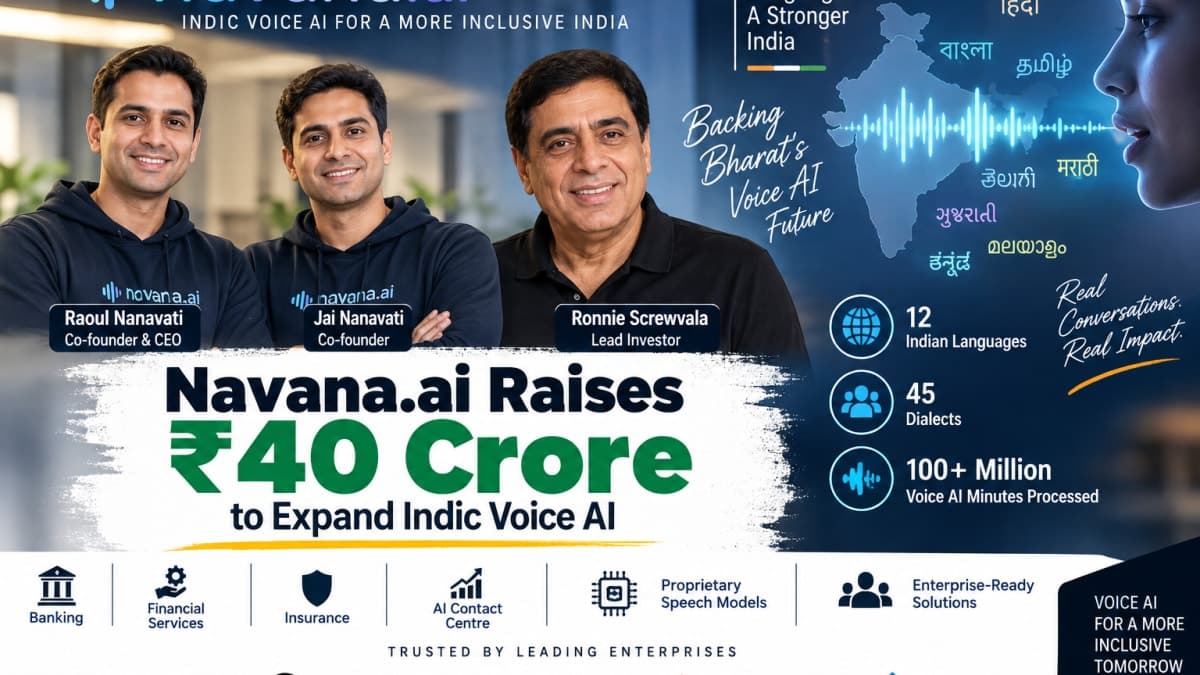
Ronnie Screwvala leads Series A as the startup targets regulated enterprises with voice technology built for India's linguistic diversity
Indian voice AI startup Navana.ai has raised ₹40 crore in a Series A funding round, giving the company fresh capital to expand its technology across the banking, financial services and insurance sector.
The round was led by entrepreneur and investor Ronnie Screwvala. Antler India, Sharad Sanghi, Sandeep Singhal and Paula Mariwala also participated.
Navana.ai plans to deploy the money across three main areas: expanding its BFSI presence, improving proprietary speech models designed for Indian languages and dialects, and further developing its AI Contact Centre and automated evaluation platform.
The funding comes as Indian enterprises increasingly explore conversational AI for high-volume operations such as customer support, collections and sales. For Navana.ai, the challenge is more specific: making those systems work across India's linguistic diversity while satisfying the privacy and compliance requirements of regulated businesses.
Building Voice AI Around Indian Languages
Founded by brothers Raoul Nanavati and Jai Nanavati, Navana.ai develops voice AI systems aimed primarily at enterprises.
Its technology is designed around a problem that can be particularly difficult in India. A customer may switch between languages during the same conversation, speak with a regional accent or interact from an environment with considerable background noise.
Navana.ai says its proprietary speech technology covers 12 Indian languages and 45 dialects and is designed to handle conditions including code-switching, overlapping speech, accents and noisy audio.
Its website describes Bodhi, the company's proprietary speech-model technology, as being trained using large volumes of real-world conversations.
The company's language-coverage and performance statements are Navana.ai's own claims rather than independently verified benchmarks.
More Than 100 Million Voice AI Minutes Processed, Company Says
Navana.ai says its systems have now processed more than 100 million minutes of voice AI interactions.
Its customer roster includes Bajaj Finserv, Protean, Ujjivan Small Finance Bank, Jana Small Finance Bank and Grihum Housing Finance, according to the company.
The technology is being used across functions including sales, collections, compliance and customer support.
That focus gives Navana.ai a different commercial test from consumer-facing AI assistants. In financial services, a voice system must not only understand what a customer is saying but also operate reliably in workflows where data protection, compliance and accuracy can be important considerations.
Why BFSI Is Central to Navana.ai's Expansion
Banking and financial services provide a potentially large use case for Indian-language voice AI because companies interact with customers across cities, towns and rural markets where English may not be the preferred language.
Navana.ai is positioning its technology for precisely this environment.
The company emphasises on-premise deployments, which allow enterprises to retain greater control over where their data resides. That architecture can be particularly relevant for organisations handling sensitive customer information.
Its product portfolio includes speech APIs, audio-intelligence tools and an AI Contact Centre designed to help businesses build, deploy and evaluate voice agents.
The new funding is expected to accelerate development of these capabilities as Navana.ai expands its work with BFSI enterprises.
Ronnie Screwvala Sees Voice AI as a Major Indian Technology Category
Screwvala's investment also reflects expectations that voice AI could become a significant part of India's digital infrastructure.
He said the category could soon be worth ₹9,500 crore and argued that competition would not be determined simply by which provider offers the lowest price.
For regulated enterprises, he highlighted two issues as particularly important: where customer data is stored and whether the underlying models meet regulatory requirements.
That distinction could become increasingly relevant as AI companies compete for large enterprise contracts.
For a bank or financial institution, a cheaper AI service may offer limited value if its deployment model creates unacceptable data-governance or compliance risks.
Voice Could Broaden Access to AI in India
Navana.ai is also framing its technology around accessibility.
“We strongly believe that voice AI will enable automation to truly benefit every Indian’s life, irrespective of their language or literacy,” co-founder and CEO Raoul Nanavati said while announcing the funding.
The argument is particularly relevant in India because voice interfaces can reduce dependence on typing, English proficiency and familiarity with complex digital interfaces.
For businesses, that potentially creates another route for automating customer interactions without requiring customers themselves to change how they communicate.
However, translating that opportunity into reliable commercial deployments requires systems that can deal with the variations found in real conversations rather than controlled speech samples.
The Bigger Opportunity for Indic AI
India's AI market is increasingly producing companies that are not merely adapting English-first technologies but developing models and infrastructure around local languages and enterprise requirements.
Voice is one of the areas where that localisation can be particularly important.
A production-grade Indian voice system may have to interpret different accents, mixed-language conversations, interruptions and industry-specific vocabulary — sometimes simultaneously.
Navana.ai's Series A therefore represents more than additional capital for expanding sales. It is also a bet that specialised, locally developed speech infrastructure can carve out a defensible position as Indian enterprises adopt more AI-driven customer interactions.
The ₹40 crore round gives the company additional resources to test that proposition at scale, particularly in financial services, where both the commercial opportunity and the operational requirements are substantial.