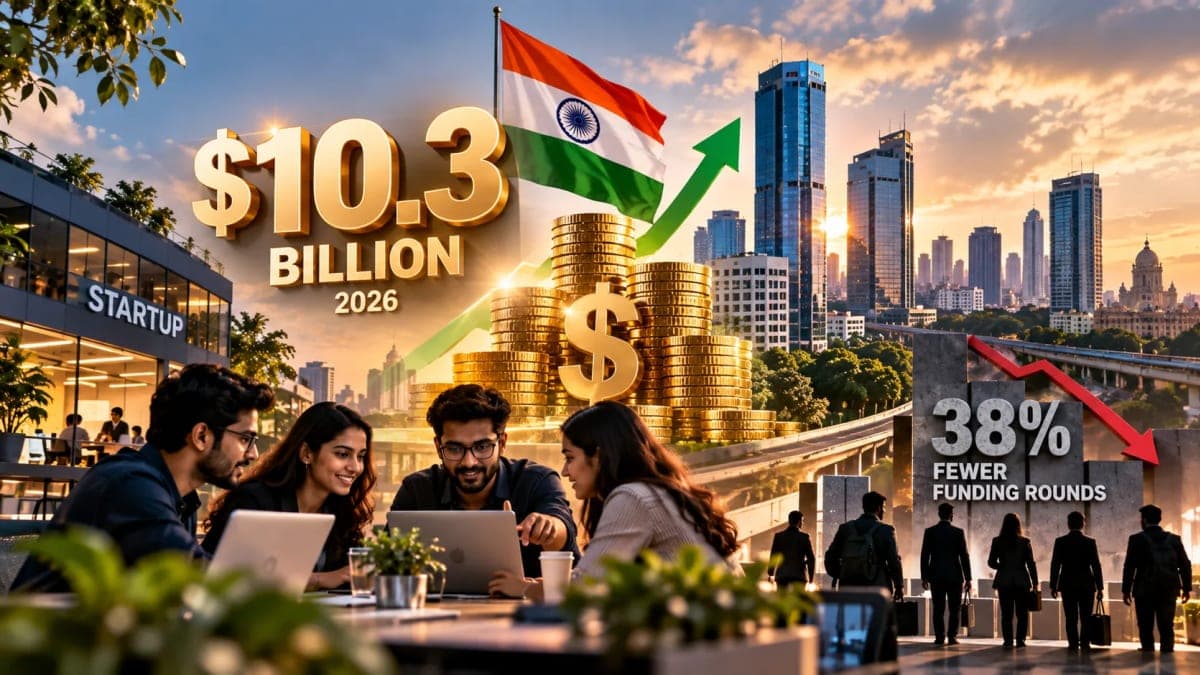
India’s technology ecosystem attracted $10.3 billion in equity funding between January 1 and September 21, 2026, according to Tracxn Technologies’ India Tech 9M 2026 Report.
The total was about 7% higher than the $9.7 billion recorded in the comparable period of 2025 and roughly 3% above the $10 billion reported for the comparable period of 2024.
But the increase in investment came alongside a sharp contraction in deal activity.
The number of funding rounds fell 38% to 1,134, compared with 1,838 a year earlier. First-time funded companies also declined 30% to 338. The combination of rising overall funding and fewer transactions indicates that a greater share of capital was concentrated in larger deals rather than spread across a growing number of startups.
Mega-rounds lift the overall funding total
Large transactions played an important role in pushing the funding total higher.
India recorded 18 funding rounds of at least $100 million during the period. Among the biggest were Nxtra’s $1 billion private-equity round, Neysa’s $600 million funding round and CRED’s $540 million Series H.
The numbers provide important context for the headline $10.3 billion figure: funding increased despite substantially fewer rounds because several companies secured particularly large investments.
Seed funding falls while early-stage investment rises
Funding trends differed considerably depending on the stage of a company.
Seed-stage funding declined 37% to $698 million, highlighting a more difficult environment at the earliest end of the startup pipeline.
Early-stage funding, however, increased 27% to $4.2 billion, while late-stage companies attracted approximately $5.4 billion.
The number of Series A and later funding rounds also fell 23% to 409.
Taken together, the figures show that the rise in total startup capital was not evenly distributed across the ecosystem. The decline in seed funding and first-time funded companies contrasts with stronger capital flows into businesses further along in their development.

Enterprise infrastructure records sharp funding growth
Enterprise-focused businesses were among the strongest recipients of investment.
Funding for Enterprise Infrastructure surged 436% to $1.6 billion, compared with $292 million during the comparable period a year earlier.
Enterprise Applications attracted $3.5 billion, representing a 49% increase, while FinTech funding rose 13% to $2.2 billion.
At the business-segment level, AI Infrastructure attracted $1.2 billion, making it the most-funded segment cited in the report. Digital Lending followed at $799 million, while Payments received $773 million.
The sector breakdown adds another dimension to the overall funding picture: infrastructure supporting artificial intelligence and enterprise technology attracted substantial amounts of capital even as investment became more selective elsewhere.
India adds six new unicorns
India's technology ecosystem produced six new unicorns during the period, compared with four in the comparable period of 2025.
Tracxn's data also indicates that the latest group reached billion-dollar valuations with less prior capital. The new unicorns had raised an average of $101 million before their unicorn rounds, compared with $205 million for the comparable 2025 group.
The average period from Series A to reaching a $1 billion valuation also shortened to 4.9 years from 6.6 years.
Bengaluru captures 43% of India's tech funding
Geographically, Bengaluru remained India's largest technology funding hub, attracting approximately $4.4 billion, equivalent to 43% of the country's total tech funding during the period.
Mumbai ranked second with approximately $1.8 billion, while Gurugram attracted $1.6 billion. Noida and Delhi followed with $660 million and $446 million respectively.
Bengaluru's share increased from 38% in the comparable period of 2025 to 43% in 2026, while Gurugram's share doubled from 8% to 16%, helped substantially by Nxtra's $1 billion transaction.
IPO activity holds steady while acquisitions decline
The exit market presented a mixed picture.
India recorded 29 technology IPOs during the period, unchanged from the comparable periods in 2024 and 2025.
Acquisition activity moved in the opposite direction. The number of acquisitions declined 31% to 91 from 131 a year earlier.
Among the largest reported transactions was Innovist's $434 million sale to L'Oréal, followed by Adani Energy Solutions' $319 million acquisition of IntelliSmart and UpGrad's $218 million acquisition of Unacademy.
What the $10.3 billion figure actually tells us
The headline funding number points to growth, but the underlying data tells a more nuanced story.
India's technology sector attracted more capital than in the comparable period of 2025, yet that money was distributed across substantially fewer funding rounds. Seed investment and the number of companies securing their first funding declined, while large transactions, enterprise technology and AI infrastructure helped lift the overall total.
That distinction matters: higher aggregate funding does not necessarily mean funding conditions improved for every type of startup.
With Tracxn's report covering transactions only through September 21, 2026, the figures should also be treated as a year-to-date snapshot rather than India's final startup funding total for 2026.