Maharashtra FDA Puts Three Bollywood Stars Under Scrutiny
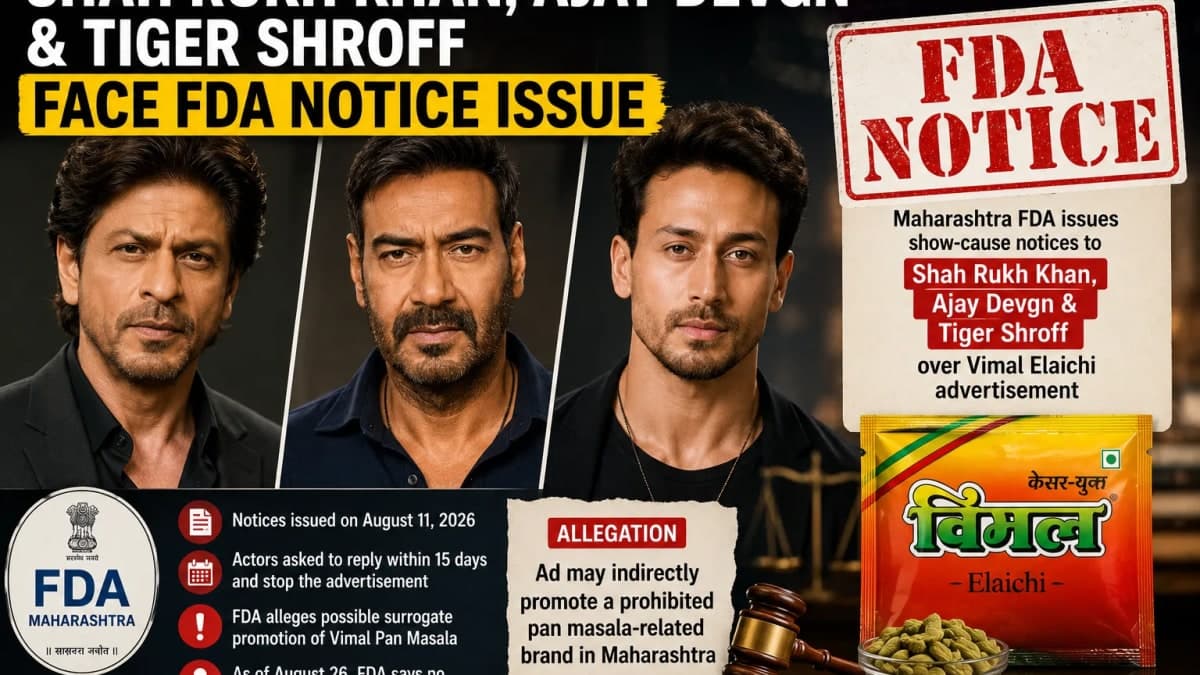
Three of Bollywood's biggest names — Shah Rukh Khan, Ajay Devgn and Tiger Shroff — have become part of a regulatory dispute over celebrity endorsements and surrogate advertising.
The Maharashtra Food and Drug Administration issued show-cause notices to the actors over their participation in an advertisement for Vimal Elaichi.
The regulator's concern centres on whether advertising the elaichi product indirectly reinforces the identity and consumer recognition of Vimal Pan Masala, which falls within products prohibited in Maharashtra.
The notices do not establish that the actors have violated the law. Instead, they require the endorsers to explain their position and provide information requested by the regulator.
The case could nevertheless have wider implications for how celebrities evaluate brand-extension advertising in India.
What Is the Vimal Elaichi Advertisement Controversy?
The three actors appeared as endorsers in a campaign promoting Vimal Elaichi, a cardamom product carrying the Vimal branding.
According to the FDA's preliminary position, the use of the Vimal identity may create an association in consumers' minds with Vimal Pan Masala.
That connection is at the heart of the regulator's concerns.
The FDA is examining whether the elaichi advertisement functions purely as promotion of an independent product or whether it effectively maintains visibility for a brand associated with a prohibited pan masala-related product.
This distinction is critical to understanding the controversy.
The issue is not simply that celebrities appeared in an elaichi advertisement. The regulatory question is whether that advertisement could amount to surrogate or indirect promotion of another restricted product.
Actors Were Given 15 Days to Explain
The show-cause notices were issued on August 11 and sought written explanations within 15 days of receipt.
The FDA also directed the actors to discontinue their participation in the advertisement and remove related promotional material from digital platforms under their control.
The regulator sought information including endorsement agreements, campaign details, product information and evidence concerning the due diligence conducted before the celebrities participated in the campaign.
It also sought evidence to establish whether Vimal Elaichi operates as an independently available product rather than a communication primarily designed to reinforce another brand category.
The actors were given the option to seek a personal hearing through themselves or authorised representatives.
FDA Says Responses Had Not Arrived
The controversy returned to attention on August 26 when Maharashtra FDA Commissioner Tukaram Mundhe addressed questions about the notices.
Mundhe said that, at that point, the regulator had not received responses from the three actors.
He also indicated that the department was examining advertisements across different media for potential violations rather than focusing only on particular celebrities.
The comments are significant because they show the matter remains part of an ongoing regulatory process.
Until responses are received and evaluated — or further proceedings occur — conclusions about liability would be premature.
Why Maharashtra FDA Is Examining Surrogate Advertising
The regulatory action is part of a broader effort to enforce restrictions surrounding misleading advertising and prohibited products.
Maharashtra has restrictions covering gutkha, pan masala and specified tobacco or nicotine-related products.
Direct advertising of restricted categories can be difficult or prohibited under applicable regulations.
This has made surrogate advertising an increasingly important regulatory issue.
A surrogate advertisement generally involves promoting a legally marketable product while potentially using its branding to preserve consumer awareness of another restricted category.
For example, a brand associated strongly with a restricted product might also appear on products such as cardamom, mouth fresheners, water or other permissible goods.
The key legal and regulatory question is whether the advertised product represents a genuine independent business or primarily serves as a vehicle for promoting the restricted brand.
Celebrity Endorsements Carry Enormous Influence
The involvement of Shah Rukh Khan, Ajay Devgn and Tiger Shroff makes the case especially prominent.
Major film stars can reach hundreds of millions of consumers through movies, television, advertising and social media.
That visibility is precisely why brands pay significant amounts for celebrity endorsements.
But enormous influence can also bring greater scrutiny.
When a famous actor promotes a product, consumers may associate the celebrity's reputation with the brand's credibility.
Regulators have consequently become increasingly interested in the responsibility celebrities carry when participating in commercial campaigns.
The Maharashtra FDA action brings that responsibility into sharper focus.
What Does Due Diligence Mean for Celebrity Endorsers?
One of the important aspects of the notices is the regulator's interest in due diligence.
Before endorsing a product, celebrities and their management teams may need to examine what exactly is being advertised, whether claims made about the product can be substantiated and whether the campaign complies with applicable regulations.
For extremely famous personalities, this process can involve lawyers, talent-management agencies, advertising companies and brand representatives.
The current controversy raises a broader question for India's advertising industry:
How far should celebrities be expected to investigate the products and brand structures they endorse?
The answer matters because endorsements are increasingly treated as more than simply acting assignments.
They are commercial representations capable of influencing consumer decisions.
Why the Case Matters for Bollywood
The outcome could influence how Bollywood stars approach future advertising contracts.
Celebrity endorsements are a major component of India's advertising economy. Actors frequently promote products across categories ranging from automobiles and smartphones to food, fashion and financial services.
Brands connected with restricted or controversial product categories create additional risk.
Celebrities may increasingly demand stronger contractual guarantees, legal reviews and clearer information about brand-extension strategies before agreeing to campaigns.
Management agencies could also strengthen internal compliance processes.
That would represent an important shift from asking only whether an endorsement is commercially attractive to also asking whether it creates regulatory or reputational exposure.
Pan Masala Advertising Has Already Generated Celebrity Controversies
Celebrity involvement with pan masala-associated brands has generated public debate before.
Actors endorsing such brands have sometimes faced criticism from consumers who argue that famous personalities should consider the broader social impact of their advertising choices.
The issue becomes more complicated when advertisements feature products such as elaichi or mouth fresheners rather than directly promoting the restricted category.
Brands can legitimately sell multiple products under a common identity.
At the same time, regulators must determine whether certain brand extensions effectively become indirect advertising for products whose direct promotion is restricted.
That tension lies at the centre of the current case.
Regulators Face Their Own Difficult Balancing Act
The challenge is not limited to celebrities and advertisers.
Regulators also have to distinguish legitimate brand extensions from surrogate promotion.
An overly broad interpretation could create uncertainty for businesses that genuinely sell multiple products under the same brand.
An overly narrow interpretation, however, could allow advertising restrictions to be bypassed simply by placing familiar branding on another product.
Effective regulation therefore requires examining factors such as actual product availability, sales, distribution, advertising expenditure, brand presentation and the overall nature of the campaign.
That makes these cases more complicated than simply identifying a shared brand name.
Digital Platforms Make Enforcement More Complicated
Modern advertising no longer disappears when a television campaign ends.
Promotional videos can remain accessible on YouTube, Instagram, Facebook, websites and other digital platforms for years.
Old advertisements can also be reposted by fan accounts, marketing channels and unrelated users.
That creates a new enforcement challenge.
Celebrities and companies may be able to remove promotional material from accounts they directly control, but eliminating every copy from the wider internet may be impossible.
The Maharashtra FDA's scrutiny therefore reflects a broader transformation in advertising regulation as authorities adapt rules originally designed for traditional media to an always-on digital environment.
What Could Happen Next?
The next stage depends on the regulatory process and any responses submitted by the actors or their representatives.
The FDA has indicated that where explanations are not submitted within the required period, or where explanations are considered unsatisfactory, further action may follow.
However, a show-cause notice should not be confused with a final penalty or judgment.
The actors must have an opportunity to present their position.
Questions surrounding the nature of Vimal Elaichi, the structure of the campaign, the actors' endorsement agreements and the due diligence performed could all become relevant when the matter is assessed.
The eventual regulatory outcome will therefore depend on evidence and applicable legal provisions rather than public reaction alone.
Balanced Analysis: Celebrity Responsibility vs Fair Regulatory Process
The controversy involves two principles that need to be considered together.
First, celebrities possess extraordinary advertising power.
When stars with enormous audiences endorse products, expecting a reasonable degree of diligence is understandable. Consumers can interpret celebrity participation as a signal of credibility, particularly when advertisements are designed around the star's personal reputation.
Second, regulatory fairness matters.
Receiving a show-cause notice is not equivalent to being found guilty of violating advertising or food-safety regulations. The allegations need to be assessed after the endorsers have had an opportunity to explain their involvement.
There is also a legitimate commercial question surrounding brand extensions.
A company associated with one product category is not automatically prevented from selling another lawful product. The important issue is whether the second product represents a genuine commercial offering or primarily functions as an advertising substitute for a restricted category.
Determining that requires evidence.
A Bigger Warning for India’s Celebrity Advertising Industry
Whatever the final outcome, the notices send a clear signal to India's celebrity endorsement market.
Fame does not isolate endorsers from regulatory scrutiny.
Actors, athletes, influencers and other public figures may increasingly need to treat advertising contracts as compliance decisions as well as commercial opportunities.
For brands, the case reinforces the need to demonstrate that products promoted under shared brand identities are genuine and independently marketed.
For regulators, it presents an opportunity to clarify where legitimate brand extension ends and surrogate advertising begins.
And for consumers, the controversy is another reminder that celebrity presence should not substitute for evaluating a product itself.
The immediate story concerns Shah Rukh Khan, Ajay Devgn and Tiger Shroff.
The larger story concerns how India's advertising ecosystem defines responsibility when celebrity influence, brand extensions and restricted products intersect.
This article is based on reporting published by TOI.