Zee Studios Expands Its Pan-India Film Strategy With Major 2026-27 Slate
Zee Studios is significantly widening its cinematic footprint with a new 2026-27 portfolio designed around India's increasingly interconnected film market.
Rather than concentrating primarily on one language or one style of commercial cinema, the studio's upcoming line-up stretches across several Indian film industries. The portfolio includes Hindi, Telugu, Tamil, Marathi, Kannada and Gujarati projects, alongside a broader commitment to other regional-language markets.
The strategy brings together established stars, regional talent and filmmakers working across action, romance, thrillers, mythology, suspense and commercially oriented entertainment.
Sunny Deol's 'Baap' Adds Major Star Power to Hindi Slate
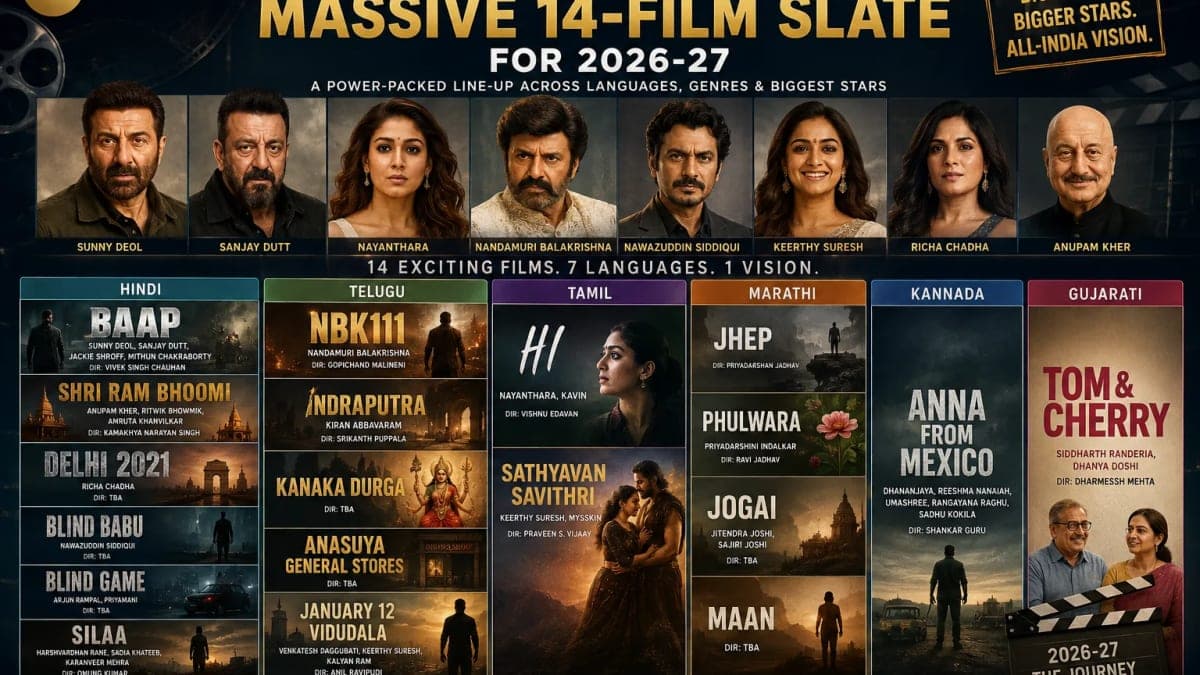
One of the most attention-grabbing projects is Baap, an ensemble entertainer featuring Sunny Deol, Sanjay Dutt, Jackie Shroff and Mithun Chakraborty. The film is being directed by Vivek Singh Chauhan.
The combination of four veteran action stars gives the project considerable nostalgia value while also positioning it as one of the slate's most overtly commercial Hindi titles.
Another prominent project is Shri Ram Bhoomi, starring Anupam Kher, Ritwik Bhowmik and Amruta Khanvilkar under director Kamakhya Narayan Singh. The project draws on themes connected with Indian mythology and history.
The Hindi portfolio also includes Delhi 2021, starring Richa Chadha; Blind Babu, led by Nawazuddin Siddiqui; and Blind Game, featuring Arjun Rampal and Priyamani. Harshvardhan Rane, Sadia Khateeb and Karanveer Mehra are attached to Silaa, directed by Omung Kumar.
Nandamuri Balakrishna Leads Zee Studios' Telugu Push
Zee Studios' strategy extends strongly into South Indian cinema.
In Telugu, NBK111 brings together Nandamuri Balakrishna and director Gopichand Malineni. The portfolio also includes Indraputra, starring Kiran Abbavaram and directed by Srikanth Puppala.
Other Telugu projects announced as part of the wider slate include Kanaka Durga, Anasuya General Stores and January 12 Vidudala, which features Venkatesh Daggubati, Keerthy Suresh and Kalyan Ram and is directed by Anil Ravipudi.
The significance of this expansion goes beyond individual star names. Telugu cinema has developed a substantial audience outside its home market, and participation in such projects gives a national studio access to both strong regional theatrical audiences and the broader pan-India ecosystem.
Nayanthara and Keerthy Suresh Strengthen Tamil Portfolio
Tamil cinema is another important part of the company's new strategy.
Hi, directed by Vishnu Edavan, stars Nayanthara alongside Kavin. Zee Studios is also backing Sathyavan Savithri, featuring Keerthy Suresh and Mysskin and directed by Praveen S. Vijaay.
These projects underline a broader change in Indian filmmaking: regional-language movies are increasingly being treated as potentially national properties rather than content restricted to a single state or linguistic audience.
Kannada and Gujarati Cinema Join the Expansion
The studio is also backing Anna From Mexico in Kannada. Directed by Shankar Guru, the film features Dhananjaya, Reeshma Nanaiah, Umashree, Rangayana Raghu and Sadhu Kokila.
Another notable move is Zee Studios' expansion into Gujarati cinema with Tom and Cherry, starring Siddharth Randeria and Dhanya Doshi and directed by Dharmessh Mehta.
The Gujarati move is particularly interesting because it demonstrates that the studio's strategy is not limited to India's largest film industries. Developing projects in comparatively smaller theatrical markets could allow Zee Studios to cultivate audiences and talent before those markets become more competitive for national production houses.
Marathi Cinema Remains an Important Part of the Portfolio
Marathi cinema continues to occupy a meaningful position in Zee Studios' regional strategy.
Upcoming projects include Jhep, directed by Priyadarshan Jadhav; Phulwara, starring Priyadarshini Indalkar and directed by Ravi Jadhav; Jogai, featuring Jitendra Joshi and Sajiri Joshi; and Maan.
The continued focus on Marathi films suggests Zee Studios is pursuing regional cinema as a sustained business rather than treating multilingual production as an occasional experiment.
Why Zee Studios' Multilingual Strategy Matters
The announcement arrives at a time when the traditional boundaries separating India's film industries have become less rigid.
Audiences now routinely discover movies made outside their primary language through dubbed theatrical releases, streaming platforms, television and social media. Successful films can consequently travel far beyond their original regional markets.
Zee Studios appears to be positioning itself around that shift.
The company says its portfolio strategy reflects the idea that India's entertainment market cannot be represented through a single type of story, language or cinematic perspective. Its stated objective is to work with different creative ecosystems while developing entertainment capable of crossing geographical and linguistic boundaries.
Star Power Alone Will Not Guarantee Success
Despite the scale and diversity of the portfolio, a large slate does not automatically translate into box-office success.
Working across numerous languages requires an understanding of different audience expectations, distribution systems and local creative cultures. A film designed for one regional market may not necessarily travel nationally simply because it features a recognisable star or receives a dubbed release.
That makes execution particularly important.
Zee Studios' diversified portfolio can reduce dependence on the performance of a single film or language market, but it also creates the challenge of maintaining consistent quality across a large number of productions.
The strongest advantage may therefore be diversification itself: large Hindi entertainers can coexist with regional productions, star-led spectacles and comparatively focused stories instead of forcing every project into the same pan-India formula.
A Broader Bet on the Future of Indian Cinema
Zee Studios' 2026-27 strategy reflects the continuing transformation of India's entertainment industry from several largely separate language markets into a more connected cinematic ecosystem.
Sunny Deol and Sanjay Dutt provide established Hindi star power; Nandamuri Balakrishna strengthens the Telugu offering; Nayanthara and Keerthy Suresh expand the Tamil presence; while Marathi, Kannada and Gujarati productions broaden the portfolio further.
The real test will come when these projects reach audiences.
If Zee Studios can combine strong regional identities with effective nationwide distribution and marketing, its multilingual strategy could strengthen the company's position in India's increasingly competitive film-production landscape.