New Studio Partnership Talks Put Brahmastra 2 Back in Focus
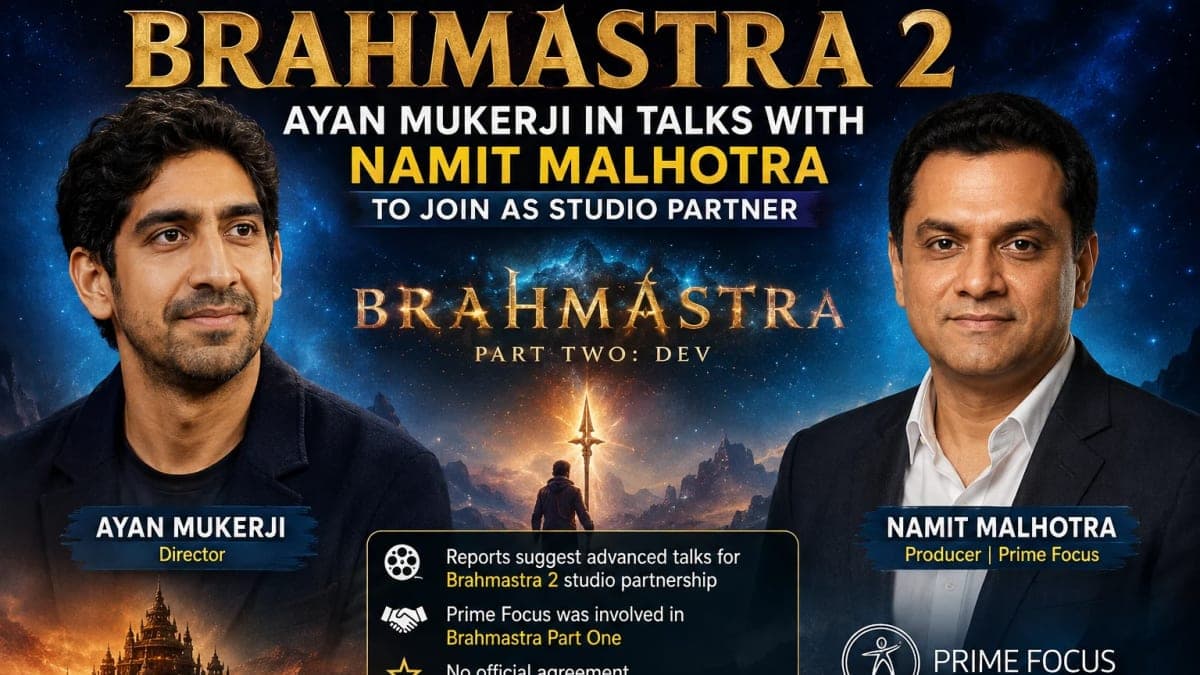
Ayan Mukerji's long-awaited Brahmastra 2 has returned to the spotlight following reports that producer Namit Malhotra is in advanced discussions to become a studio partner on the fantasy sequel.
Malhotra, the founder of Prime Focus and a producer associated with the ambitious Ramayana project, is reportedly being considered as a potential partner for the next chapter of Mukerji's Astraverse.
The development could prove important for a project whose scale depends heavily on visual effects, production technology and substantial financial resources. However, the reported discussions should not yet be treated as a completed partnership, as no final agreement has been publicly announced.
Starlight Pictures Remains Central to Brahmastra 2
Reports indicate that Mukerji's Starlight Pictures Private Limited, which was involved with the first Brahmastra, is positioned to produce the sequel and holds the intellectual-property rights connected to the franchise.
The company has reportedly been searching for a studio partner capable of supporting the scale required for the next instalment.
That search has attracted considerable attention because Brahmastra was conceived not simply as a standalone film but as the beginning of a larger cinematic universe built around the Astras and their mythology.
A sequel therefore carries expectations beyond those of a conventional follow-up. Its production partner would potentially have to support a large-scale fantasy film while helping the franchise develop its broader universe.
Why Namit Malhotra and Prime Focus Could Be a Significant Fit
The reported discussions with Namit Malhotra are particularly notable because Prime Focus already has a connection with the franchise.
Prime Focus was among the companies involved with the first Brahmastra. Its experience in visual-effects-driven filmmaking could also make it strategically relevant to a sequel expected to depend heavily on digital environments, fantasy action and large-scale spectacle.
Malhotra's involvement with Ramayana, another Indian production with major visual-effects ambitions, adds another layer of interest to the potential partnership.
For Brahmastra 2, such expertise could be valuable because the film's challenge is not merely to produce more visual effects than its predecessor. The sequel will also need to create a visually coherent mythology while meeting audience expectations established by the first film.
Search for a Studio Partner Has Seen Several Turns
The latest development follows reports of discussions involving other major studios.
Jio Studios had reportedly been considered as a potential studio partner, but those discussions did not result in an association. Reports have also linked Dharma Productions and Yash Raj Films with earlier discussions that ultimately did not produce a finalized partnership.
This history makes the reported talks with Malhotra particularly important.
At the same time, the absence of an official announcement means the situation remains fluid. Advanced negotiations can indicate serious interest, but they do not guarantee that a final agreement will be signed.
Brahmastra Established the Astraverse in 2022
Released in 2022, Brahmastra: Part One – Shiva introduced audiences to Mukerji's Astraverse, a fantasy mythology built around powerful supernatural weapons known as Astras.
Ranbir Kapoor played Shiva, while Alia Bhatt appeared as Isha. The film combined romance, mythology, action and extensive visual effects in an attempt to establish a large-scale Indian fantasy franchise.
Its ending also created the foundation for the next chapter, with Dev positioned as a crucial figure in the expanding mythology.
That setup has helped maintain interest in Brahmastra 2 even as the project has gone through an extended development period.
Why the Potential Partnership Matters
A studio partnership could have implications far beyond financing.
Large fantasy productions require extensive coordination between visual-effects teams, production designers, cinematographers, stunt departments and post-production specialists. A company with established technical infrastructure can therefore influence both the economics and creative execution of a project.
Prime Focus' experience could theoretically provide Brahmastra 2 with an ecosystem suited to its visual ambitions.
There is also a broader industry dimension.
Indian filmmakers and studios are increasingly attempting large-scale productions designed to compete for audiences accustomed to technically sophisticated international franchise cinema. Projects such as Brahmastra and Ramayana represent efforts to combine Indian mythology and storytelling traditions with contemporary visual-effects technology.
A collaboration between Mukerji and Malhotra could therefore become another significant test of whether that model can be executed sustainably at franchise scale.
What Could Change if the Deal Goes Through?
Should the negotiations result in a partnership, one of the immediate benefits could be greater clarity around the sequel's production structure.
A confirmed studio partner could help establish financing, production schedules, visual-effects planning and distribution strategy.
However, expectations would also increase.
The first Brahmastra demonstrated the commercial potential of an Indian fantasy universe but also generated debate over elements such as dialogue, storytelling and character development. The sequel will consequently face pressure not only to expand the spectacle but also to strengthen the narrative foundation of the Astraverse.
Technical ambition alone may not determine whether the second film succeeds.
A Promising Development, but Confirmation Is Still Needed
Reports of advanced discussions between Ayan Mukerji's team and Namit Malhotra represent an encouraging development for followers waiting for concrete movement on Brahmastra 2.
On paper, Prime Focus appears compatible with the requirements of a franchise built around visual spectacle. Its previous involvement with Brahmastra and experience with large VFX productions could make the partnership particularly relevant.
Nevertheless, the distinction between negotiations and a finalized agreement remains important.
Until Mukerji, Starlight Pictures, Malhotra or Prime Focus formally announces the collaboration, the proposed partnership should be regarded as a developing industry report rather than a confirmed production deal.
If an agreement is eventually reached, however, it could become an important step toward turning the long-discussed second chapter of the Astraverse into a fully structured production.
This article is based on reporting published by BollywoodHungama.