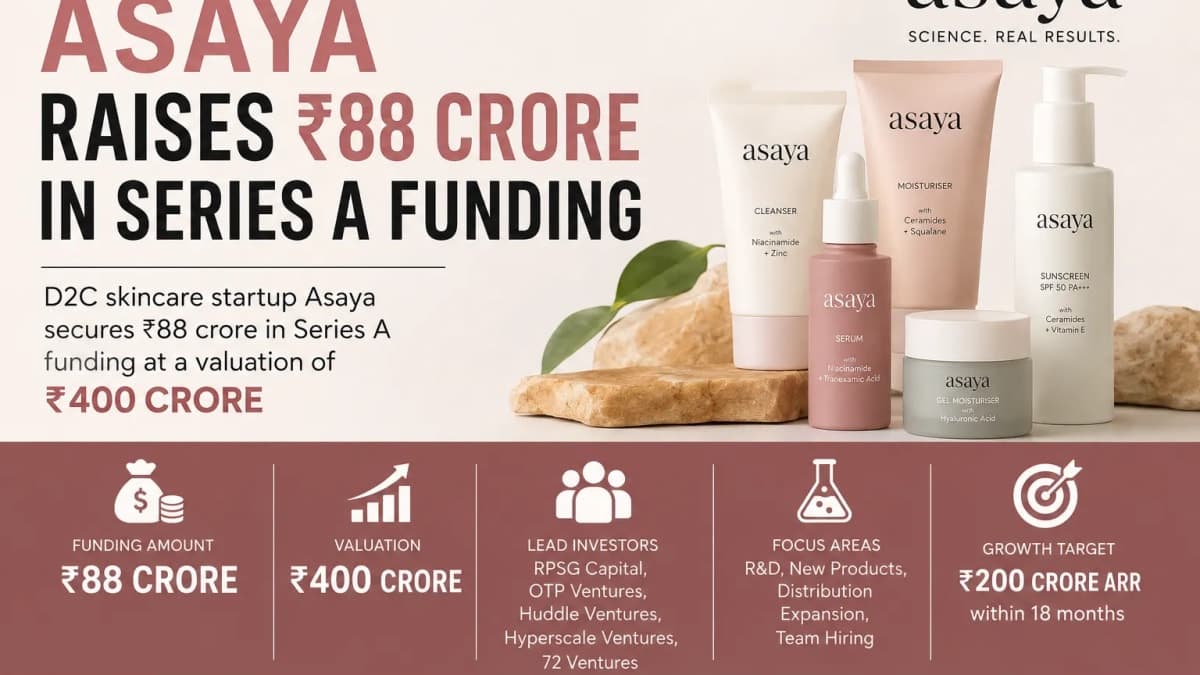
Asaya Secures ₹88 Crore Series A Funding
Indian direct-to-consumer skincare brand Asaya has secured ₹88 crore, or roughly $9.2 million, in a Series A funding round, giving the Bengaluru-based company additional capital to accelerate its next phase of expansion.
The investment values Asaya at approximately ₹400 crore on a post-money basis. The round saw participation from RPSG Capital, OTP Ventures, Huddle Ventures, Hyperscale Ventures and 72 Ventures. It included a combination of primary and secondary capital, with some early angel investors receiving an opportunity to exit their holdings.
The transaction represents a significant step for the young skincare company as it attempts to move beyond its digital-first foundations and build a larger presence across products, channels and geographies.
Where Asaya Plans to Invest the Fresh Capital
Research and product development will form an important part of Asaya's investment strategy. The company plans to allocate nearly 20% of the new funding to research and development, while the remaining capital is expected to support product-line expansion, distribution growth and hiring.
Asaya also plans to expand its workforce as it scales operations. According to the company, it is targeting a doubling of its team in the coming months.
This approach indicates that the startup is trying to balance customer acquisition and distribution with investment in product development—an increasingly important consideration in India's crowded beauty and personal-care industry.
A Skincare Brand Focused on Melanin-Rich Skin
Founded in 2021 by Neeraj Biyani, Eeti Sharma and Mandeep Singh Bhatia, Asaya has positioned itself as a science-focused skincare company developing products for concerns particularly relevant to melanin-rich skin.
Hyperpigmentation is one of the company's central areas of focus. Its portfolio includes products across multiple skincare categories, including cleansers, serums, spot treatments, moisturisers and sunscreens. The company also addresses concerns such as dehydration and acne.
Rather than relying exclusively on its own website, Asaya has been widening its reach through ecommerce and quick-commerce platforms as well as selected offline retail channels.
That multi-channel strategy could become increasingly important as digital-first beauty companies seek growth beyond customers acquired through conventional online advertising.
Asaya's Valuation Climbs to ₹400 Crore
The Series A round values Asaya at ₹400 crore, representing roughly a threefold increase from its previous valuation, according to the company. Asaya has also said that its revenue has grown 16-fold.
The latest financing comes less than a year after Asaya raised ₹28 crore in a pre-Series A round in September 2025. That earlier investment was led by RPSG Capital and included participation from OTP Ventures and Huddle Ventures, along with angel investors Suyash Saraf and Anisha Agarwal Saraf.
The repeat participation of existing investors can be interpreted as a sign of continued investor confidence in the company's growth strategy, although future performance will ultimately depend on whether Asaya can convert its expansion plans into sustainable revenue and profitability.
Why the ₹88 Crore Funding Matters
India's beauty and personal-care market has produced a growing number of digital-first brands targeting specific consumer concerns rather than competing only as broad cosmetics companies.
Within that environment, Asaya is attempting to differentiate itself through a science-led positioning and its focus on skincare concerns associated with melanin-rich skin.
The ₹88 crore investment gives the company greater resources to deepen that differentiation through research while simultaneously expanding distribution.
The funding is particularly notable because the company is not directing all of the capital toward marketing and customer acquisition. Allocating nearly one-fifth to R&D suggests that formulation and product innovation are intended to remain an important part of its long-term strategy.
From D2C Brand to Omnichannel Skincare Business
Asaya began with a primarily direct-to-consumer approach, but its expanding presence across ecommerce, quick commerce and offline retail reflects a wider evolution occurring among Indian D2C companies.
Pure online distribution can help young brands launch quickly and build direct relationships with consumers. However, scaling beyond a certain point can require access to additional channels, particularly in categories such as skincare where customers may discover and purchase products across multiple platforms.
For Asaya, expanding offline and digital distribution could therefore broaden its addressable customer base while reducing dependence on any single sales channel.
Growth Ambitions After Series A
Asaya has set an ambitious growth target following the fundraise. Co-founder Neeraj Biyani said the company is targeting ₹200 crore in annual recurring revenue within 18 months. The company has also said it has reached profitability at the variable contribution level.
Achieving that target would require continued momentum in customer acquisition, repeat purchases and distribution expansion.
The additional funding gives Asaya greater financial capacity to pursue those objectives, but rapid expansion also introduces execution challenges, particularly as the company adds employees, products and sales channels simultaneously.
Balanced Analysis: Opportunity Comes With Intense Competition
Asaya's Series A provides several advantages. A higher valuation, support from existing investors and substantial new capital could help the company invest in research while building a larger distribution network.
Its specialised focus on hyperpigmentation and melanin-rich skin may also provide a clearer brand identity than a broad, general-purpose skincare positioning.
However, India's skincare category is highly competitive. Digital-first startups compete not only with other emerging D2C companies but also with established Indian and multinational beauty businesses with significant marketing budgets and extensive retail networks.
Expanding rapidly can additionally increase operating complexity and expenditure. Asaya will therefore need to ensure that customer retention, product performance and unit economics develop alongside headline revenue growth.
The company's next stage will likely be defined not simply by how quickly it expands, but by whether it can build a durable consumer brand while maintaining the science-led positioning that helped distinguish it in the first place.
Conclusion
Asaya's ₹88 crore Series A represents an important milestone in the skincare startup's journey from a young D2C company toward a larger omnichannel beauty business.
With a ₹400 crore valuation and plans to invest in R&D, new products, distribution and talent, the company now has more resources to pursue aggressive expansion.
The bigger test will be execution. If Asaya can translate product innovation and wider availability into repeat customers and sustainable growth, the Series A could provide the foundation for its next phase. If competition and expansion costs rise faster than sales, maintaining that momentum could prove considerably more difficult.
This article is based on reporting published by Indian Startup News.