From Early Responsibility to Entrepreneurship
At an age when most teenagers are primarily occupied with school, examinations and decisions about their future, Durgesh Shimpi’s life took a very different course.
Durgesh, from the Jalgaon region of Maharashtra, lost his father when he was nine years old. The loss brought financial responsibility into his life unusually early and exposed him to the realities of earning, selling and dealing with customers. Reports about his journey describe him learning business through small-scale trading before eventually moving toward a product closely connected with his home region.
That product was banana chips.
Why Banana Chips Made Sense in Jalgaon
The choice was closely tied to geography. Jalgaon has long been associated with banana cultivation, giving a locally based food entrepreneur access to a familiar agricultural product and a market where bananas are already part of the regional economy.
Instead of viewing bananas only as produce to be sold in their conventional form, the business sought to create additional value through a packaged snack.
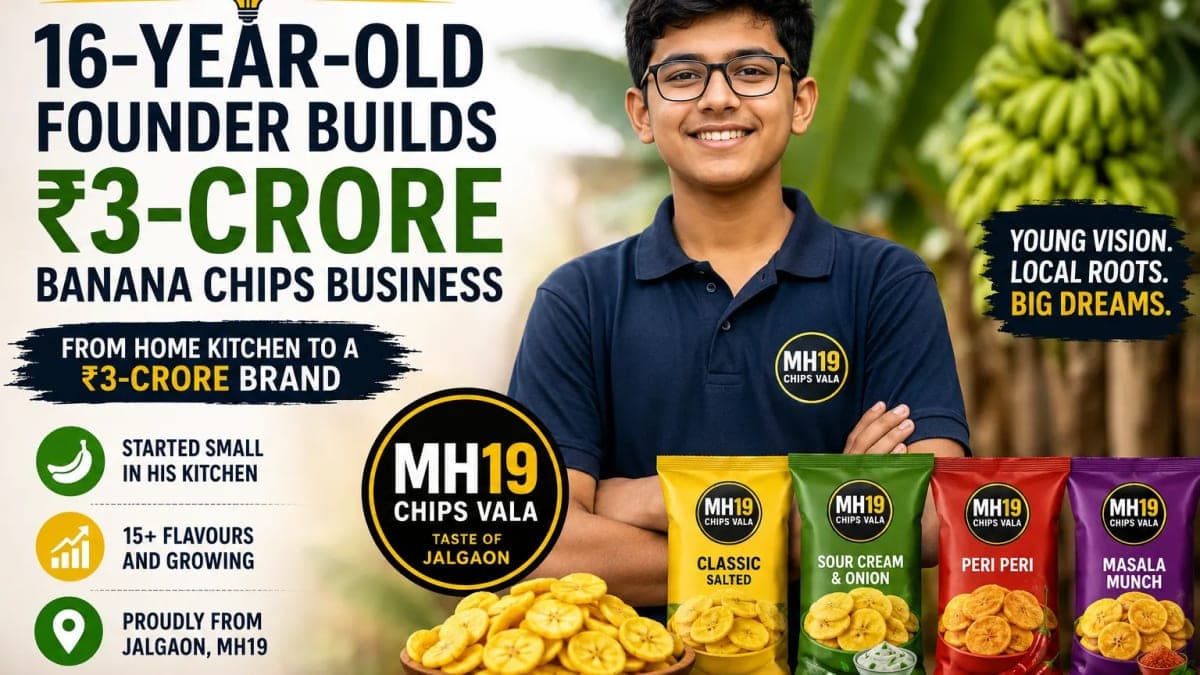
Durgesh and his family began making banana chips on a small scale, with accounts of the venture tracing its early production to the home kitchen. From those modest beginnings emerged MH19 Chips Vala, a name built around Jalgaon’s MH-19 vehicle-registration identity.
The regional branding gave the product something beyond taste: a recognizable connection with its place of origin.
From a Simple Snack to a Growing Brand
Banana chips are hardly a new product in India, which makes the business story particularly interesting. Rather than attempting to invent an entirely new food category, the founders worked on differentiating a familiar snack.
Reports about MH19 Chips Vala say its range expanded to around 15 flavours, giving consumers more choice than a conventional salted banana-chip offering. The business also relied heavily on local selling, customer relationships and gradual distribution growth rather than beginning with a large institutional funding round.
This approach illustrates an important lesson for small consumer businesses: innovation does not always have to mean creating a new product. It can also come from packaging, flavours, positioning, distribution and branding an existing product differently.
The ₹3-Crore Milestone Needs an Important Distinction
The headline-grabbing figure associated with MH19 Chips Vala is approximately ₹3 crore, but it is important not to automatically interpret that number as annual revenue.
Available reports describe the figure primarily as a business or brand valuation, while reported monthly sales figures are considerably lower. Some accounts place monthly sales in the range of roughly ₹1.5 lakh to ₹5 lakh, although figures vary between reports.
That distinction matters because valuation, revenue and profit represent very different measures of a company's financial position.
The achievement remains notable, particularly given the founders' ages and the venture's grassroots beginnings, but describing the ₹3-crore figure accurately gives readers a clearer picture of the scale of the business.
A Business Built Beyond India’s Startup Metros
One of the larger lessons from MH19 Chips Vala is where the company emerged.
India's startup conversation is often dominated by Bengaluru, Mumbai, Delhi-NCR and other major technology and investment centres. Yet consumer brands can emerge from much smaller cities by building around regional supply chains and local customer demand.
For entrepreneurs in agricultural regions, this model can be especially relevant. Agricultural products that are normally sold as commodities can potentially generate greater value when transformed into branded, packaged and differentiated consumer products.
MH19 Chips Vala demonstrates this principle on a small but highly visible scale: take something strongly associated with the local economy, process it into a consumer product and build a brand around its regional identity.
Why the Story Matters
Durgesh's journey is compelling because it challenges several assumptions about entrepreneurship.
A founder does not necessarily need to begin with venture capital, an advanced technology product or a metropolitan headquarters. A relatively ordinary product can become a meaningful business when entrepreneurs understand their customers, improve the offering and build distribution consistently.
The story also highlights the growing visibility of young founders from smaller Indian cities. Digital commerce, social media and India's expanding appetite for regional consumer brands have made it easier for local businesses to imagine markets beyond their immediate neighbourhoods.
At the same time, scaling a packaged-food company brings challenges that are very different from starting one.
Maintaining food quality, hygiene, regulatory compliance, packaging standards, reliable sourcing, margins and distribution becomes increasingly difficult as volumes grow. Competition from established snack companies and emerging direct-to-consumer brands can also put pressure on smaller players.
Balanced Analysis: The Real Test Comes After the Viral Story
The journey of MH19 Chips Vala makes for an inspiring founder story, but long-term business success will depend on execution rather than publicity alone.
A ₹3-crore valuation can create visibility, but sustainable growth requires consistent revenue, healthy margins, repeat customers and the ability to expand without sacrificing product quality.
The company also operates in a category where barriers to entry are relatively low. Competitors can introduce similar flavours and products, making branding, distribution and customer loyalty increasingly important.
There is another important dimension: education and personal development. Running a growing company while still being of school age creates unusual demands. Long-term success should ideally allow young entrepreneurs to continue learning while building professional systems around their businesses.
If MH19 Chips Vala can turn its regional popularity into a scalable packaged-food operation, the company could become more than an inspiring teenage entrepreneurship story. It could provide a practical example of how agricultural regions can create stronger consumer brands around products already available locally.
Conclusion
What began with a young boy confronting responsibility at an unusually early age has developed into an entrepreneurial story attracting national attention.
Durgesh Shimpi's journey with MH19 Chips Vala shows how a simple observation—bananas are abundant locally, but there is room to create more value from them—can become the foundation of a business.
The ₹3-crore valuation may be the number that grabs headlines, but the more significant story is the process behind it: identifying a local opportunity, starting small, learning directly from customers and gradually turning an everyday snack into a recognizable regional brand.
This article is based on reporting published by TOI.