Crane Venture Partners Makes a Major India Bet
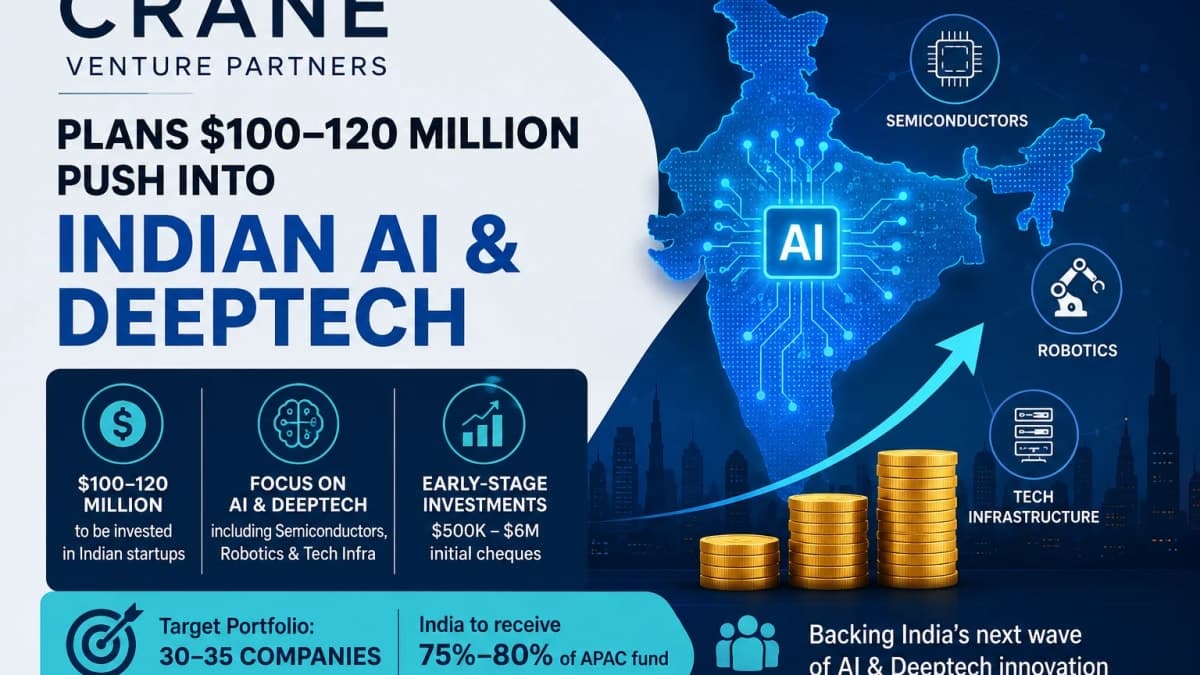
India's artificial intelligence and deeptech ecosystem is attracting another significant pool of international venture capital, with Crane Venture Partners planning to direct approximately $100–120 million toward Indian startups.
The capital will come from Crane's first Asia-Pacific fund. The vehicle was initially launched at $135 million in September 2025 and ultimately raised about $150 million after exercising a greenshoe option. India is expected to account for roughly 75% to 80% of the fund's deployment, according to the firm's partners.
That allocation would make India the dominant market in Crane's APAC strategy, ahead of the fund's other target geographies, Singapore and Australia.
Importantly, the $100–120 million figure is not necessarily a fixed ceiling. Crane Managing Director Anandamoy Roychowdhary indicated that the eventual amount invested in India could be higher depending on the opportunities the firm finds.
Why Crane Sees Opportunity in Indian Deeptech
Crane's investment thesis is based partly on the belief that India's advanced-technology ecosystem is undervalued relative to its long-term potential.
The firm sees an opportunity in companies that combine strong technical talent with comparatively efficient use of capital. In other words, Indian startups may have the potential to build globally competitive technology businesses without requiring funding at the scale often associated with comparable ventures in the United States.
Crane co-founder and partner Scott Sage has described Indian AI and deeptech as an unusually mispriced investment opportunity, arguing that the potential outcomes can be substantial relative to the amount of capital required.
This view is important because it suggests Crane is not looking at India merely as a lower-cost technology market. Instead, its strategy appears to be based on the possibility that Indian founders can develop original intellectual property and products capable of competing internationally.
AI, Semiconductors and Robotics Among Key Areas
Crane's strategy is concentrated around technically complex businesses rather than broad consumer internet investing.
Artificial intelligence represents a major part of the opportunity, while hard deeptech accounts for roughly 35% to 40% of Crane's investments so far. Areas of interest include technologies such as semiconductors, robotics and specialised technology infrastructure.
These sectors generally require substantial research, specialised engineering talent and longer development cycles than conventional software startups. Successful companies, however, can potentially develop intellectual property and technical advantages that are difficult for competitors to reproduce.
Early-Stage Startups at the Centre of Strategy
Crane primarily operates as a seed-stage investor, although it can participate in Series A rounds when an opportunity fits its strategy.
Its typical initial investment is around $2 million to $3 million, while first cheques can range from approximately $500,000 to $6 million depending on the company and stage.
The firm has already committed to approximately nine to 10 investments over a six-to-eight-month period from the APAC vehicle.
Over roughly two to two-and-a-half years, Crane expects the fund to develop a portfolio of around 30 to 35 companies.
Why the $100–120 Million India Allocation Matters
Crane's planned deployment matters beyond the headline amount.
Deeptech startups often face a different financing challenge from conventional internet companies. Building hardware, semiconductor technology, robotics platforms or sophisticated AI infrastructure can require years of engineering and product development before commercial scale is reached.
That makes access to patient early-stage capital particularly important.
An international investor committing the majority of an APAC fund to India could therefore give technically ambitious founders another source of institutional funding at the stage when financing can be hardest to secure.
The move also adds to evidence that specialised investors are becoming more interested in India's foundational technology ecosystem. Other venture funds have also announced dedicated pools of capital targeting areas including AI and deeptech, reinforcing competition for promising companies.
From Services Strength to Technology Ownership
India has long been recognised globally for its software engineering talent and IT services industry. The emerging deeptech investment story is somewhat different.
Investors are increasingly searching for businesses capable of owning core technology, intellectual property and specialised infrastructure rather than relying mainly on service delivery.
If more Indian startups succeed in areas such as AI infrastructure, robotics and semiconductor technologies, the country's technology sector could gradually expand its role from a major provider of engineering talent to a larger producer of globally valuable technology assets.
Crane's investment strategy reflects that possibility.
Balanced Analysis: Big Opportunity, but Deeptech Carries Significant Risk
The planned investment is a positive signal for India's startup ecosystem, but the size of the opportunity should be viewed alongside the challenges involved.
Deeptech companies can require substantial capital before generating meaningful revenue. Hardware development, manufacturing, specialised talent, regulatory requirements and lengthy enterprise sales cycles can all increase execution risk.
AI startups face another challenge: technology is advancing extremely quickly, meaning that an advantage considered significant today can become less distinctive as models, infrastructure and development tools improve.
For venture investors, identifying companies with genuine and defensible technology will therefore be more important than simply investing in businesses carrying an AI or deeptech label.
Crane's early-stage strategy gives it the opportunity to enter promising companies at relatively young stages, but it also means accepting the uncertainty that accompanies emerging technologies.
What Comes Next
The next phase will show how rapidly Crane converts its India allocation into actual investments and which technological categories receive the largest share of the capital.
With around nine to 10 investments already committed and a longer-term target of approximately 30–35 portfolio companies from the APAC fund, the firm's India strategy is already moving beyond simple market exploration.
If Indian startups can translate strong engineering talent into proprietary technology and international businesses, Crane's $100–120 million commitment could become part of a broader shift in global venture capital toward India's AI and deeptech ecosystem.
At the same time, the ultimate significance of the investment will depend not simply on how much money is deployed, but on whether the startups receiving that capital can turn technically ambitious ideas into sustainable, scalable businesses.
This article is based on reporting published by Moneycontrol.