A Tiny Wearable With a Big Ambition
Deepinder Goyal’s latest technology venture is targeting an area that most mainstream fitness wearables barely touch: continuous monitoring of blood flow to the brain.
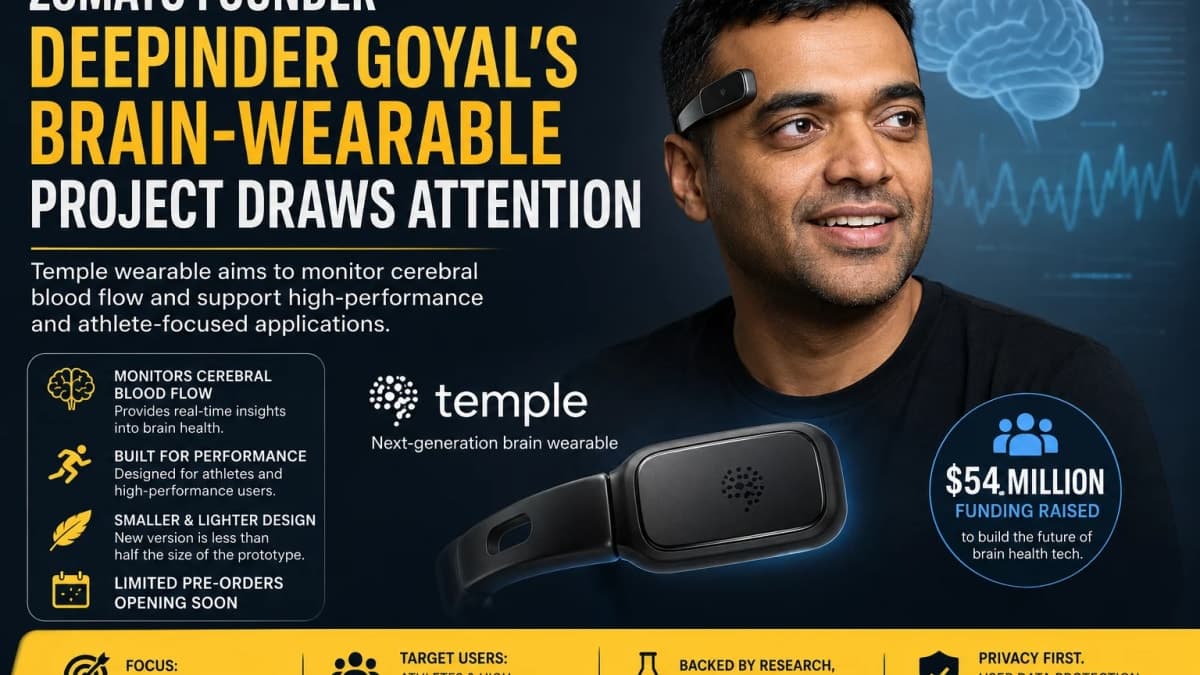
Known as Temple, the device is designed to sit near the temple and monitor cerebral blood flow. While familiar wearables generally concentrate on metrics such as heart rate, sleep, movement and recovery, Temple is attempting to bring brain-related physiological measurements into a compact wearable format.
The device initially attracted widespread curiosity when Goyal appeared publicly wearing an unusual sensor on the side of his forehead. What looked like a mysterious gadget was eventually revealed as part of his experimental health-tech work.
Now the project appears to be moving closer to becoming an actual commercial product.
Temple Gets Significantly Smaller
The latest version of Temple is less than half the size of the prototype previously shown publicly, according to Goyal. He has described the redesigned hardware in highly ambitious terms, including claims about its compactness and capabilities.
Those descriptions should currently be treated as claims from the project's founder rather than independently verified comparisons with every wearable on the market.
More significantly for potential customers, Goyal has indicated that pre-orders for a limited launch edition will begin soon. That would mark an important transition for Temple from an experimental prototype toward a consumer-facing product.
What Does the Temple Wearable Measure?
Temple's central focus is cerebral blood flow, or the amount of blood being supplied to the brain.
Continuous measurement of this signal could potentially provide researchers, athletes and users with another way of studying how the brain and body respond to factors such as physical exertion and stress.
Goyal has previously positioned Temple as a high-performance wearable for elite athletes, arguing that it could capture measurements that existing consumer devices generally do not provide.
That ambition also makes the technical challenge considerably harder.
Collecting a physiological signal is only the first part of creating a useful health wearable. The measurements must be sufficiently accurate and repeatable, while the software must translate them into information that users can meaningfully understand.
From Zomato to Experimental Health Technology
Temple also illustrates an important shift in Goyal’s entrepreneurial career.
After spending nearly two decades building Zomato, Goyal stepped away from the chief executive position at Eternal earlier in 2026 and moved into a vice-chairman role. He indicated that the change would give him greater freedom to pursue experimental projects carrying risks that may not fit comfortably inside a publicly listed company.
Temple has emerged as one of the most prominent examples of that strategy.
The startup raised $54 million in February 2026 at a post-money valuation of about $190 million, with participation from founder friends, early Zomato investors and more than 30 Temple employees, according to Goyal's announcement reported at the time.
That level of backing gives the company considerable resources to develop its hardware, recruit specialist researchers and engineers, and attempt to turn an unconventional idea into a scalable product.
Why Temple Matters for the Wearable Industry
The consumer wearable market has become increasingly sophisticated, but much of it remains centered around familiar signals including heart rate, movement, temperature, sleep and recovery.
Temple is attempting to differentiate itself by moving the sensing target toward the brain.
If the technology proves accurate and useful outside controlled research environments, it could expand the definition of performance wearables. Athletes could become an especially important early market because professional sport places a premium on marginal improvements in recovery, concentration and physiological understanding.
Indian badminton star PV Sindhu has recently been seen wearing the device, further increasing public attention around Temple and its potential sports applications.
But visibility among prominent athletes does not by itself establish clinical or scientific effectiveness.
Scientific Validation Remains the Critical Question
Temple's ambitions have generated skepticism alongside excitement.
Medical experts have previously cautioned against treating experimental brain-health measurements as established medical insights without sufficient evidence. Earlier discussion around Temple also produced criticism of the scientific basis for some broader hypotheses associated with Goyal’s research efforts.
This distinction will be essential as the device approaches consumers.
There is a substantial difference between a wearable successfully detecting a physiological signal and proving that the signal can reliably predict health, ageing, cognition, recovery or athletic performance.
Independent research, transparent methodology, reproducible measurements and peer-reviewed validation could therefore become as important to Temple's future as miniaturising its hardware.
Balanced Analysis: High Potential, High Burden of Proof
Temple sits at an interesting intersection of consumer electronics, sports technology and neuroscience.
On the positive side, the project is tackling a measurement that is largely absent from mainstream wearable devices. Its substantial funding, specialist hiring ambitions and focus on miniaturisation suggest that Temple is more than a conceptual experiment.
The challenge is that brain-related technology inevitably attracts stronger scrutiny than ordinary fitness tracking.
Consumers may interpret neurological measurements as indicators of their health even when the underlying science is still developing. Temple will therefore need to communicate clearly what its readings can—and cannot—tell users.
Data privacy could become another important issue. If future brain-focused wearables collect increasingly detailed physiological information, questions surrounding ownership, storage, consent and use of such sensitive data will become difficult to ignore.
What Comes Next?
The planned opening of limited-edition pre-orders could provide the first meaningful indication of demand for Temple outside its development and testing environment.
But commercial interest will only answer one part of the question.
The bigger test will be whether Temple can demonstrate that continuous cerebral blood-flow monitoring produces reliable, actionable information valuable enough to justify wearing a sensor on the forehead.
If it succeeds, Goyal could help establish a new category of performance wearable. If independent evidence fails to support its more ambitious possibilities, Temple may remain an intriguing technological experiment rather than a major consumer-health platform.
Either way, the project shows how the wearable industry is beginning to look beyond steps, sleep and heart rate toward significantly more complex biological signals.
This article is based on reporting published by Yourstory.