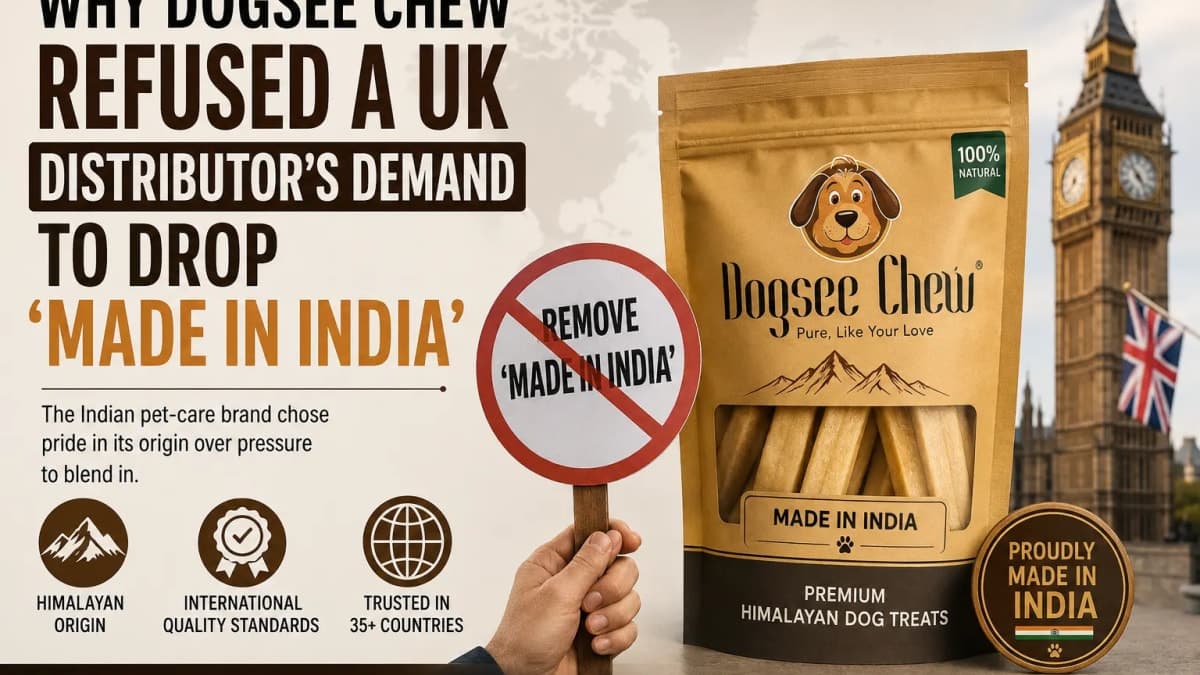
Dogsee Chew Turns Indian Origin Into a Global Brand Statement
For many consumer startups, entering an overseas market comes with a difficult choice: adapt enough to win local customers without stripping away the identity that makes the brand distinctive.
For Bengaluru-based Dogsee Chew, its Indian and Himalayan origins became part of that distinction.
The natural pet-treat company, founded by Bhupendra Khanal and Sneh Sharma, has expanded from India into international markets with products built around Himalayan cheese chews. Dogsee says its products emphasize natural ingredients, sustainable sourcing and preservative-free formulations.
As Dogsee expanded abroad, however, the founders encountered doubts about whether international consumers would readily trust pet food originating from India.
Sharma has publicly recalled that the company was repeatedly warned that overseas buyers could be skeptical of Indian-origin pet products. Instead of treating the association with India as a weakness, Dogsee leaned into the story behind its Himalayan ingredients, traditional production methods and sourcing network.
That strategy provides the broader context for the company's reported refusal to accept a UK distributor's demand to remove or play down the “Made in India” identity.
Why Dogsee Did Not Want To Hide Its Origin
For Dogsee, removing the Indian connection would have meant more than changing a few words on packaging.
The company's flagship proposition is closely connected with Himalayan cheese, traditionally known as churpi. Dogsee says its hard chews are made from Himalayan cheese produced from cow and yak milk, while the company has built its branding around taking products rooted in the region to customers worldwide.
That made provenance commercially important.
Rather than attempting to look like a Western pet-care company, Dogsee positioned its origin as a point of differentiation. Sharma has argued that explaining the Himalayan sourcing and traditional cheese-making process helped turn initial skepticism into consumer interest and, ultimately, supported premium positioning.
The decision therefore represented both a question of identity and a business calculation: if Dogsee removed the very origin story differentiating its products, it risked becoming another pet-treat brand competing largely on price, distribution and packaging.
From Bengaluru Startup to International Pet Brand
Dogsee's international expansion gives that decision greater significance.
The company was founded in 2015 and has since developed a presence across dozens of countries. Sharma said in a 2026 account of the company's export journey that Dogsee had reached more than 35 countries.
Khanal has similarly described the company as having a substantial international business. In May 2026, he said the United States had become Dogsee's largest market, while the UK had held that position for several years. He also highlighted the company's presence in Europe and Japan.
International sales are especially important to Dogsee's business model. Khanal said only about 3% of the company's revenue in the previous financial year came from India, underscoring how heavily its growth has depended on overseas consumers.
That makes maintaining an explicitly Indian identity in export markets more consequential than a symbolic branding exercise.
Compliance Became Part of Dogsee's Global Strategy
Dogsee's experience also illustrates an important reality for Indian consumer brands hoping to expand overseas: national pride alone cannot overcome regulatory barriers or concerns about product quality.
Pet-food regulations differ significantly between the UK, European Union, United States, Japan and other markets. Sharma has described navigating those requirements as difficult but ultimately valuable because certifications and compliance standards created a competitive barrier that other companies would also have to cross.
Khanal has said Dogsee built its operations around international quality standards, including BRCGS and BSCI certifications.
This combination — emphasizing Indian provenance while meeting international standards — has become central to the company's positioning.
Why the UK Distributor Episode Matters
The dispute is significant beyond Dogsee itself because it reflects a broader challenge facing Indian consumer brands.
Companies expanding overseas have traditionally faced pressure to make their branding appear more internationally familiar. In some categories, an unfamiliar country of origin can influence perceptions about quality, manufacturing or pricing.
One response is to minimize where a product comes from.
Dogsee followed the opposite strategy.
Instead of attempting to separate its product from India, it sought to connect Indian origin with a specific story: Himalayan ingredients, traditional cheese-making, local sourcing and modern manufacturing standards.
That distinction matters.
A simple “Made in India” label does not automatically create consumer trust. Quality, regulatory compliance, distribution and customer experience remain essential. But when origin is genuinely connected to the product, provenance can become an asset rather than something a company needs to disguise.
Building a Premium Brand Through Authenticity
Dogsee's approach also demonstrates how smaller companies can compete against established international brands.
Large pet-care businesses can often spend more on advertising and distribution. Emerging brands therefore need another reason for customers to notice them.
For Dogsee, Himalayan cheese provided that differentiation.
The company describes its hard chews as natural, human-grade, preservative-free and made from Himalayan cheese. It also says its sourcing network supports thousands of people in Himalayan communities.
That allows Dogsee to sell more than a functional dog treat. It can also sell provenance and a distinctive production story.
Balanced Analysis: Principle or Smart Branding?
Dogsee's decision can easily be presented purely as a patriotic stand, but the commercial reasoning is equally important.
Refusing a distributor's demand could potentially cost a young company access to an important market. Distributors provide local relationships, retail access and market knowledge, so rejecting their advice is not risk-free.
At the same time, abandoning a defining element of a brand simply to satisfy one distribution partner can create longer-term problems. Consumers increasingly encounter brands across multiple countries and digital platforms, making inconsistent positioning difficult to maintain.
Dogsee's subsequent international expansion suggests that an Indian identity did not prevent it from developing a meaningful overseas business. However, its success should not be interpreted as proof that origin alone drives international demand.
The stronger lesson is that origin works when it is supported by product differentiation, regulatory compliance, reliable supply chains and consistent quality.
For Dogsee, “Made in India” could therefore function not merely as a country-of-origin label, but as part of the commercial narrative surrounding its Himalayan products.
What It Means for Indian Startups Going Global
Dogsee's journey highlights a changing ambition among Indian consumer startups.
International expansion no longer necessarily means manufacturing in India while adopting a largely anonymous global identity. Companies can increasingly attempt to build international brands while retaining visible links to where their products originate.
But achieving that requires more than national branding.
Companies must demonstrate that products made in India can satisfy demanding international regulations, deliver consistent quality and compete with established global alternatives.
Dogsee's story shows one possible route: keep the origin, strengthen the standards and make authenticity part of the product proposition.
For other Indian startups looking abroad, that may be the more durable lesson behind the company's decision not to hide where it came from.
This article is based on reporting published by Inc42.