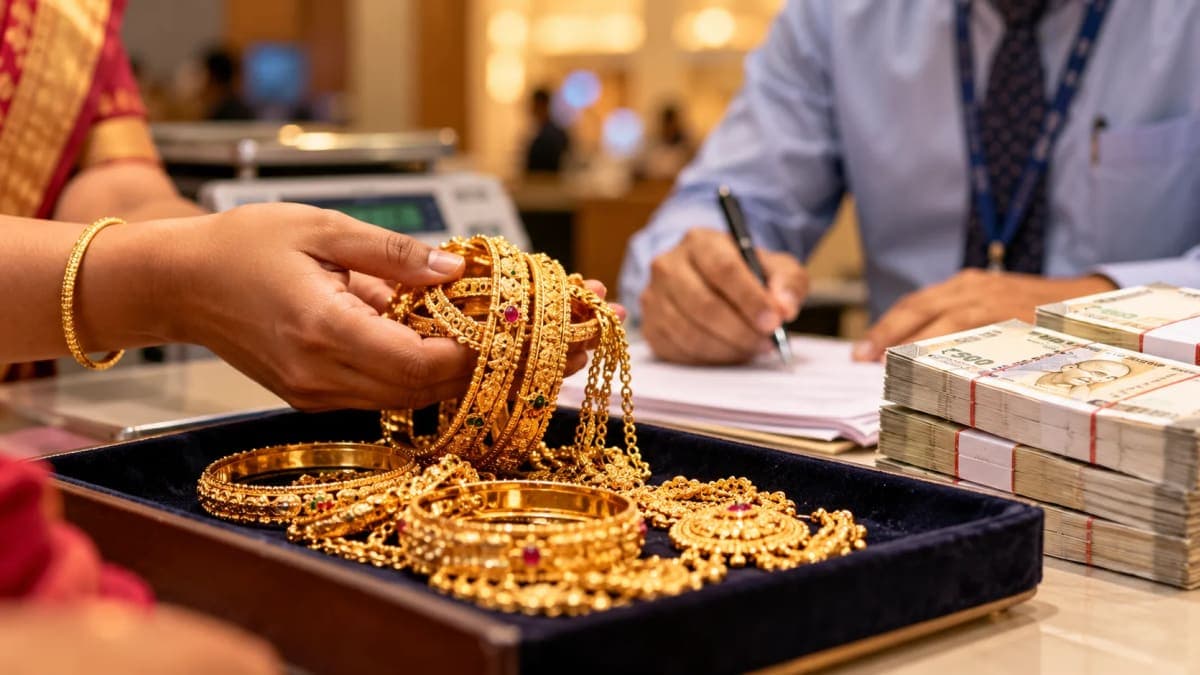
Gold Loans Rise More Than Fourfold in Two Years
India's gold-loan market has witnessed a remarkable expansion, as households increasingly use jewellery as collateral to access formal credit.
Loans against gold jewellery rose 4.4 times to ₹5.52 lakh crore in July 2026, compared with ₹1.24 lakh crore in July 2024, according to Reserve Bank of India data collated by Moneycontrol. Outstanding loans stood at ₹2.06 lakh crore in July 2025.
The surge highlights a significant shift in India's retail credit market, with gold-backed borrowing gaining ground at a time when lenders have become more cautious about some unsecured forms of credit.
Gold Loans Take a Bigger Share of Personal Credit
The expansion is not limited to the absolute size of the gold-loan book.
Gold loans accounted for only 2.2% of total personal loans in July 2024. That share increased to 4.8% in July 2025 and climbed further to 7.7% in July 2026, according to the data reported by Moneycontrol.
Over the same period, the combined share of education loans, consumer durable loans and credit-card loans moved in the opposite direction — from 7.7% in July 2024 to 7.4% in July 2025 and 6.7% in July 2026.
This suggests gold-backed credit is becoming a more important component of household borrowing rather than simply growing alongside the broader personal-loan market.
Why Are Gold Loans Growing So Quickly?
Two major factors have supported the expansion: higher gold prices and changes in lending rules.
When gold prices rise, the value of jewellery pledged as collateral also increases. Subject to regulatory loan-to-value limits, this can allow borrowers to obtain larger loans against the same quantity of gold.
Regulatory changes have also increased borrowing capacity for smaller consumption loans.
Under the RBI's revised framework, lenders can extend loans of up to 85% of the pledged gold's value for borrowing up to ₹2.5 lakh. The maximum loan-to-value ratio is 80% for loans above ₹2.5 lakh and up to ₹5 lakh, while borrowing above ₹5 lakh remains subject to a 75% ceiling.
The uniform framework took effect from April 1, 2026 and also limits the tenure of consumption-focused bullet-repayment gold loans to a maximum of 12 months.
Bank Gold Loans Grow 88.1% Year-on-Year
The latest figures also demonstrate the speed of the recent expansion.
Bank lending against gold jewellery grew 88.1% year-on-year to ₹5.52 lakh crore by the end of July 2026, according to RBI data reported by The New Indian Express and other publications.
The growth rate, however, was lower than the 136.4% year-on-year pace recorded a year earlier.
Gold loans were among the fastest-growing major categories of bank personal lending, while overall personal loans increased 16.2% year-on-year during the period.
One important qualification is that the bank gold-loan figure does not fully capture gold-backed agricultural credit because most banks classify such lending under agriculture rather than the gold-loan category.
South India Still Dominates the Gold-Loan Market
Despite rapid expansion elsewhere, southern India remains the centre of India's gold-backed lending market.
Tamil Nadu, Andhra Pradesh, Karnataka, Telangana and Kerala together represented more than 70% of the outstanding gold-loan portfolio as of June 2026, according to CRIF High Mark's How India Lends report cited by Moneycontrol.
Tamil Nadu accounted for 30% of the portfolio, followed by Andhra Pradesh at 15.9% and Karnataka at 10.2%.
But growth is increasingly spreading beyond the traditional southern markets.
Among the 10 largest states tracked by CRIF, Uttar Pradesh recorded 122.8% year-on-year growth in its gold-loan portfolio as of June. West Bengal followed with 99.7% growth, Rajasthan with 91.2%, while Gujarat and Telangana each recorded 80.5% growth.
Banks Step Up Their Gold-Loan Push
Banks are also paying greater attention to the segment.
Punjab National Bank Managing Director and CEO Ashok Chandra, discussing the expansion of the bank's gold-loan business in an August interview, said clearer RBI guidelines had encouraged the lender to focus more actively on the product.
“Bank has started putting forward for the gold loan also. We are seeing good growth happening in the gold loan sector,” Chandra said.
Gold loans can be attractive to lenders because they are secured by physical collateral, unlike credit-card debt and many other consumer loans.
What Does the ₹5.52 Lakh Crore Figure Tell Us?
The rise of gold loans reflects more than higher borrowing alone.
India's large stock of household gold can function as a readily available source of collateral. When gold prices rise, the borrowing capacity attached to that asset can increase without households having to sell their jewellery outright.
For lenders, meanwhile, gold-backed loans offer collateral protection that unsecured personal credit does not provide.
The combination of higher collateral values, revised RBI rules, greater participation by banks and continued borrower demand has therefore helped transform gold loans into a much larger part of India's formal retail-credit market.
The rapid increase also makes repayment behaviour and asset quality important indicators to watch as the market expands. CRIF data cited by Moneycontrol showed that, as of June 2026, 0.9% of the gold-loan portfolio was overdue by 31–90 days, 0.3% by 91–180 days and 0.2% by more than 180 days.
Sources
This report is based primarily on Reserve Bank of India data, as reported and analysed by Moneycontrol, along with lending data reported by The New Indian Express and information from CRIF High Mark's How India Lends report.