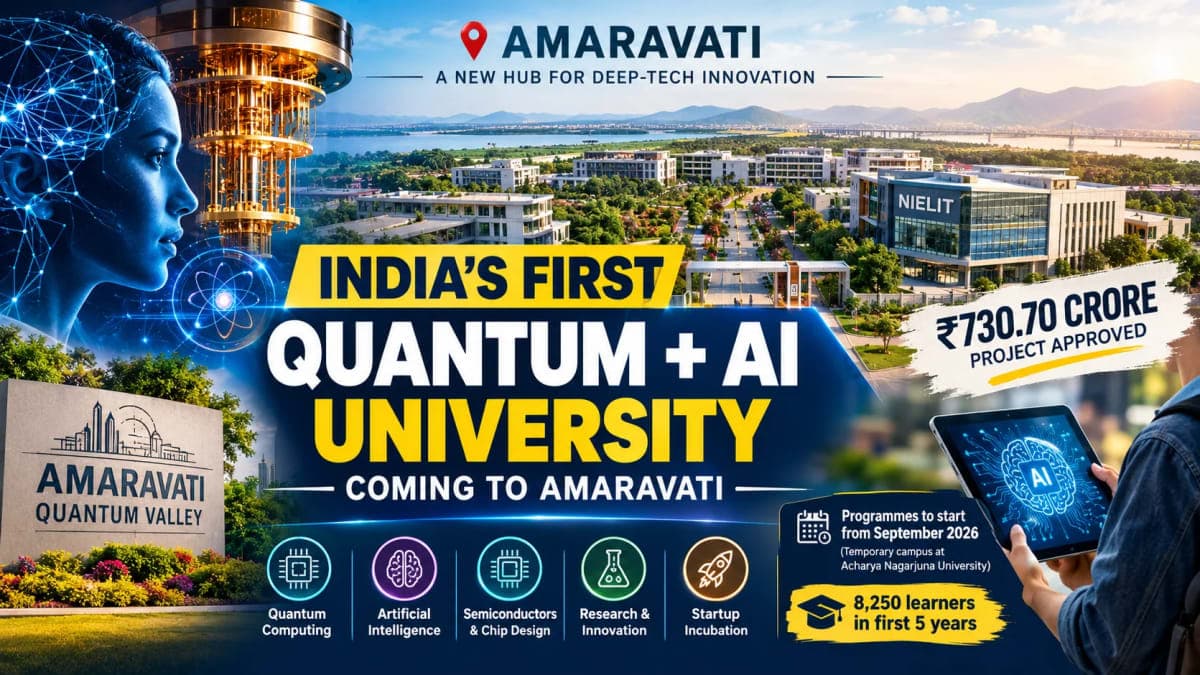
Amaravati Gets Major Quantum and AI Education Project
India's ambitions in quantum computing and artificial intelligence are moving deeper into higher education, with Andhra Pradesh approving a dedicated Quantum and AI university campus in Amaravati.
The project will be established by the National Institute of Electronics and Information Technology (NIELIT), a Deemed-to-be University under the Union Ministry of Electronics and Information Technology (MeitY).
The proposed campus represents an investment of ₹730.70 crore over five years and will be developed on approximately 8.5 acres in Amaravati.
Funding is planned through 100% Grant-in-Aid from MeitY.
The project is being described as India's first institutionally dedicated academic campus focused specifically on the convergence of quantum technologies and artificial intelligence.
Classes Expected to Begin in September 2026
Students may not have to wait for construction of the permanent campus to finish before programmes begin.
Academic and advanced technology skill-development programmes are expected to start from September 2026 through a temporary facility at Acharya Nagarjuna University in Guntur.
The permanent Amaravati campus will be developed in parallel.
This approach could allow NIELIT to begin developing a talent pipeline while laboratories, residential facilities and other infrastructure are being built.
The university plans to offer programmes ranging from undergraduate and postgraduate education to PhD courses, diplomas and specialised technology training.
What Students Could Study at the Quantum & AI Campus
The proposed academic scope goes well beyond conventional computer science.
Key areas are expected to include:
Quantum Computing
Quantum Communication
Quantum Security
Artificial Intelligence
Machine Learning
Data Science
Semiconductor Fabrication
Chip Design
VLSI
Embedded Systems
High-Performance Computing
AI-Quantum Convergence
The combination is significant because many of these technologies increasingly overlap.
Artificial intelligence requires enormous computing resources. Semiconductor innovation determines the hardware on which advanced computing systems operate. Quantum computing, meanwhile, is being explored for classes of problems that could eventually exceed the practical capabilities of conventional computers.
Training specialists across these interconnected areas could help India develop a broader deep-tech workforce rather than treating each technology as an isolated discipline.
Massive Research and Innovation Block Planned
One of the most important components of the proposed university will be a roughly 1.25 lakh-square-foot Quantum Research, Innovation and Incubation Block (QRIIB).
The facility is planned to support advanced research infrastructure including quantum photonics laboratories, nano-fabrication cleanrooms and computing facilities.
It is also expected to support startup incubation and technology transfer.
This distinction matters.
A university capable of teaching quantum computing is valuable, but a research ecosystem capable of developing intellectual property, creating prototypes and helping scientists commercialise technology could have a much larger economic impact.
If executed effectively, the Amaravati project could connect students, researchers, startups and established technology companies within the same ecosystem.
Project Targets 8,250 Learners Over Five Years
The university is expected to train approximately 8,250 learners during its first five years.
That figure reflects a broader challenge facing India's technology ambitions.
Building quantum computers, semiconductor systems and sophisticated AI infrastructure requires more than investment in machines. It requires scientists, engineers, researchers and technicians with specialised skills.
India already has a large technology workforce, particularly in software and IT services.
Frontier technologies, however, demand increasingly specialised capabilities spanning physics, mathematics, computer science, electronics, materials science and engineering.
The Amaravati campus is designed to help narrow that skills gap.
IIT Tirupati and Other Institutions Expected to Collaborate
NIELIT also proposes academic and research collaboration with established institutions in the region.
Potential partners include:
IIT Tirupati, IIIT Sri City, Andhra University and JNTU institutions.
Such partnerships could help the university access existing academic expertise while building its own faculty and research capacity.
Collaboration will be especially important in quantum technologies, where specialised equipment and highly trained researchers are expensive and relatively scarce.
Rather than duplicating every capability, institutions can potentially share expertise, laboratories and research programmes.
Why India Is Investing in Quantum Technology
Quantum technology has become a strategic priority for several major economies.
Unlike conventional computers, which process information using bits represented by zeros and ones, quantum computers use quantum bits—or qubits—which exploit properties of quantum physics.
The technology remains at an early stage and practical large-scale quantum computing still faces significant scientific and engineering challenges.
However, researchers believe quantum systems could eventually transform certain areas of computing, including optimisation, materials discovery, cryptography and scientific simulation.
Quantum communication could also play an important role in future cybersecurity systems.
India has responded to these possibilities through the National Quantum Mission, a government-backed programme intended to strengthen research and technological capabilities across quantum computing, communications, sensing and materials.
The Amaravati university project could contribute to that strategy by developing the people required to sustain it.
AI and Quantum Computing Could Become Increasingly Connected
Artificial intelligence and quantum computing are often discussed separately, but researchers are increasingly exploring where the two fields could intersect.
AI may help researchers optimise complex quantum systems, while future quantum computers could potentially accelerate certain computational tasks relevant to machine learning.
Whether these possibilities become commercially transformative remains uncertain.
That uncertainty is precisely why research capacity matters.
Countries that develop expertise early may be better positioned to benefit if quantum technologies become commercially viable at scale.
By creating an institution explicitly combining the two fields, India is effectively investing in that possibility.
Semiconductor Education Adds Another Strategic Layer
The inclusion of semiconductor fabrication, chip design and VLSI makes the project particularly noteworthy.
India is simultaneously attempting to strengthen its domestic semiconductor ecosystem through the India Semiconductor Mission.
Semiconductors form the physical foundation of almost every modern digital technology—from smartphones and data centres to AI accelerators and advanced scientific equipment.
Quantum systems themselves require highly specialised hardware.
A campus that combines AI software, semiconductor engineering and quantum science could therefore create opportunities for multidisciplinary research that conventional academic structures sometimes struggle to support.
Amaravati’s ‘Quantum Valley’ Ambition
The university is also part of a much larger technology strategy for Andhra Pradesh.
The state government wants Amaravati to develop into a Quantum Valley—an ecosystem bringing together research institutions, technology companies, computing infrastructure, startups and skilled professionals.
A separate Amaravati Quantum Computing Centre is already part of this broader effort.
The university could become the talent and research pillar of that ecosystem.
The strategy resembles the cluster model seen in successful technology hubs worldwide, where universities, investors, research laboratories and companies are geographically concentrated.
Such ecosystems can accelerate innovation because researchers and businesses can exchange talent and ideas more easily.
Sustainability Built Into the Campus Plan
The permanent campus is also planned with sustainability in mind.
Proposals include solar electricity generation, solar water heating, energy-efficient infrastructure, electric-vehicle charging and scientific waste-management systems.
The broader objective is to move towards net-zero campus operations.
Plans also include smart classrooms, laboratories, hostels, an auditorium, recreation facilities and approximately 500 beds of residential capacity.
These features indicate that the project is being designed as a full research-and-education campus rather than simply a collection of specialised laboratories.
Why This Project Matters for India
The significance of the Amaravati project lies in the convergence of several national priorities.
India is simultaneously investing in:
Artificial Intelligence through the IndiaAI Mission.
Quantum technology through the National Quantum Mission.
Semiconductors through the India Semiconductor Mission.
Each programme addresses a different component of the future technology economy.
The Amaravati campus attempts to bring education and talent development across all three areas into a common academic ecosystem.
If successful, it could provide a model for how Indian universities adapt to technologies that increasingly cross traditional departmental boundaries.
Balanced Analysis: Ambition Is High, Execution Will Decide the Outcome
The announcement is significant, but creating a world-class quantum and AI university requires much more than constructing a modern campus.
Quantum research infrastructure is expensive.
Recruiting and retaining highly specialised faculty can be difficult because top researchers are in global demand.
Advanced laboratories must remain continuously updated, while meaningful partnerships with industry require more than signing agreements.
The university will also need to demonstrate strong research output, patents, startups, technology transfers and graduate outcomes if it wants to establish an international reputation.
Another challenge is technological uncertainty.
Quantum computing is developing rapidly, but the timeline for widespread commercial applications remains difficult to predict.
That means educational programmes must be flexible enough to evolve alongside the science.
The project's strongest advantage may therefore be its multidisciplinary structure. Combining quantum science with AI, semiconductors and high-performance computing reduces dependence on the success of any single emerging technology.
From Technology Consumer to Deep-Tech Creator
India's technology sector has already built enormous global influence through software services, digital infrastructure and startups.
The next challenge is different.
The country increasingly wants to create foundational technologies rather than merely build applications using technologies developed elsewhere.
Quantum systems, advanced semiconductors and AI infrastructure sit near the centre of that ambition.
Universities will play an essential role because breakthrough technologies typically emerge from long periods of research before becoming commercial products.
The Amaravati Quantum & AI campus therefore represents something larger than another university project.
It is an attempt to connect education, scientific research, advanced computing, entrepreneurship and industrial development within a single deep-tech ecosystem.
Whether Amaravati ultimately becomes India's Quantum Valley will depend on execution over many years.
But the ₹730.70 crore university project gives that ambition a significant institutional foundation.
This article is based on reporting published by New India Express.