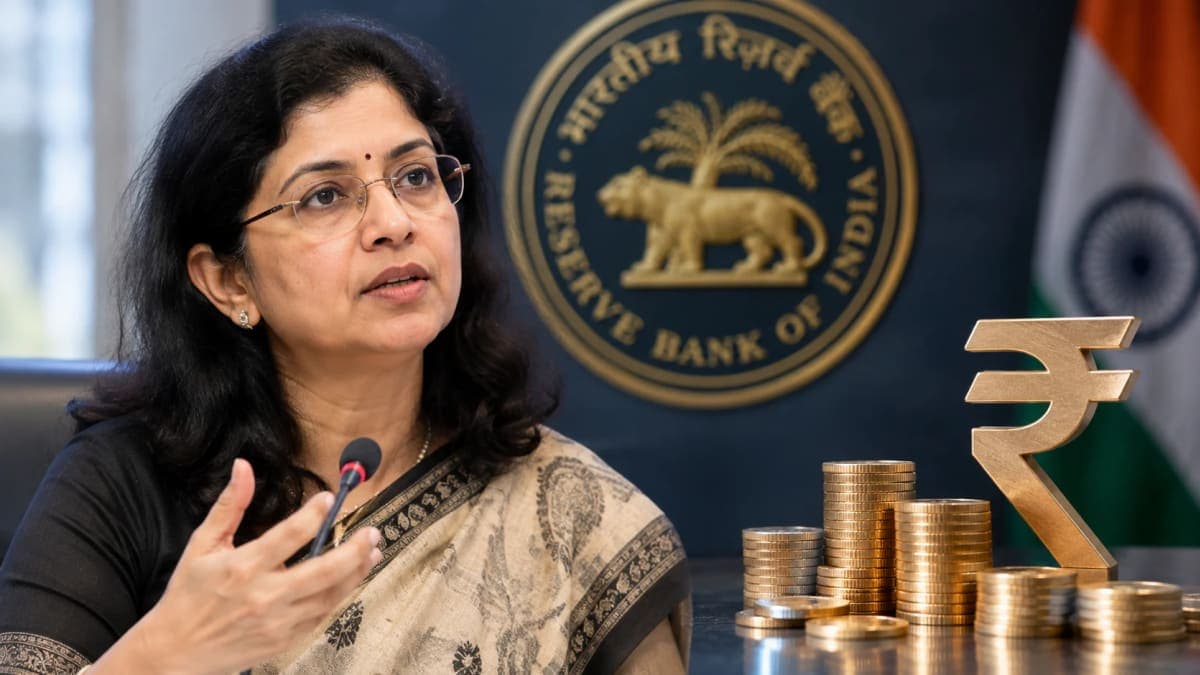
Rupee Could Stabilise and Potentially Appreciate, Says RBI Deputy Governor
Mumbai: The Indian rupee may have room to recover from its recent weakness as India’s external position improves, Reserve Bank of India Deputy Governor Poonam Gupta has said, pointing to the country’s economic fundamentals and prospects for stronger capital flows.
Speaking at the 13th SBI Banking and Economics Conclave, Gupta said the rupee had depreciated 13.1% on a point-to-point basis between March 31, 2025 and September 16, 2026. She suggested that the decline over the past year and a half could ultimately prove temporary.
“One may think of the cumulative depreciation of the INR in the past year and a half to be a temporary phenomenon,” Gupta said.
She added that there appeared to be a “fair case” for the currency not only to stabilise but potentially appreciate from current levels.
Rupee Has Fallen More Than 13% in 18 Months
The comments come after a challenging period for the Indian currency. According to Gupta, the rupee's cumulative depreciation reached 13.1% between March 31, 2025 and September 16, 2026.
The rupee closed at 95.74 against the US dollar on Wednesday, according to The Economic Times. It had touched a record low of 96.96 in late May, before measures aimed at attracting foreign inflows helped the currency stabilise.
Importantly, Gupta did not provide a specific exchange-rate target or timetable for any appreciation. Her remarks therefore represent an assessment of the factors that could support the currency rather than a forecast of a particular rupee-dollar level.
Improving Balance of Payments Could Support Rupee
A central part of Gupta’s argument is India’s balance-of-payments outlook.
She pointed to a relatively small current account deficit of less than 1% of GDP, supported by services exports and remittances. Higher oil and gold prices have, however, put temporary pressure on the current account.
India recorded a balance-of-payments deficit of $5 billion in 2024-25, which widened to $23.6 billion in 2025-26, according to figures cited in reports on Gupta's remarks.
Gupta expects some of these pressures to ease and the capital account to become more favourable later in the current financial year. Rising foreign direct investment, healthier corporate and banking balance sheets and measures designed to attract overseas capital could contribute to that improvement.
RBI Measures Have Attracted Large Foreign-Currency Inflows
The RBI has already taken steps aimed at strengthening foreign-currency inflows.
On June 5, the central bank announced measures that included allowing banks to raise fresh three- and five-year Foreign Currency Non-Resident Bank, or FCNR(B), deposits and swap those dollars with the RBI at a concessional rate. The broader framework also covered overseas foreign-currency borrowings and external commercial borrowings.
According to data cited by Mint, inflows through these schemes had crossed $143.5 billion as of September 18, with FCNR(B) deposits accounting for nearly $133 billion.
Such inflows can strengthen foreign-exchange availability and reduce some pressure on the domestic currency, although exchange rates continue to respond to a much wider range of global and domestic factors.
RBI Says It Has Resources to Manage External Pressures
Gupta also stressed the central bank's commitment to maintaining orderly conditions in the foreign-exchange market.
She said the RBI has sufficient resources to deal with external pressures, while describing current market dynamics as not fully aligned with India's underlying economic position.
This distinction is important: the RBI does not need to defend a permanently fixed rupee-dollar exchange rate. Its interventions can instead be used to manage excessive volatility and disorderly market conditions.
Strong Economy, But Financial Markets Tell a More Complex Story
Gupta also highlighted what she described as a disconnect between parts of India's financial markets and the strength of the real economy.
India's economy grew 7.8% in FY26, and the same pace was estimated to have continued in the first quarter of FY27, according to figures cited in reports covering her speech. Yet financial markets have not necessarily reflected that economic momentum.
One factor she highlighted was global investors finding attractive AI-related opportunities in other economies, which has diverted capital and investor attention away from India. She suggested this divergence could prove temporary as global shocks ease and relative valuations change.
What Could Determine the Rupee's Next Move?
Gupta's remarks establish a supportive medium-term case rather than guaranteeing appreciation.
The rupee's direction will continue to depend on several variables, including India's current account and capital flows, crude oil and gold prices, foreign portfolio and direct investment, movements in the US dollar, global interest rates and broader risk sentiment.
If India's balance of payments strengthens as expected and capital inflows improve, pressure on the rupee could ease. Conversely, renewed global shocks, expensive energy imports or weaker foreign investment could complicate that outlook.
For markets, the key message from the Deputy Governor is therefore not a specific exchange-rate forecast, but the view that the recent depreciation may not necessarily represent a permanent weakening of the currency.