TILT Unveils ₹250 Crore Impact-First Venture Fund
India’s impact-investing ecosystem is getting a significant new pool of early-stage capital with the launch of TILT, an investment platform backed by The/Nudge Foundation.
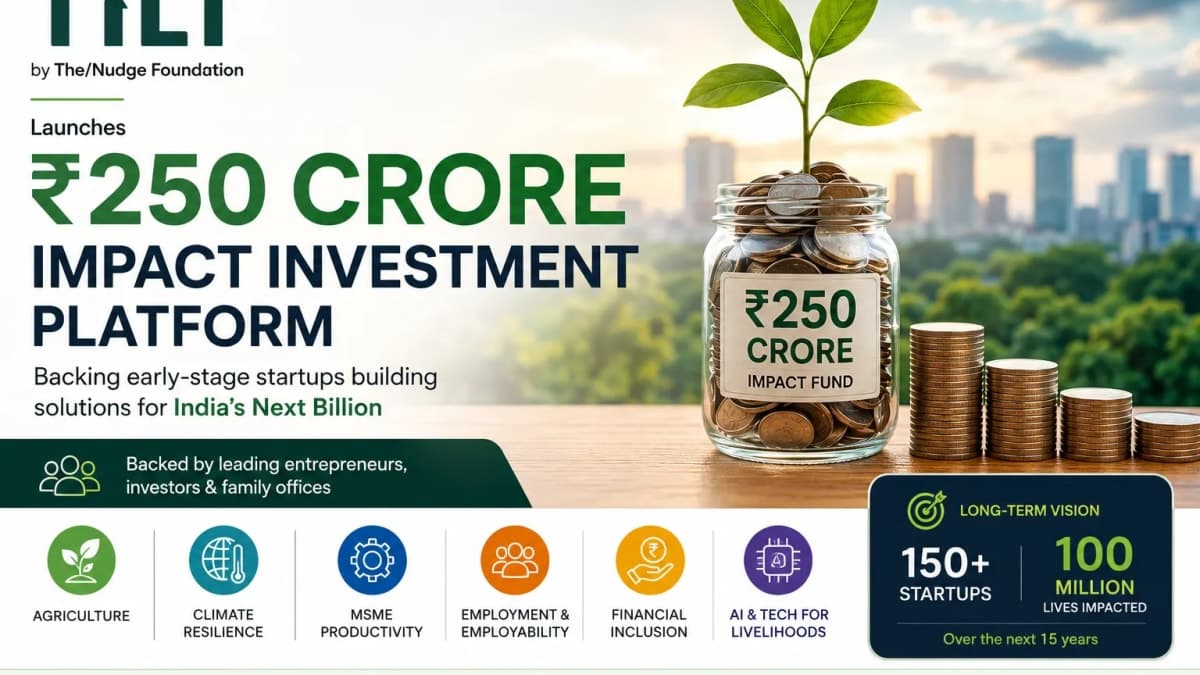
TILT has introduced its first venture fund with a corpus of ₹250 crore, aimed at supporting businesses serving what it describes as India’s “Next Billion” — communities that remain relatively underserved by traditional markets but are increasingly gaining access to technology, financial services and economic opportunities.
Unlike conventional venture funds that may prioritize rapid growth and financial returns within relatively short timelines, TILT is positioning itself around patient, impact-first capital.
The objective is to give promising businesses more time to develop sustainable models while addressing large social and economic challenges.
Seed to Series A Startups Will Be the Main Target
TILT intends to concentrate primarily on companies between the Seed and Series A stages.
Individual investments are expected to range from approximately ₹2 crore to ₹16 crore.
The strategy targets a particularly challenging part of the startup funding cycle. Businesses serving lower-income or underserved communities can require significant time to establish distribution networks, validate demand and develop commercially sustainable operations.
Such companies may demonstrate meaningful social potential before reaching the growth metrics traditionally expected by venture capital investors.
TILT is attempting to occupy that gap by combining investment capital with a longer-term approach to company building.
The fund is expected to make roughly 20–25 investments while reserving capital to participate in later funding rounds of selected portfolio companies.
Agriculture, Climate, MSMEs and Financial Inclusion in Focus
TILT’s investment mandate covers several sectors closely connected with livelihoods and economic participation.
The fund will look for science and technology-driven businesses operating across agricultural value chains, climate resilience, informal employment and emerging models of work.
Other areas of interest include MSME productivity, employability, financial inclusion, market access and distribution.
Technology and artificial intelligence applications that can solve livelihood-related challenges are also part of the investment strategy.
This broad mandate means TILT could potentially support startups ranging from technology platforms helping small businesses become more productive to companies improving agricultural income, employment opportunities or financial access.
Major Indian Entrepreneurs and Investors Back TILT
The ₹250 crore fund has attracted backing from the Livelihood Impact Fund as well as several prominent entrepreneurs, investors and family offices.
Its supporters include Deep Kalra, Binny Bansal, Hari Menon, Vidit Aatrey, Amit Gupta and the Raj & Indra Nooyi Family Office.
The participation of experienced business builders is notable because impact-oriented startups often need more than financial capital.
Companies operating in difficult markets may also require strategic guidance, partnerships, distribution relationships and access to broader entrepreneurial networks.
TILT plans to complement its investments with support in areas such as research, market development, partnerships and ecosystem infrastructure.
The/Nudge’s Experience Creates the Foundation for TILT
The new investment platform builds on years of work by The/Nudge Foundation in the livelihood and social entrepreneurship ecosystem.
Over the previous eight years, The/Nudge has supported more than 190 social enterprises and deployed approximately ₹180 crore through grants.
That experience appears to have helped identify a recurring financing problem.
Grants can help entrepreneurs experiment with new solutions and establish early evidence that their ideas work. But businesses trying to move from successful pilots to sustainable commercial scale frequently require a different form of financing.
At the same time, conventional venture investors may consider some of these companies too early, too complex or too slow-growing for traditional venture-return expectations.
TILT is designed to provide investment capital during this transitional stage.
Why the ₹250 Crore TILT Fund Matters
The significance of TILT goes beyond the size of its first fund.
India has produced a rapidly expanding startup ecosystem, but investment capital is not distributed evenly across industries or customer groups.
Businesses targeting affluent consumers or rapidly expanding digital markets can sometimes demonstrate revenue growth relatively quickly. Startups working with small farmers, informal workers, micro-businesses or financially underserved communities often operate under very different conditions.
Customer acquisition can be difficult, infrastructure may be fragmented and distribution costs can be high.
As a result, potentially useful businesses may struggle to attract sufficient capital even when they are solving genuine economic problems.
Patient investment models could help address this mismatch.
If TILT can demonstrate that companies serving underserved markets can simultaneously create measurable social benefits and financially sustainable businesses, it could encourage additional institutional capital to enter impact-focused sectors.
Technology and AI Could Expand the Opportunity
Technology will be an important component of TILT’s investment thesis.
Digital infrastructure, smartphones, artificial intelligence and expanding financial connectivity have created new ways of reaching customers who were previously difficult or expensive for businesses to serve.
AI, for example, could potentially help small enterprises automate tasks, improve agricultural decision-making, connect workers with employment opportunities or reduce the cost of delivering financial and educational services.
However, technology alone does not guarantee impact.
Products must remain affordable, accessible and commercially viable for the communities they are intended to serve. Companies will also need to demonstrate that technological solutions generate measurable improvements rather than simply expanding digital adoption.
This makes execution particularly important for the businesses TILT chooses to support.
Ambitious Long-Term Impact Target
TILT has outlined a much larger ambition beyond its first ₹250 crore vehicle.
Over the next 15 years, the platform aims to support more than 150 startups and contribute to improving the lives of 100 million people.
Those numbers represent long-term objectives rather than guaranteed outcomes, and achieving them will depend heavily on the performance and scalability of portfolio companies.
Nevertheless, the target illustrates the scale at which TILT intends to operate.
Balanced Analysis: Opportunity Comes With Challenges
TILT enters the market at a time when combining commercial investment with measurable social impact is receiving increasing attention.
Its patient-capital strategy could prove particularly valuable for entrepreneurs whose businesses require longer development periods than conventional venture-backed companies.
There are, however, important challenges.
Impact investing must balance financial sustainability with social objectives. A company that creates meaningful benefits but cannot establish a viable business model may remain dependent on external capital. Conversely, aggressive pursuit of commercial growth could gradually shift a company away from the communities it was originally designed to serve.
Measuring impact presents another challenge.
Metrics such as customers reached or jobs created can provide useful indicators, but determining whether people's incomes, resilience or economic opportunities have improved over time requires deeper measurement.
TILT’s long-term credibility will therefore depend not simply on how much capital it deploys, but on the quality of businesses it backs and the economic outcomes those businesses eventually generate.
What Comes Next for TILT?
The ₹250 crore fund provides TILT with an opportunity to test whether patient venture capital can successfully bridge the space between philanthropy and traditional venture investing.
Its initial portfolio will be closely watched.
Strong commercial performance from startups operating in agriculture, climate resilience, MSMEs, employment and financial inclusion could provide evidence that markets serving underserved Indians are investable at scale.
If that happens, TILT’s biggest contribution may extend beyond the companies it directly finances.
It could help demonstrate that solving large livelihood challenges and building sustainable businesses do not necessarily have to be competing objectives.
This article is based on reporting published by Yourstory.