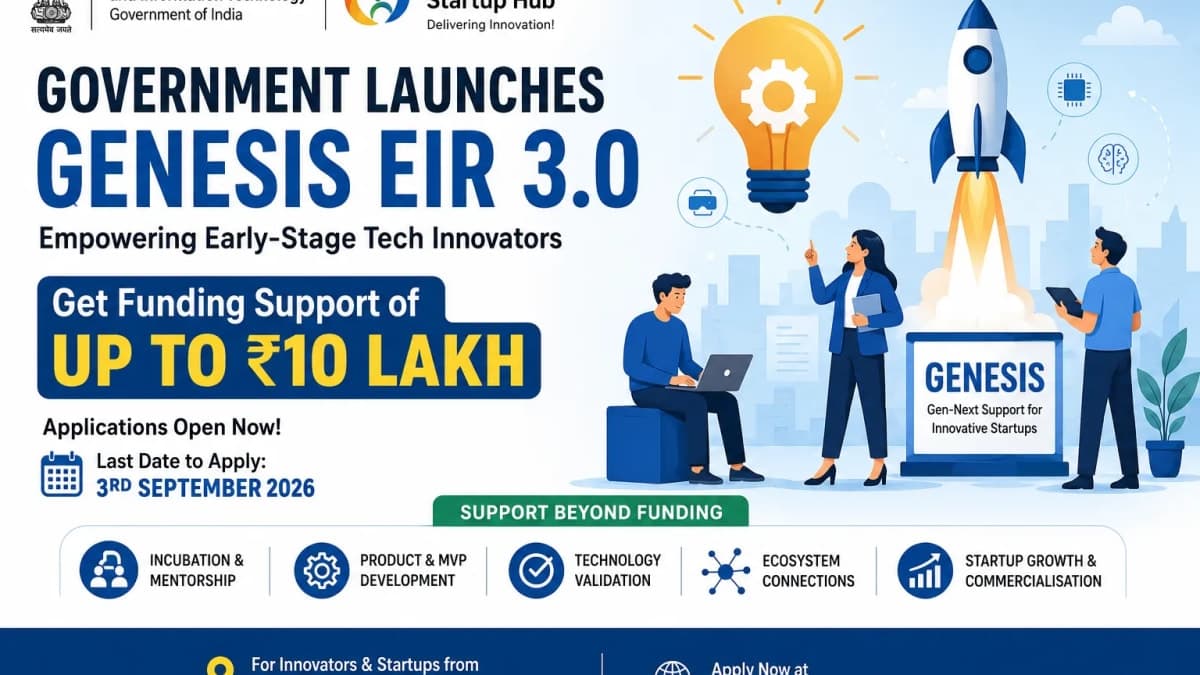
GENESIS EIR 3.0 Targets India's Next Generation of Tech Founders
India's government-backed startup ecosystem is expanding its focus on founders at the earliest stages of building technology businesses.
MeitY, through MeitY Startup Hub, has launched GENESIS Entrepreneur-in-Residence Cohort 3 as part of the wider GENESIS — Gen-Next Support for Innovative Startups — initiative.
The programme was formally launched during the GENESIS NextGen Startup Summit – Coimbatore Edition, held at Rathinam Global University in Coimbatore on August 4, 2026. Applications are open until September 3, 2026.
Rather than focusing only on established startups, EIR 3.0 is designed for people who may still be developing an idea, proof of concept, prototype or early minimum viable product.
That makes the programme particularly relevant to founders who have technical potential but have not yet reached the stage where conventional venture capital or institutional investment is readily accessible.
Up to ₹10 Lakh Financial Assistance
One of the programme's biggest attractions is financial assistance of up to ₹10 lakh for selected innovators through participating GENESIS incubators.
The funding is intended to help entrepreneurs advance early-stage technologies and reduce the gap between an innovative concept and a pilot-ready solution.
However, funding is only one part of the support package.
Selected participants can also receive incubation, individual mentorship, product and MVP development assistance, technology validation support, startup ecosystem connections and guidance towards commercialisation.
For early-stage founders, this combination can be significant because technical ideas frequently require more than capital. Access to experienced mentors, infrastructure, industry networks and business-development guidance can influence whether a prototype ultimately becomes a viable company.
Which Technology Sectors Are Covered?
GENESIS EIR 3.0 covers a broad range of emerging technology areas.
The government's identified focus domains include Electronics and IT, DeepTech, Artificial Intelligence and Machine Learning, Internet of Things, Semiconductor and VLSI technologies, cybersecurity, blockchain, quantum technologies, and AR/VR and spatial or immersive technologies.
The range reflects India's broader effort to develop domestic capabilities in strategically important technology sectors while encouraging more technology-focused entrepreneurship outside the country's traditional startup centres.
Who Can Apply for GENESIS EIR 3.0?
The programme is open to Indian citizens who may be entrepreneurs, innovators, researchers, students or founders and co-founders of early-stage startups.
According to the official eligibility conditions, proposed innovations should generally be at Technology Readiness Level 1–4, covering stages such as ideation, proof of concept, prototype, MVP or early validation.
The startup should be based in a Tier-II or Tier-III city. If the company has already been incorporated, it should be less than two years old on the application date.
Applicants must also meet restrictions concerning previous government financial assistance: the startup should not have received more than ₹10 lakh in support under another Central or State government scheme for the same proposed idea or startup.
Why Tier-II and Tier-III Cities Matter
A notable feature of GENESIS is its geographical focus.
India has built one of the world's most active startup ecosystems, but access to investors, experienced mentors, specialised talent and incubation infrastructure has historically been stronger in major technology centres.
GENESIS attempts to broaden that opportunity by supporting entrepreneurs in emerging startup locations.
Instead of requiring promising founders to first establish themselves in the largest startup hubs, programmes such as EIR can potentially create stronger local innovation networks around universities, incubators and technology institutions.
This could become particularly important for founders developing products that address regional industries or problems where local knowledge provides an advantage.
GENESIS Has a Broader ₹490 Crore Mandate
EIR 3.0 forms part of the larger GENESIS programme rather than operating as a standalone funding initiative.
The GENESIS scheme has a total budget outlay of ₹490 crore and is designed to support startups and innovators through different stages — from experimentation and early development to validation, investment and eventual scale.
Its support framework includes Entrepreneur-in-Residence, Pilot, Investment and DeepTech funding components.
The EIR component specifically targets the earliest part of that pipeline, where entrepreneurs may have promising technology but still need resources to demonstrate that their idea can work in practice.
Why GENESIS EIR 3.0 Matters
For India's startup ecosystem, the importance of GENESIS EIR 3.0 goes beyond the maximum ₹10 lakh assistance.
One of the persistent challenges for very early-stage technology entrepreneurs is the gap between developing an idea and creating something sufficiently mature to attract customers or investors.
Deep-tech ventures can face an even more difficult path because building prototypes, conducting technical validation and accessing specialised expertise can require substantial time and resources before meaningful revenue appears.
A structured programme combining capital with incubation and mentoring can help reduce some of these barriers.
The initiative could also strengthen the pipeline of technology startups emerging from universities, research communities and smaller cities — groups that may possess technical expertise but have fewer connections to established startup networks.
Balanced Analysis: Funding Helps, but Execution Will Decide the Impact
GENESIS EIR 3.0 offers a potentially useful entry point for entrepreneurs who are too early for traditional institutional investment.
The ₹10 lakh ceiling can be meaningful for proof-of-concept development, prototyping and early validation, particularly when combined with incubation infrastructure and mentorship.
However, government-backed funding alone cannot guarantee that participating ideas will become sustainable businesses.
The programme's longer-term impact will depend on factors such as the quality of startup selection, effectiveness of participating incubators, speed of fund deployment, technical mentorship and the ability to connect promising ventures with customers and follow-on investors.
Another important measure of success will be whether startups supported in Tier-II and Tier-III cities can continue growing after completing the programme instead of losing momentum once initial assistance ends.
If GENESIS successfully connects early-stage innovators with strong incubation, industry expertise and subsequent capital, EIR 3.0 could help expand India's technology entrepreneurship pipeline beyond its largest metropolitan startup clusters.
Application Deadline
Applications for GENESIS EIR Cohort 3 opened on August 4 and are scheduled to close on September 3, 2026.
Eligible innovators therefore have a limited window to submit their proposals for consideration.
This article is based on reporting published by DD India.