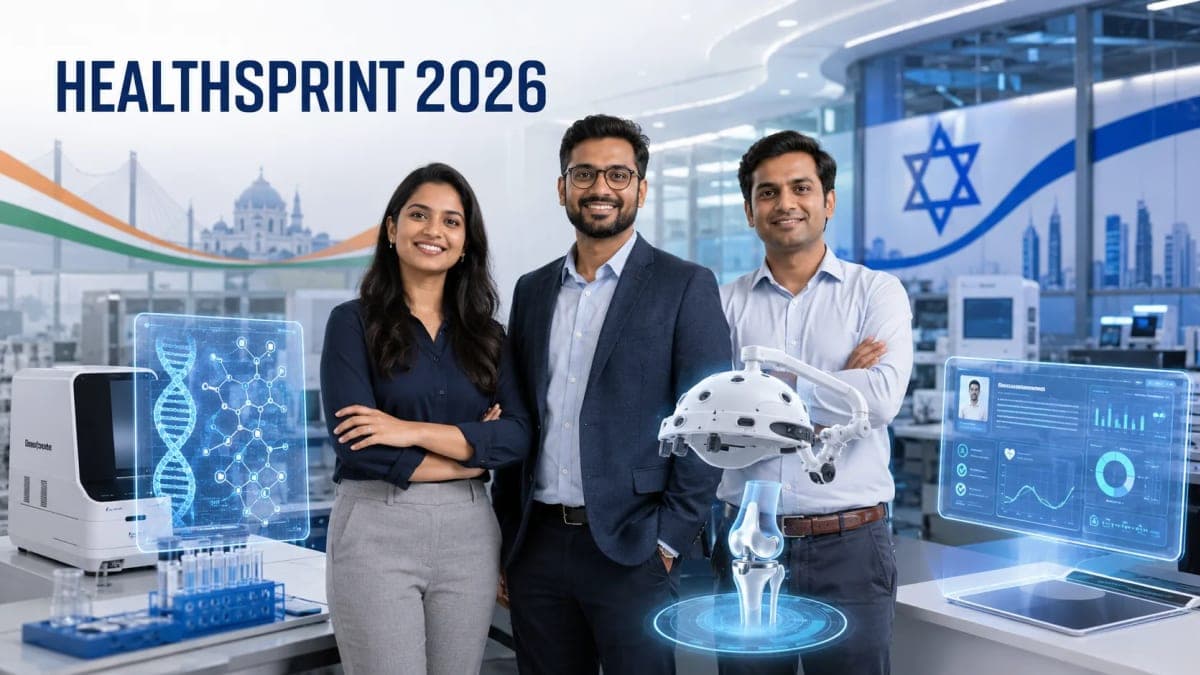
Three Indian Medtech Startups Win HealthSprint 2026, Earn Global Launchpad in Israel
Three South Indian healthcare startups—BioCipher Labs, Prodancy and Mykare.ai—have been named the winners of HealthSprint 2026, an India–Israel initiative designed to prepare promising medical-technology ventures for investment and international growth.
The programme was jointly organised by the Consulate General of Israel in Bengaluru and Bengaluru-based technology startup accelerator GINSERV. The winners were chosen after shortlisted founders presented their solutions to healthcare specialists, mentors and investors from India and Israel.
Three Winners Address Different Healthcare Challenges
The selected companies operate across diagnostics, surgical care and healthcare management:
BioCipher Labs: AI-Assisted Molecular Diagnostics
Bengaluru-based BioCipher Labs is developing an artificial intelligence-powered molecular diagnostics platform. Its work represents the “Diagnose” side of healthcare innovation, where faster and more effective analysis could support clinical decision-making.
However, diagnostic technologies must demonstrate consistent accuracy, reliability and clinical value before they can achieve widespread adoption. The exposure provided through HealthSprint could help the company refine its validation and commercialisation strategy.
Prodancy: An Indigenous Surgical Helmet
Prodancy, also based in Bengaluru, has developed an Indian-made surgical helmet intended for joint-replacement procedures. The product seeks to reduce reliance on imported consumables used during such operations.
If the solution performs successfully in clinical settings and meets the necessary quality standards, it could strengthen domestic medical-device manufacturing while giving hospitals another procurement option.
Mykare.ai: Digital Management for Smaller Hospitals
Kochi-based Mykare.ai has created an AI-native patient-management platform for clinics and smaller hospitals. Its focus is particularly relevant because smaller healthcare facilities may lack the extensive technology infrastructure available to large hospital groups.
The platform’s longer-term impact will depend on factors including ease of use, affordability, integration with existing systems and the protection of patient information.
Winners to Join Fully Funded Israel Programme
Each winning startup will receive a fully funded, one-week immersion in Israel. During the programme, the founders are expected to engage with healthcare institutions, clinicians, innovation centres, investors and other participants in the country’s health-technology ecosystem.
The trip is intended to help the companies explore clinical validation, improve their investment readiness and assess possible routes into international markets. It offers more than ceremonial recognition: access to clinical and commercial networks can help young medical-technology companies test their assumptions before committing significant resources to expansion.
HealthSprint Selected 15 Startups from 175 Applications
HealthSprint 2026 received 175 applications. Fifteen companies were shortlisted—five in each of the programme’s Diagnose, Treat and Manage categories—to pitch before mentors, investors and industry professionals.
The broader cohort participated in mentoring, business-refinement sessions, masterclasses and global-market readiness activities. The structure reflects a central challenge in healthcare entrepreneurship: a promising product alone is not enough. Companies must also establish clinical usefulness, regulatory readiness, a workable business model and the ability to scale safely.
Why the HealthSprint 2026 Result Matters
The three winners represent complementary areas of healthcare delivery. BioCipher Labs focuses on identifying medical conditions, Prodancy addresses surgical procedures and Mykare.ai supports the administration of patient care.
Their selection also highlights two important trends in India’s healthcare startup sector: the increasing use of AI and a growing effort to develop domestically produced alternatives to imported medical technologies.
For India, international programmes can give startups access to specialist expertise and potential global partners. For Israel’s innovation ecosystem, collaboration with Indian companies provides exposure to a large, diverse and cost-sensitive healthcare market.
Recognition Is Only the Beginning
Winning HealthSprint does not guarantee regulatory approval, commercial adoption, investment or international success. Medical technologies face demanding requirements related to patient safety, clinical evidence, privacy, manufacturing quality and integration into hospital workflows.
A one-week programme is also relatively short. Its real value will depend on whether the startups turn the introductions and feedback they receive into clinical studies, partnerships, funding discussions or market-entry plans.
Nevertheless, the award gives BioCipher Labs, Prodancy and Mykare.ai a valuable platform. Their progress after the Israel programme will show whether HealthSprint can translate cross-border mentorship into measurable healthcare and business outcomes.
This article is based on reporting published by The Economic Times.