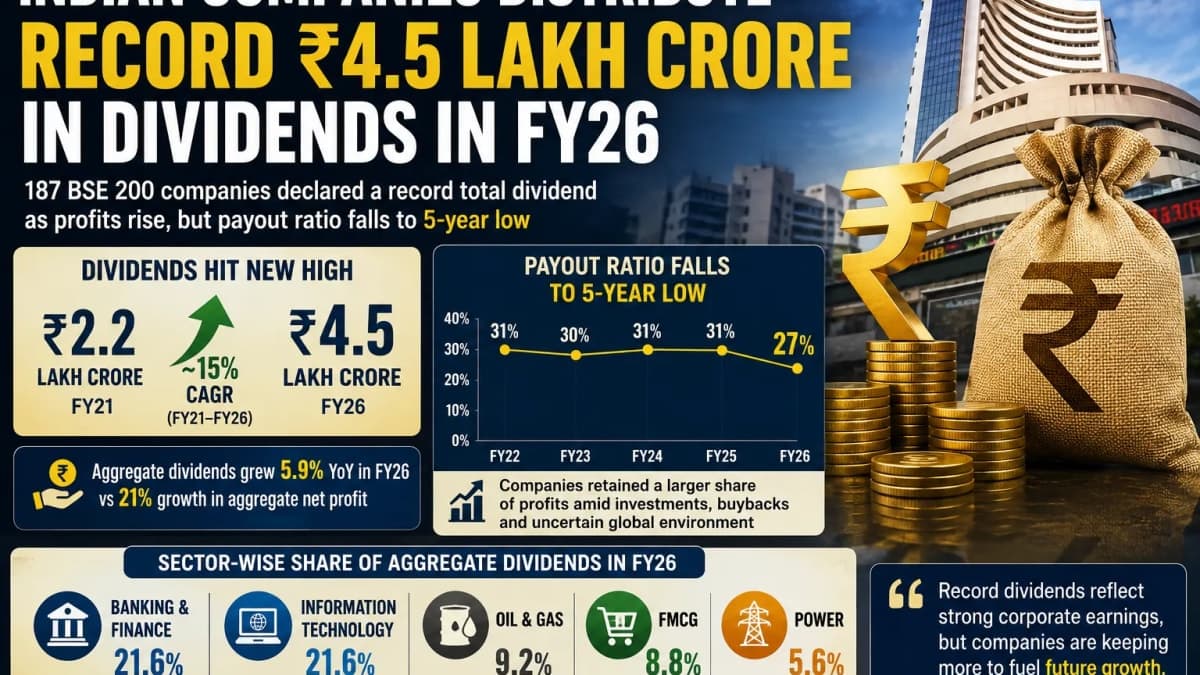
India Inc delivered a record amount of cash to shareholders in FY26, with aggregate dividends reaching ₹4.5 lakh crore among 187 companies from the BSE 200 that had reported audited results.
The headline number marks a significant increase from ₹2.2 lakh crore in FY21, meaning aggregate dividends for the sample have roughly doubled over five years. The increase translates into an annualised growth rate of about 15% over the five-year period.
But there is another side to the record.
Despite companies paying more dividends in absolute rupee terms, the proportion of their profits returned to shareholders fell. The aggregate dividend payout ratio dropped to 27% in FY26, its lowest level in five years, compared with 31% in the previous financial year.
The combination tells an important story: corporate India is generating substantially larger profits and paying record dividends, while simultaneously retaining a greater proportion of those earnings.
₹4.5 Lakh Crore Dividend Pool Sets New Record
The FY26 dividend total represents a major expansion in shareholder distributions over the past five years.
For the sample of 187 BSE 200 companies, aggregate dividends increased from ₹2.2 lakh crore in FY21 to ₹4.5 lakh crore in FY26.
That represents an increase of approximately ₹2.3 lakh crore over the period.
The five-year annual growth rate in aggregate dividends was about 15%, illustrating how stronger corporate earnings have translated into significantly higher cash distributions to investors.
However, FY26 itself produced more moderate growth.
On a year-on-year basis, aggregate dividends increased 5.9%, slower than the double-digit dividend growth recorded in each of the previous four years.
That slowdown becomes more meaningful when compared with the pace at which corporate profits increased.
Profits Rose 21%, But Dividends Increased Only 5.9%
The companies in the sample recorded 21% year-on-year growth in aggregate net profit during FY26.
Dividend growth, by comparison, was only 5.9%.
That gap explains why the overall dividend payout ratio declined despite the record amount distributed.
The payout ratio measures the proportion of profits that companies return to shareholders as dividends.
In simple terms, if a company earns ₹100 and distributes ₹30 as dividends, its dividend payout ratio is 30%.
For the FY26 sample, that ratio fell from 31% to 27%.
So while shareholders collectively received more money than ever, companies retained a larger percentage of their profits.
Why Are Companies Retaining More Cash?
The decline in the payout ratio does not necessarily indicate weaker corporate finances.
In this case, it primarily reflects profits growing much faster than dividends.
The analysis also points to share buybacks and the desire to conserve cash amid a volatile geopolitical environment as factors influencing capital-allocation decisions.
Companies have several choices when deciding what to do with profits.
They can distribute cash through dividends, repurchase shares, repay debt, fund acquisitions, invest in new capacity or retain cash to strengthen their balance sheets.
The FY26 numbers suggest companies are balancing shareholder distributions against the need to maintain financial flexibility.
That distinction matters for investors: a declining payout ratio does not automatically mean companies are becoming less shareholder-friendly if the retained earnings are being deployed productively.
Banking and Finance Emerges as a Dividend Powerhouse
Banking and financial companies were among the largest contributors to India's FY26 dividend pool.
The banking and finance sector accounted for 21.6% of aggregate dividends, the same proportion as the information technology sector.
The financial sector's contribution has increased considerably over recent years.
Its share of aggregate dividends stood at around 15% in FY22, meaning the sector has gained more than six percentage points in its contribution to the overall dividend pool.
Improving asset quality, declining credit costs and growth in loan assets have helped strengthen banking-sector profitability, providing companies with greater capacity to distribute cash.
The development is significant because it demonstrates how the composition of India's dividend market is evolving alongside corporate profitability.
IT Companies Account for Another 21.6%
India's information technology sector remained one of the country's most important sources of shareholder cash returns.
IT companies accounted for 21.6% of the aggregate dividend pool, matching banking and finance as the largest sectoral contributors.
The IT industry's significance becomes even clearer when examining its payout ratio.
The sector recorded a 75% dividend payout ratio in FY26, the highest among the sectors covered, for the second consecutive year.
However, that ratio declined from 81% in FY25.
A 75% payout ratio means that, at the aggregate level, IT companies returned a much larger proportion of their earnings to shareholders than the broader sample's 27%.
That reflects the mature cash-generating characteristics of many large Indian technology companies.
FMCG Companies Increase Their Payout Ratio
Fast-moving consumer goods companies showed a different trend.
The FMCG sector's dividend payout ratio increased to 71% in FY26 from 68% a year earlier.
That placed FMCG behind IT among the sectors with the highest proportion of earnings distributed as dividends.
FMCG companies also contributed 8.8% of total dividends in the sample.
Consumer staples businesses often generate relatively predictable cash flows, which can support consistent dividend policies, although payout decisions ultimately vary significantly between individual companies.
Which Sectors Paid the Most Dividends?
The sectoral breakdown shows how concentrated India's dividend pool remains.
Banking and finance: 21.6%
Information technology: 21.6%
Oil and gas: 9.2%
FMCG: 8.8%
Power: 5.6%
Together, major sectors including banking and finance, IT, oil and gas and power accounted for roughly two-thirds of aggregate dividends.
The data also demonstrates that record shareholder distributions are not being driven evenly across corporate India.
Large, profitable and cash-generating businesses continue to account for a substantial portion of the dividend pool.
From ₹2.2 Lakh Crore to ₹4.5 Lakh Crore in Five Years
The longer-term trajectory provides perhaps the clearest indication of the expansion in shareholder payouts.
Aggregate dividends in the analysed sample stood at:
FY21: ₹2.2 lakh crore
FY26: ₹4.5 lakh crore
That means the dividend pool has increased by approximately 105% over five years.
In absolute terms, companies are distributing around ₹2.3 lakh crore more than they did in FY21.
For long-term equity investors, the increase illustrates an often-overlooked component of stock-market returns.
Share-price appreciation attracts most of the attention, but dividends can provide an additional stream of cash returns, particularly for investors holding mature, profitable businesses over extended periods.
Record Dividends Don't Mean Record Generosity
The most important nuance in the FY26 numbers is the distinction between the total amount distributed and the proportion of earnings distributed.
₹4.5 lakh crore is a record absolute dividend amount.
But the 27% payout ratio is a five-year low.
Those figures are not contradictory.
If profits rise significantly faster than dividends, companies can distribute a record amount of cash while simultaneously retaining a larger proportion of their earnings.
That is exactly what the FY26 figures indicate.
Net profits increased 21%, while dividends rose 5.9%. As a result, shareholders received more cash in absolute terms, but a smaller percentage of corporate profits.
What the Numbers Mean for Investors
For investors, headline dividend totals alone provide only part of the picture.
A high dividend payout can be attractive, particularly for income-oriented investors, but it does not automatically indicate a better investment.
Companies retaining profits may be able to use that capital for expansion, acquisitions, debt reduction or other investments capable of generating future growth.
Conversely, mature companies with fewer capital requirements may choose to return a larger proportion of earnings to shareholders.
The contrast between sectors illustrates this clearly.
IT's 75% payout ratio and FMCG's 71% stand far above the overall 27% ratio, while the growing contribution from banking and finance reflects a different story — rapidly improving profitability increasing the sector's capacity to distribute dividends.
Investors therefore need to examine both dividend growth and the underlying earnings supporting those payments.
A Broader Dividend Boom Is Also Helping Government Finances
The strength in corporate distributions has been visible elsewhere in the economy.
Separately, the central government's dividend receipts from central public sector enterprises reached a record ₹78,438 crore in FY26, exceeding the budget target. Major contributors included Coal India, Oil and Natural Gas Corporation, Indian Oil Corporation and Bharat Petroleum Corporation.
That figure should not be confused with the ₹4.5 lakh crore BSE 200 sample discussed above, but it provides additional evidence of strong dividend generation among major Indian enterprises during FY26.
Conclusion
FY26 produced a striking combination for corporate India: record dividends alongside a five-year-low payout ratio.
The 187 BSE 200 companies covered in the analysis distributed an aggregate ₹4.5 lakh crore, roughly double the ₹2.2 lakh crore paid in FY21.
Banking and finance and IT emerged as the biggest contributors, accounting for 21.6% each, while IT maintained the highest sectoral payout ratio at 75%.
Yet the overall payout ratio dropped from 31% to 27% because corporate net profits grew much faster than dividends.
For investors, that may be the most important takeaway from the record. Indian companies are not simply returning unprecedented amounts of cash to shareholders — they are also retaining a greater share of their growing profits.
The next question is how effectively that retained capital is deployed. If companies use it to finance productive investment and future growth, today's lower payout ratio could potentially support tomorrow's earnings and dividends.