Sensex and Nifty Record Third Consecutive Weekly Loss
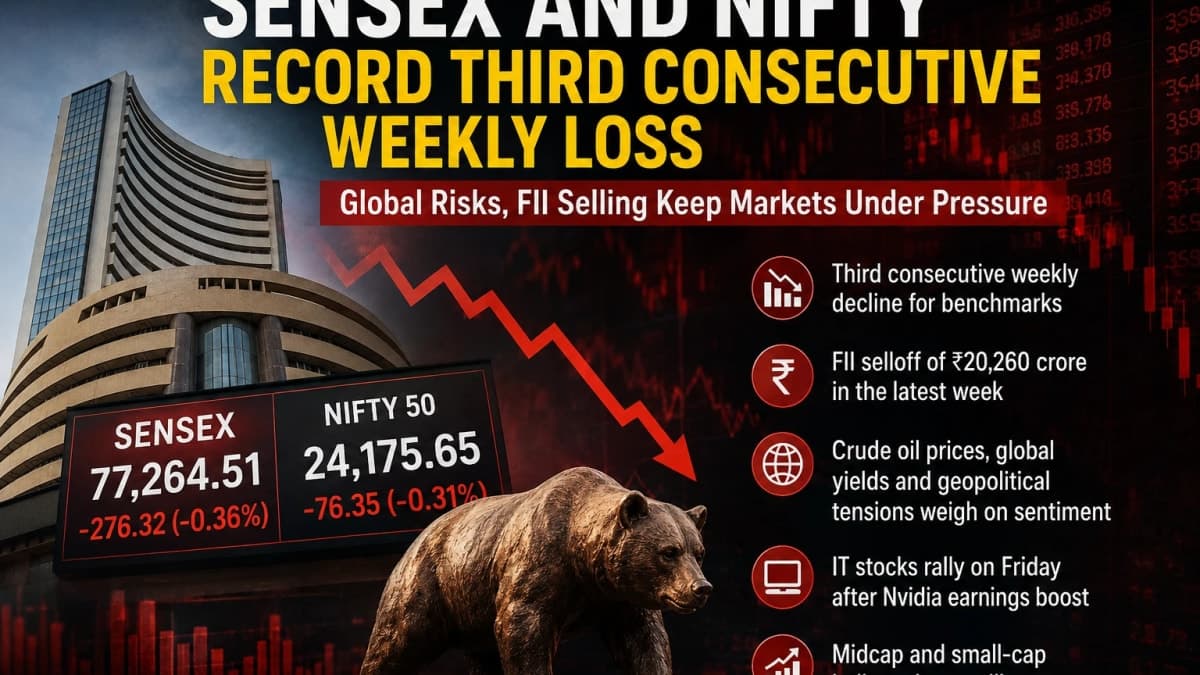
India’s benchmark equity indices ended another volatile week in negative territory, extending their weekly losing streak to three — the longest such run in about five months.
For the week ended August 28, the BSE Sensex declined 276.32 points, or 0.36%, to 77,264.51, while the Nifty 50 dropped 76.35 points, or 0.31%, to 24,175.65.
The weekly decline came despite a recovery in Friday’s session. The Sensex gained 330.92 points, or 0.43%, while the Nifty climbed 84.80 points, or 0.35%, helped significantly by strength in technology shares.
The contrast between Friday’s rebound and the overall weekly decline highlights the uncertainty currently shaping Indian equities: buyers are still willing to step in after sharp falls, but several domestic and international risks continue to restrict a sustained recovery.
Why Did the Indian Stock Market Remain Under Pressure?
A combination of global and domestic factors weighed on investor confidence during the week.
Geopolitical uncertainty, elevated crude oil prices and rising U.S. bond yields remained important concerns. Higher global yields can make U.S. assets relatively more attractive to international investors, potentially reducing the appeal of riskier emerging-market equities.
Oil is particularly important for India because the country relies heavily on imported energy. Sustained high crude prices can increase import costs, pressure the rupee and complicate the inflation outlook.
Foreign institutional investor activity added another layer of pressure. FIIs were net sellers for a second consecutive week, selling Indian equities worth about ₹20,260 crore during the latest week, according to market data reported by Moneycontrol.
The longer-term foreign-flow picture is also challenging. Reuters reported this week that overseas investors had sold roughly ₹2.4 trillion ($25.1 billion) of Indian equities during 2026, while Indian benchmarks were down more than 7% for the year at the time of its report.
Friday’s IT Rally Provides Some Relief
Technology stocks emerged as an important source of support at the end of the week.
The Nifty IT index jumped around 3.5% on Friday, with sentiment improving following strong quarterly results from U.S. chipmaker Nvidia. The technology rally helped the broader benchmarks recover after two consecutive sessions of losses.
This recovery is significant because it demonstrates that investor appetite has not disappeared completely. Positive global corporate developments can still trigger meaningful buying in Indian sectors with international exposure.
However, a one-session rebound was not enough to erase losses accumulated earlier in the week.
Midcap and Small-Cap Stocks Show Relative Resilience
One encouraging feature of the week was the performance of the broader market.
While the major benchmarks declined, the BSE 150 Mid-Cap index gained about 0.30% and the BSE 250 Small-Cap index advanced around 0.17% over the week.
That divergence suggests that the weakness was not uniformly distributed across the market.
Continued interest in selected mid- and small-cap companies, combined with domestic institutional participation, helped prevent the broader market from experiencing a deeper decline.
Domestic Investors Continue to Provide a Cushion
One of the biggest structural changes in India’s equity market has been the growing importance of domestic investors.
Despite substantial foreign selling, regular flows from Indian households and institutions have provided an important counterbalance. Reuters reported that systematic investment plan contributions exceeded ₹319.61 billion in July, more than ten times the level recorded a decade earlier.
This expanding domestic investor base may help explain why sustained foreign selling has not translated into an even sharper market correction.
It does not eliminate downside risk, but it potentially reduces the market’s dependence on foreign institutional flows compared with earlier periods.
Why the Third Consecutive Weekly Loss Matters
Three straight weeks of declines do not necessarily establish a long-term bearish trend. However, the pattern indicates that investors are finding it difficult to build enough confidence for a sustained recovery.
The market is currently balancing several competing forces.
On the negative side are foreign investor outflows, elevated oil prices, geopolitical uncertainty, currency pressure and questions over the global interest-rate outlook.
On the positive side, Indian corporate earnings have shown signs of improvement, domestic investment flows remain substantial, and selective sectors continue to attract buyers.
Reuters' latest poll of equity analysts also presents a mixed picture. Although analysts lowered their forecasts for Indian equities for a third consecutive quarterly survey, more than 70% of respondents who answered an additional question said a market correction of 10% or more was unlikely during the following three months.
What Could Decide the Market’s Next Move?
Investors are likely to closely track U.S. interest-rate expectations, Treasury yields, crude oil prices, geopolitical developments, foreign institutional flows and movements in the rupee.
Corporate earnings will remain equally important.
If earnings growth remains healthy while global financial conditions stabilize, recent weakness could eventually attract investors looking for opportunities at lower valuations.
On the other hand, continued foreign selling combined with expensive energy and higher global yields could keep large-cap indices under pressure.
Balanced Analysis: Correction or Warning Signal?
The third consecutive weekly decline should be viewed as a sign of increased caution rather than automatically interpreted as the beginning of a prolonged bear market.
The negative case is straightforward: foreign investors have been reducing exposure to India, the rupee has weakened, oil remains expensive and competing Asian markets have attracted global capital. These conditions can restrict valuation expansion.
But there are meaningful counterweights.
Domestic investment remains strong, corporate earnings have improved in several areas, broader-market stocks showed resilience during the latest week and Friday’s sharp technology rally demonstrated that buyers can return quickly when catalysts improve.
The next phase of the market may therefore depend less on whether Sensex and Nifty have fallen for three weeks and more on whether foreign flows stabilize, oil prices ease and earnings remain strong enough to justify current valuations.
For now, Indian equities appear to be operating in a cautious environment where sharp rebounds and renewed selling pressure can coexist.
This article is based on reporting published by Reuters.