GST Council to Meet on September 12 as Businesses Await Major Compliance Reforms
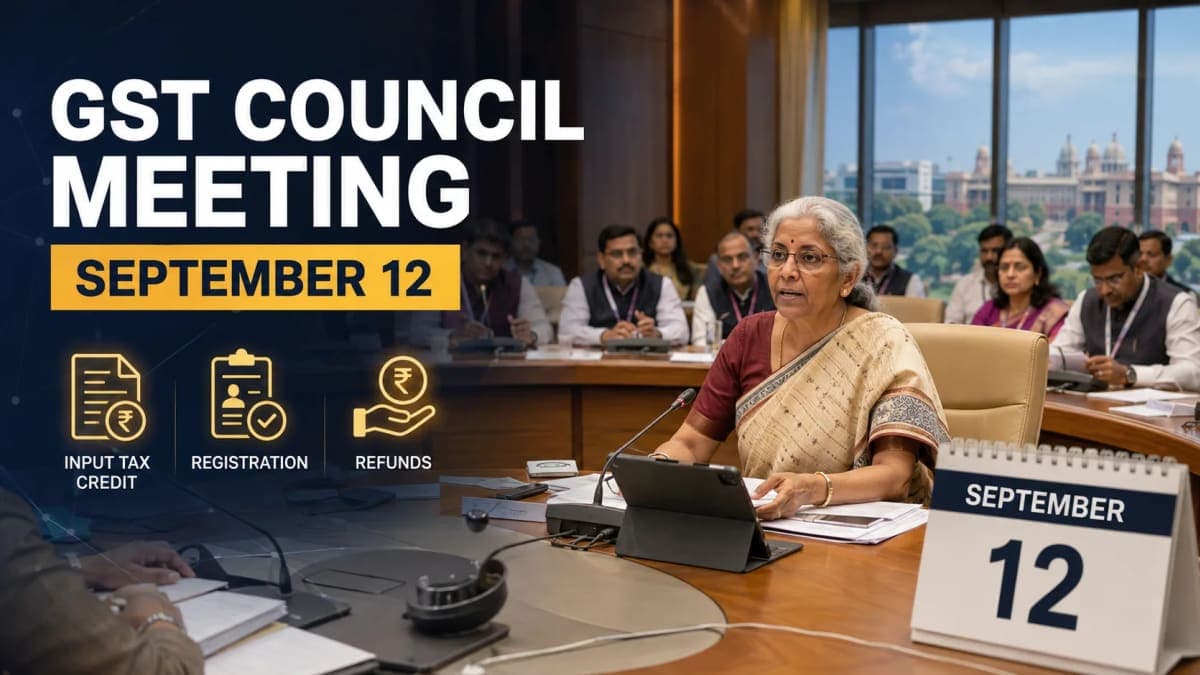
The Goods and Services Tax Council will hold its 57th meeting in New Delhi on September 12, 2026, bringing the Centre and states together to consider the next stage of reforms to India’s indirect-tax system.
The main Council meeting will be preceded by an officers’ meeting on September 11, according to an office memorandum issued by the GST Council Secretariat on August 28.
Union Finance Minister Nirmala Sitharaman will chair the meeting, which will include finance ministers or other representatives from the states and Union Territories.
Although the formal agenda had not been publicly released when the meeting was announced, reports indicate that blocked input tax credit, refund procedures, corporate guarantees, GST registration and cancellation processes are likely to receive attention.
57th GST Council Meeting Comes After a Long Gap
The upcoming meeting will be the Council’s first in approximately a year. Its previous session, held in September 2025, approved a major restructuring of GST rates and procedural rules.
The revised system replaced the earlier four principal slabs of 5%, 12%, 18% and 28% with a two-rate structure of 5% and 18%. A separate 40% rate was retained for specified ultra-luxury and demerit goods.
The September meeting is therefore expected to examine implementation issues that have emerged following those changes, alongside unresolved compliance and tax-credit concerns.
The gap between meetings has increased expectations among businesses, tax practitioners and state governments. However, proposals reported ahead of the session should not be treated as final decisions until the Council formally approves and announces them.
Blocked Input Tax Credit May Be Reviewed
One of the issues likely to be discussed is the restriction on input tax credit under Section 17(5) of the Central Goods and Services Tax Act.
The input tax credit mechanism allows registered businesses to offset the GST paid on eligible purchases against the tax collected on their sales. It is central to GST’s objective of preventing repeated taxation at multiple stages of the supply chain.
Section 17(5), however, blocks credit for specified categories of goods and services, subject to certain exceptions. These include some motor vehicles, food and beverages, outdoor catering, health and beauty services, club memberships and employee travel benefits.
Industry groups have frequently argued that some of these restrictions increase operating expenses and weaken the seamless-credit principle underlying GST. Any relaxation could improve working capital for eligible businesses, but it could also reduce government revenue.
The Council will consequently need to balance tax simplicity and business costs against the possibility of inappropriate or difficult-to-verify credit claims.
Refund and Unutilised Credit Rules Could Change
Reforms concerning refunds and the transfer of unutilised input tax credit are also expected to be examined.
Businesses can accumulate credit when the GST paid on their inputs exceeds their immediate tax liability. Delayed or restricted access to this amount can tie up working capital, especially for exporters and sectors affected by an inverted duty structure.
A clearer or faster refund system could improve liquidity and reduce the cost of compliance. At the same time, authorities remain concerned about fraudulent invoices and refund claims, making verification an important part of any simplified process.
The usefulness of a reform will depend not only on the legal provision but also on whether the GST technology platform and tax departments can implement it consistently.
Corporate Guarantee Taxation May Be Simplified
The GST treatment of corporate guarantees is another issue likely to appear before the Council.
A corporate guarantee is commonly provided by a parent company or another group entity to support the borrowing of a related business. Determining the taxable value of such a service can become complicated when no direct payment is made between the companies.
Businesses have sought greater clarity and simpler valuation rules because inconsistent interpretations can create disputes and additional compliance costs.
Uniform guidance could reduce uncertainty for corporate groups. Any revised rule, however, would need to distinguish legitimate commercial arrangements from structures designed primarily to reduce tax liability.
Registration Reforms Expected to Receive Attention
The Council may consider simplifying GST registration for businesses that transfer input tax credit exceeding ₹2.5 lakh per month.
Reports suggest that registration practices for such applicants are not uniform across central and state tax formations. Different documentation and verification requirements can lead to uncertainty, delays and inconsistent treatment.
A common registration procedure could make it easier for businesses operating across jurisdictions. The Council may also examine whether smaller businesses should receive a more convenient route to registration in multiple states.
Under GST, a company may require separate registrations in different states where it conducts taxable operations. Managing several registrations can increase the burden of filing returns, maintaining records and responding to tax authorities.
Simplification could help expanding small businesses, although policymakers must ensure that easier registration does not create additional opportunities for fake firms and fraudulent credit claims.
Automated Registration Cancellation May Be Discussed
Changes to GST registration cancellation procedures are also reportedly under consideration.
Automation could speed up straightforward cases in which a taxpayer has closed operations, no longer requires registration or meets clearly defined cancellation conditions. It could also reduce the administrative workload faced by tax departments.
Nevertheless, excessive reliance on automated decision-making can create problems when data is incomplete or a business requires an opportunity to explain unusual activity. Any automated system should include transparent notices, reasonable response periods and an accessible review process.
Transition Issues After GST Rate Restructuring
The Council is also expected to examine operational questions arising from the 2025 GST overhaul.
Businesses holding older inventory may face uncertainty when tax rates or compensation-cess arrangements change between the date of purchase and the date of sale. The automobile sector is one area where transitional treatment has reportedly attracted attention.
Clear rules are necessary to prevent companies from facing unexpected tax costs or obtaining duplicate benefits. Transitional provisions also need to be simple enough for tax officers and businesses to apply consistently.
GST Appellate Tribunal May Come Under Review
The Council could take stock of the implementation and functioning of the Goods and Services Tax Appellate Tribunal.
A functioning tribunal system is important because taxpayers need an independent forum to challenge disputed tax demands without immediately approaching constitutional courts.
Delays in establishing tribunal benches have contributed to a backlog of unresolved disputes. Reviewing their operational readiness could help strengthen the GST system’s dispute-resolution framework, though durable improvement will require sufficient members, infrastructure and consistent procedures.
Why the September 12 Meeting Matters
GST affects almost every organised business and a large share of goods and services consumed in India. Even procedural changes can influence company cash flows, product costs and the ease of operating across state borders.
The upcoming meeting matters for three main reasons:
It follows a major restructuring of GST rates.
It may address long-standing input tax credit and registration concerns.
It provides the Centre and states an opportunity to review implementation problems after a year-long gap.
For businesses, simpler rules could reduce paperwork and unlock working capital. For governments, however, the priority is to protect revenue and prevent fraud while making legitimate compliance easier.
Balanced Outlook: Announcements Will Need Effective Implementation
The proposals associated with the meeting could improve the GST regime, but their impact will depend on the details eventually approved.
A broader entitlement to input tax credit may reduce business costs, but poorly designed rules could increase questionable claims. Faster refunds may improve liquidity, but they require strong verification systems. Automated registration processes can reduce delays, but taxpayers must retain access to human review when errors occur.
The Council’s decisions also require coordination between central and state authorities. A reform announced nationally may deliver limited benefits if field-level implementation differs from one jurisdiction to another.
The September 12 meeting could mark an important step in improving GST after the 2025 rate changes. Its real success, however, will be measured by whether the decisions create predictable rules, quicker processes and uniform treatment for taxpayers.
This article is based on reporting published by The Economic Times.