India’s Industrial Growth Moderates in July
India’s industrial sector continued to expand in July 2026, although growth lost some momentum compared with the previous month.
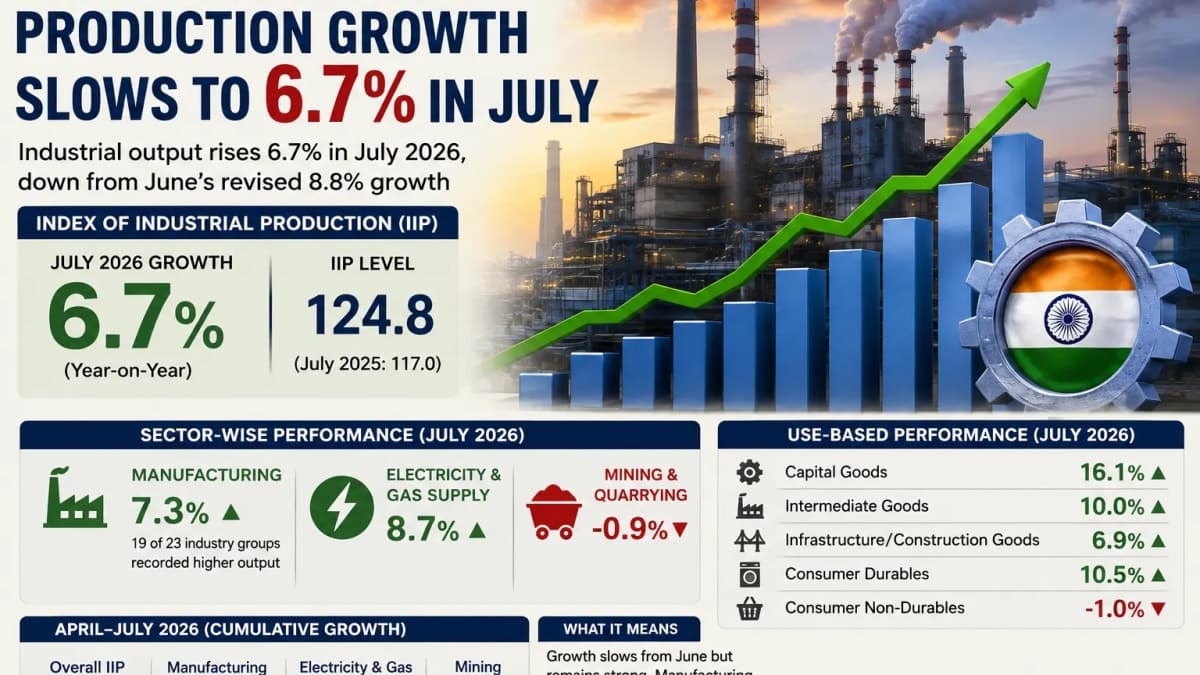
The Index of Industrial Production (IIP) increased 6.7% year-on-year in July, according to official data released by the Ministry of Statistics and Programme Implementation. The overall IIP stood at 124.8, compared with 117.0 in July 2025.
The July performance was weaker than June’s revised 8.8% expansion, highlighting a moderation in industrial momentum after a particularly strong previous month.
Despite the slowdown, the latest figures suggest that industrial activity remains on a relatively firm footing, with manufacturing and power-related production providing significant support.
Manufacturing Continues to Lead Industrial Expansion
Manufacturing, which carries the largest weight in the industrial production index, grew 7.3% year-on-year in July.
The strength was relatively broad-based, with 19 of the 23 manufacturing industry groups recording higher production compared with the same period a year earlier.
Some of the strongest-performing manufacturing segments included electrical equipment, which expanded 28.3%, motor vehicles, trailers and semi-trailers at 22.2%, and machinery and equipment at 12.1%.
These figures indicate that investment-linked and automobile-related industries remained important contributors to factory output.
Electricity Grows, but Mining Contracts
Electricity and gas supply provided another source of support, expanding 8.7% year-on-year during July.
Mining and quarrying, however, remained a weak spot. Output in the sector contracted 0.9% compared with July 2025.
The divergence is important because it shows that the headline industrial growth figure does not represent uniform strength across the economy. Manufacturing and electricity are expanding at healthy rates, but weakness in mining is limiting broader industrial momentum.
Capital Goods Output Jumps 16.1%
The use-based breakdown of the IIP provided encouraging signals for investment-oriented activity.
Capital goods production surged 16.1% year-on-year in July, making it one of the strongest categories. Intermediate goods output increased 10%, while infrastructure and construction goods rose 6.9%.
Consumer durables also performed strongly, registering growth of 10.5%.
Strong capital goods production can be particularly significant because the category includes machinery and equipment used to expand productive capacity. Sustained growth in this segment may therefore point toward continuing investment activity.
Consumer Non-Durables Remain a Concern
One weaker area was consumer non-durables, where production declined 1% year-on-year.
This category includes frequently purchased goods such as several food and everyday household products. Its contraction contrasts with the double-digit expansion in consumer durables.
The difference between the two consumer categories suggests that demand conditions remain uneven. Stronger production of durable products such as vehicles and electronics is encouraging, but weakness in everyday consumption-related goods deserves attention in the coming months.
April-July Industrial Growth Reaches 6.3%
Looking beyond a single month gives a more stable picture of India's industrial performance.
Industrial production expanded 6.3% during April-July 2026 compared with the corresponding period a year earlier. That was stronger than the 4% expansion recorded during the comparable period of the previous year.
Manufacturing grew 7% during April-July, while electricity and gas supply increased 8.7%. Mining, however, contracted 1.1% over the four-month period.
The cumulative figures suggest that the broader industrial trend remains positive despite July’s moderation.
Why the 6.7% IIP Growth Matters
Industrial production is an important indicator of activity across factories, mines, utilities and other production-linked sectors. Changes in the IIP can provide an early indication of underlying momentum in the broader economy.
July’s 6.7% expansion therefore sends a mixed but largely constructive signal.
On one hand, growth has slowed from June’s revised 8.8%, and mining as well as consumer non-durables remain areas of weakness. On the other hand, manufacturing continues to grow strongly, while capital goods, intermediate goods and consumer durables recorded healthy increases.
The strength in investment-oriented categories is particularly important because it can indicate businesses are continuing to purchase equipment and expand capacity.
Balanced Outlook: Slowdown Does Not Necessarily Signal Weakness
A decline in the growth rate from one month to another should not automatically be interpreted as an industrial downturn.
At 6.7%, July industrial production was still substantially higher than a year earlier, while cumulative April-July growth remained healthy.
Moreover, June's industrial growth was revised upward from the initially reported 7.3% to 8.8%, making July’s sequential moderation appear sharper.
The key question is whether manufacturing and investment-related industries can maintain their momentum while weaker areas recover.
If capital goods, automobiles, electrical equipment and infrastructure-related production remain strong, they could continue to support India's industrial expansion. Persistent weakness in mining or consumer non-durables, however, could create a drag on the headline numbers.
The next several IIP releases will therefore be important in determining whether July represents a normal moderation after a strong June or the beginning of a broader cooling in industrial activity.
This article is based on reporting published by Reuters.