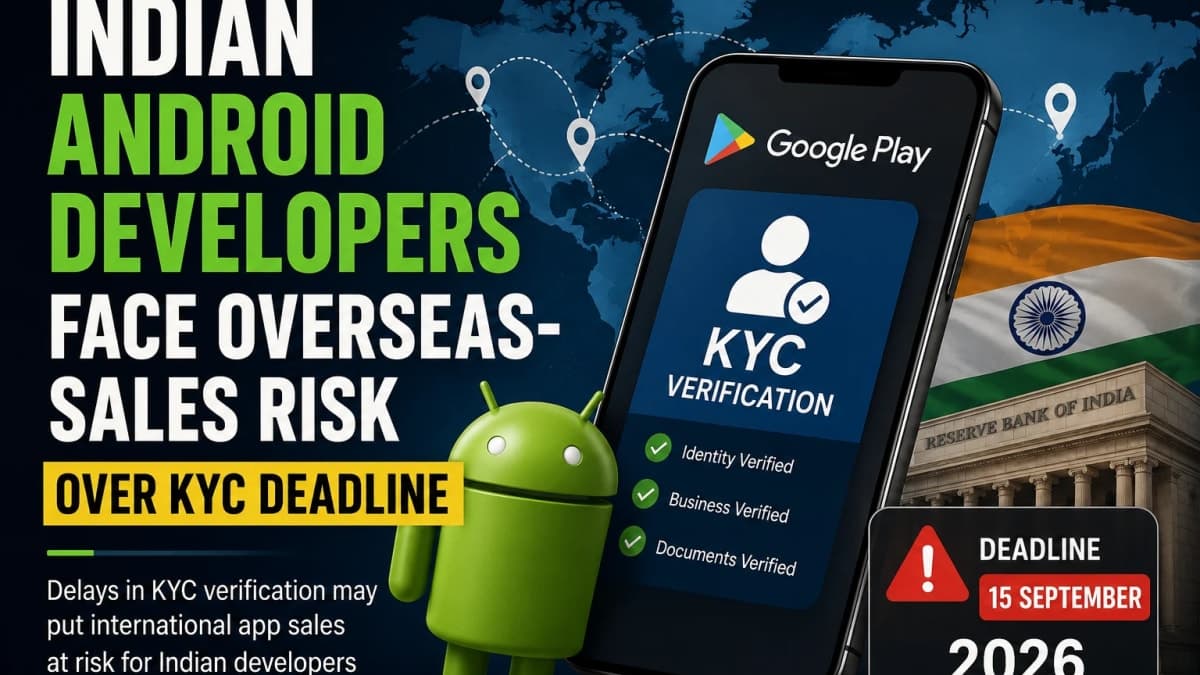
Indian Developers Confront a New Cross-Border Compliance Challenge
Indian Android developers who earn money from customers outside the country are facing a potentially significant disruption as a merchant-verification deadline draws closer.
Google Play introduced a Know Your Customer, or KYC, requirement for Indian developers receiving international payments as part of changes connected with the Reserve Bank of India’s Payment Aggregator–Cross Border framework. Google partnered with payment company BillDesk to conduct merchant verification and process payments under the regulatory structure.
The compliance exercise has become a concern for some developers because verification is not necessarily an immediate process. Developers cited in recent reporting say some applications have remained unresolved for months, creating uncertainty about whether they will be fully verified before the regulatory deadline.
September 15 Deadline Raises the Stakes
The RBI’s updated payment-aggregator framework formally covers cross-border payment aggregators and requires verification of existing merchants. According to reporting on the issue, payment aggregators face a September 15, 2026 deadline to complete full KYC of existing merchants.
For Indian Android businesses selling paid applications, subscriptions or in-app products internationally, failure to complete the process could have commercial consequences.
The concern is particularly important because developers are not simply dealing with a routine account update. Their ability to continue receiving payments linked to overseas transactions could depend on successfully completing the required verification.
Developers Report Lengthy Verification Delays
Google required affected developers to begin verifying their merchant accounts through BillDesk from January 1, 2026. Some developers have reportedly spent six to eight months attempting to complete the process, highlighting the operational bottleneck surrounding the transition.
KYC checks can require developers and companies to establish their legal and business identities through supporting documentation. This can become more complicated when company records, ownership information, payment profiles or other business details need clarification.
Google separately requires developers monetising through Google Play to maintain appropriate merchant and payments profiles, while organizational developer accounts are subject to identity and business-information verification requirements.
Why Overseas Sales Matter to Indian App Developers
International distribution has allowed Indian software companies and independent developers to build businesses without relying exclusively on domestic customers.
A developer operating from India can publish an application globally and generate income through paid downloads, subscriptions and in-app purchases across multiple markets. That makes reliable cross-border payment infrastructure an important part of the app economy.
Consequently, even a temporary interruption in overseas monetisation could affect cash flow for developers whose international customers represent a meaningful share of revenue.
Small studios and independent developers may be particularly exposed because they generally have fewer financial and compliance resources than large technology companies.
Why the KYC Rules Exist
The regulatory changes also have a broader purpose.
India’s Payment Aggregator–Cross Border framework is designed to bring greater oversight and standardisation to companies facilitating international payments. Stronger merchant identification can improve transaction traceability and help payment providers meet regulatory obligations.
From that perspective, merchant verification is part of a wider effort to create a more accountable cross-border payments system rather than a measure specifically aimed at Android developers.
The challenge is therefore less about whether verification should exist and more about whether the ecosystem can complete it efficiently without unnecessarily interrupting legitimate businesses.
Compliance Benefits Versus Short-Term Disruption
The situation presents two competing considerations.
Stronger KYC procedures can make cross-border payment systems more transparent and reduce the risks associated with poorly identified merchants. Clear verification standards can also give payment providers and regulators greater confidence about businesses receiving international funds.
At the same time, a compliance framework can create unintended economic costs if legitimate merchants cannot complete verification because of processing delays or documentation problems.
For an app developer, missing international sales for even a limited period can mean more than lost purchases. It can affect advertising budgets, cloud-service expenses, salaries and investment in future products.
What the Deadline Means for India's App Economy
The issue highlights how regulatory infrastructure has become increasingly important to India's digital-export economy.
Software distribution is global, but the money flowing back to developers still passes through national banking, tax and payment systems. A technical product can therefore reach millions of international users while its commercial viability remains dependent on domestic compliance processes.
The coming weeks will show whether pending merchant verifications can be processed smoothly enough to prevent significant disruption.
For Indian Android developers still awaiting approval, the approaching September 15, 2026 KYC deadline is consequently more than an administrative date—it could determine whether their international revenue continues without interruption.
Balanced Analysis
The KYC requirement reflects a legitimate regulatory objective: improving accountability in India's rapidly expanding cross-border digital-payment ecosystem. Better merchant verification can strengthen transparency and create clearer compliance standards for businesses handling international transactions.
However, implementation will be crucial. If developers who have submitted legitimate documentation remain stuck in prolonged verification processes, the burden shifts from compliance to business continuity.
The most constructive outcome would combine rigorous verification with efficient processing and clear communication for merchants facing unresolved cases. Such an approach would protect the objectives of India's cross-border payment regulations while reducing unnecessary disruption for developers building global businesses from India.
For India's growing software-export ecosystem, resolving these verification bottlenecks will matter not only to individual Android developers but also to the country's ambition to enable digital businesses to compete internationally.
This article is based on reporting published by Moneycontrol.