InspeCity Raises ₹100 Crore to Accelerate In-Space Satellite Servicing Ambitions
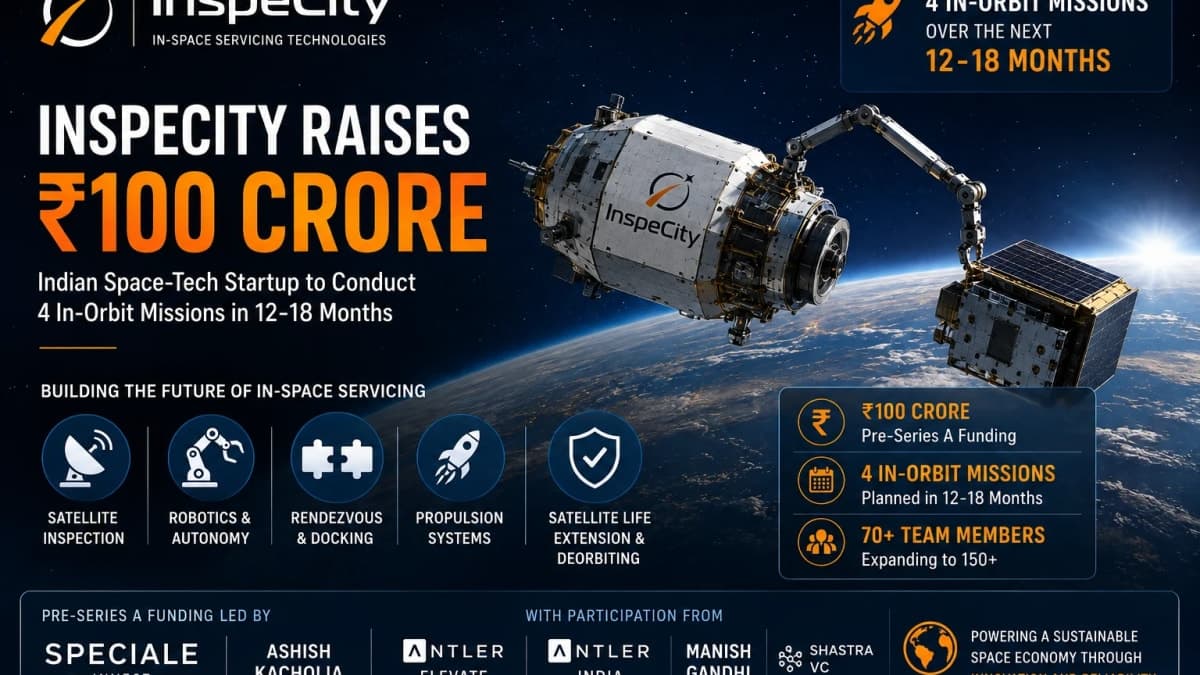
India’s private space technology ecosystem continues to expand beyond satellite manufacturing and launch services. In a significant development for the emerging in-space servicing segment, Indian space-tech startup InspeCity has raised ₹100 crore, or approximately $10.5 million, in a Pre-Series A funding round.
The funding round was led by Speciale Invest and investor Ashish Kacholia, with participation from investors including Antler Elevate, Antler India, Manish Gandhi, and Shastra VC.
The fresh capital gives InspeCity additional resources as it moves from developing and testing technologies on the ground toward demonstrating them in actual space environments.
InspeCity Plans Four In-Orbit Missions
One of the most important parts of InspeCity’s expansion strategy is its plan to conduct four in-orbit missions over the next 12 to 18 months.
These missions are expected to progressively demonstrate different technologies being developed by the company.
The areas of focus include propulsion, sensing, autonomous operations, robotics, rendezvous, and docking capabilities.
InspeCity is working on technologies associated with platforms including RIG, VEDA, and SAMA, which form part of its broader ambition to develop advanced in-space servicing capabilities.
Successfully demonstrating these systems in orbit will be particularly important. A technology that performs well during laboratory or ground testing still has to prove that it can operate reliably in the challenging conditions of space.
What Does InspeCity Do?
Founded in 2022, InspeCity is developing technology focused primarily on in-space servicing.
In simple terms, the company wants to develop systems that could enable spacecraft to approach satellites already operating in orbit and perform different types of services.
These capabilities could eventually support satellite inspection, life extension, autonomous proximity operations, and controlled deorbiting.
The company is developing propulsion systems as well as technologies related to robotics and autonomous spacecraft operations.
One of its major platforms is VEDA — Vehicle for Life-Extension and Deorbiting Activities.
VEDA is being developed to support satellite life-extension and deorbiting activities while potentially laying the foundation for more advanced orbital servicing missions in the future.
Why Satellite Life Extension Matters
Building a satellite and launching it into orbit requires substantial investment.
However, the useful life of a satellite can sometimes be limited even when several of its important systems remain operational. Fuel limitations and other technical factors can eventually prevent an otherwise functional satellite from continuing its mission.
In-space servicing could potentially change that equation.
If another spacecraft can safely approach and service an existing satellite, operators may eventually be able to extend the satellite’s operational life instead of replacing it immediately.
This could offer significant economic benefits, particularly for expensive satellite assets.
Another important issue is space debris.
As the number of satellites in orbit increases, managing inactive spacecraft and other orbital objects is becoming an increasingly important challenge. Technologies capable of servicing or safely deorbiting satellites could therefore become strategically valuable to the global space industry.
How Will InspeCity Use the ₹100 Crore Funding?
The fresh ₹100 crore investment is expected to help InspeCity accelerate the transition of its technologies from development to real-world space demonstrations.
A major priority will be supporting the company’s upcoming in-orbit missions and flight qualification activities.
The funding is also expected to strengthen its engineering and mission capabilities while supporting team expansion.
InspeCity currently has a workforce of around 70 people and reportedly plans to more than double the size of its team.
The company has also worked on projects connected with the Indian government’s Innovations for Defence Excellence (iDEX) initiative.
Why This Funding Matters for India’s Space-Tech Industry
India’s private space sector is entering a new phase.
The first wave of private-sector activity largely focused on areas such as satellite manufacturing, launch vehicles, and associated infrastructure. The ecosystem is now expanding into increasingly sophisticated areas, including propulsion, space robotics, autonomous spacecraft operations, and satellite servicing.
InspeCity’s latest funding round reflects that shift.
If the company successfully demonstrates its technologies in orbit, it could strengthen India’s position in the emerging international market for in-space servicing.
The development is also significant because satellite servicing represents a technically demanding segment of the space economy where relatively few companies globally have demonstrated mature commercial capabilities.
Major Challenges Remain
Raising ₹100 crore gives InspeCity additional financial resources, but funding alone does not guarantee success in the space industry.
Orbital servicing involves significant technological complexity.
A servicing spacecraft must be capable of accurately navigating toward another object in orbit, understanding its relative position, operating autonomously at close distances, and potentially performing docking or robotic operations.
Even small errors can have major consequences.
Mission costs, launch schedules, regulatory requirements, hardware reliability, and the possibility of technical failure also remain important risks.
For this reason, InspeCity’s planned four in-orbit missions will be crucial.
Successful demonstrations could help the company validate its technology, attract potential commercial customers, and strengthen its position for future funding rounds.
What Comes Next for InspeCity?
The next 12 to 18 months could be a defining period for InspeCity.
The startup is attempting to move beyond individual ground-tested technologies and demonstrate increasingly integrated systems in space.
The ₹100 crore funding provides the financial support required to accelerate that journey. However, the next major milestone will be proving that its technology works reliably in orbit.
If InspeCity can successfully execute its planned missions, the company could emerge as an important participant in India’s growing private space economy while helping the country build capabilities in the emerging field of satellite servicing and life extension.
This article is based on reporting published by The Economic Times.