Indian Startups Secure Nearly $198 Million in Weekly Funding
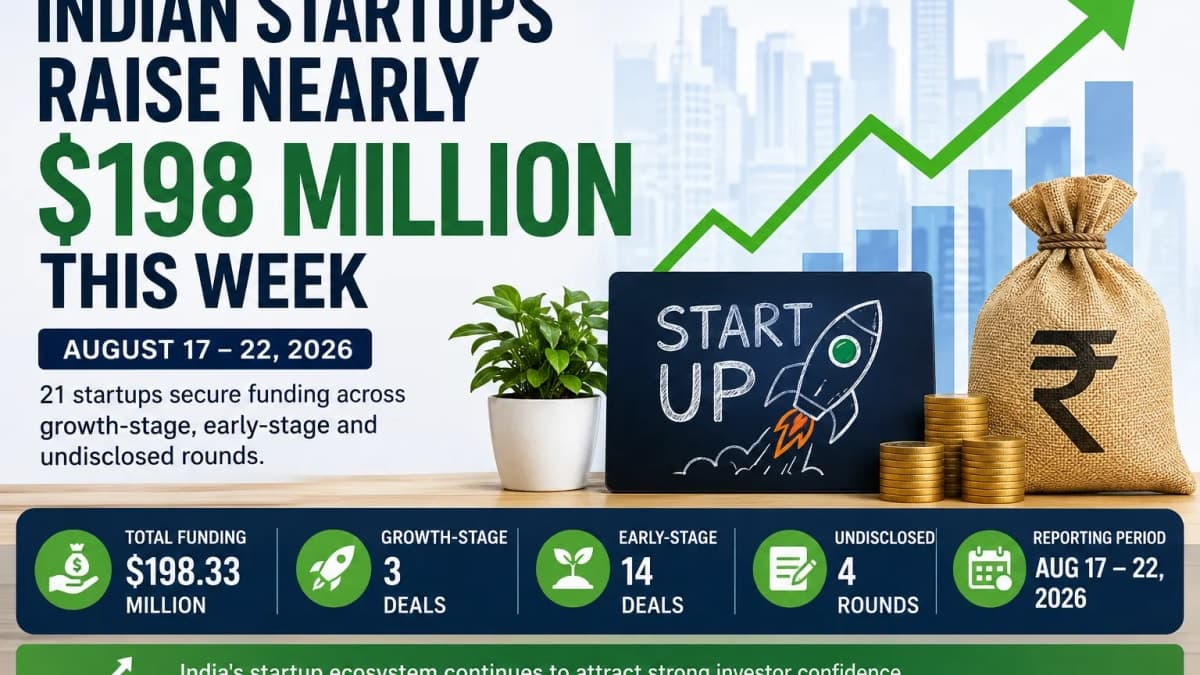
India’s startup funding landscape remained active this week as homegrown companies collectively secured nearly $198 million in fresh capital.
The latest funding activity provides another indication that investors continue to explore opportunities across India’s entrepreneurial ecosystem. Capital flowed into businesses at different stages of development, demonstrating that funding interest is not restricted only to mature startups.
While weekly investment totals can fluctuate considerably depending on the timing and size of individual deals, raising close to $200 million in a single week represents meaningful capital deployment into the startup market.
Investor Interest in Indian Startups Continues
India has developed into one of the world’s largest startup ecosystems, supported by a growing digital economy, expanding consumer markets, technological adoption and an increasing pool of entrepreneurs.
Funding remains a critical component of that ecosystem. For younger startups, fresh investment can help finance product development, technology infrastructure, hiring and early customer acquisition. More established companies can use additional capital to expand operations, enter new markets or strengthen existing business segments.
The nearly $198 million raised during the week therefore represents more than a headline funding figure. It also illustrates the continued willingness of investors to evaluate opportunities within India’s innovation economy.
Early-Stage Funding Remains Important
Large investment rounds typically receive the most attention, but early-stage funding plays an equally important role in maintaining a healthy startup ecosystem.
Young companies often require external capital before they can generate enough revenue to finance expansion independently. Seed and early-stage investors accept greater uncertainty in exchange for the possibility of backing businesses that could eventually become major companies.
Continued investment at this level can also encourage new entrepreneurs to develop products in emerging areas such as artificial intelligence, financial technology, software, consumer technology, mobility and deep tech.
What the $198 Million Funding Figure Indicates
Weekly funding numbers should be considered a snapshot rather than a definitive measure of the overall health of the startup industry.
A particularly large investment in one company can significantly increase the total for a given week. Similarly, a quieter week does not necessarily indicate declining investor confidence because several major transactions may simply be announced later.
For this reason, longer-term indicators—including the number of deals, diversity of funded sectors, follow-on investment activity, startup revenues and successful exits—provide a broader picture of ecosystem strength.
Nevertheless, nearly $198 million flowing into Indian startups within a week demonstrates that meaningful investment activity remains present.
Why the Funding Matters for India
Startup investment can have an impact beyond the companies receiving the money. Well-funded businesses can hire employees, purchase services from other companies, invest in research and development and introduce new products into the market.
Successful startups can also attract additional domestic and international investors to the country.
India’s large consumer base, rapidly developing digital infrastructure and expanding technology talent pool have helped create opportunities for companies attempting to build businesses at significant scale.
However, investors have also become increasingly focused on financial discipline. Growth alone may no longer be sufficient for many companies seeking capital. Sustainable revenue, realistic valuations, strong governance and a credible route toward profitability are becoming increasingly important considerations.
Balanced Analysis: Funding Is Positive, but Execution Matters
The nearly $198 million weekly funding total is an encouraging development, but investment raised should not automatically be interpreted as business success.
Funding provides companies with resources; how effectively those resources are deployed ultimately determines their long-term prospects.
Startups still face challenges including intense competition, customer acquisition costs, regulatory uncertainty, pressure on valuations and the need to demonstrate sustainable business models.
Investors, meanwhile, must balance the potential for rapid growth against the risks associated with young and evolving companies.
Therefore, the more important question will be whether funded startups can convert fresh capital into sustainable revenue, stronger operations and long-term value.
Outlook for India's Startup Ecosystem
India's startup ecosystem continues to evolve from an era dominated by aggressive expansion toward an environment where growth and financial sustainability increasingly need to coexist.
If investment activity remains broad across early-stage and growing companies, entrepreneurs could continue to find opportunities to finance innovative ideas. At the same time, greater scrutiny from investors could encourage stronger corporate governance and more disciplined business models.
The nearly $198 million raised this week offers another snapshot of that evolving market—one where capital remains available, but competition for quality investment is likely to remain intense.
This article is based on reporting published by EN Entrackr.