India’s D2C Story Is Moving Beyond Its Early Startup Boom
India’s direct-to-consumer sector is entering a different stage of development.
The first major wave of D2C startups was built around a relatively simple proposition: use digital platforms to reach consumers directly, build recognizable brands online and reduce dependence on traditional retail distribution.
That strategy helped create a new generation of Indian consumer companies across beauty, personal care, fashion, food, wellness, electronics and home products.
But the sector is evolving.
For many established D2C companies, the central question is no longer whether an online-first brand can attract customers. The bigger challenge is whether those customers can be acquired profitably, retained over time and served through a business capable of expanding beyond its original digital niche.
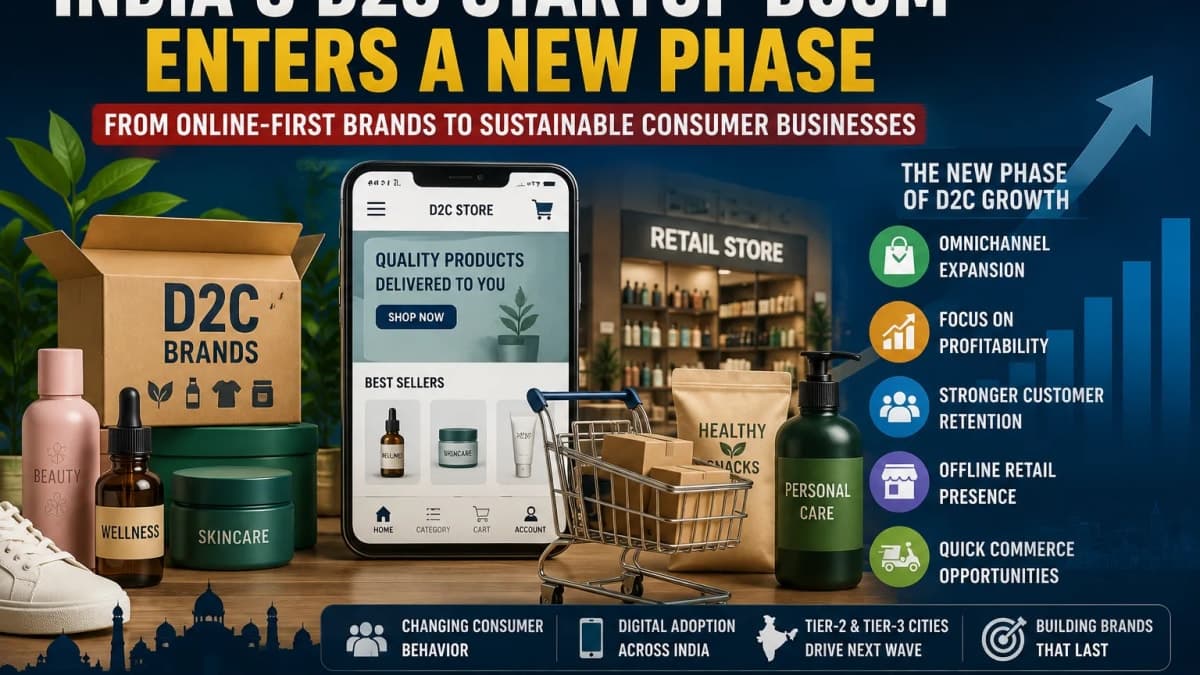
The result is a transition from the D2C startup boom to a broader omnichannel consumer-brand race.
From Digital-First Brands to Omnichannel Businesses
One of the biggest changes is the growing importance of offline distribution.
Early D2C companies could differentiate themselves by selling primarily through their own websites, social media campaigns and major e-commerce marketplaces. That gave startups a way to reach consumers without first establishing large distributor and retail networks.
But digital reach has limitations.
Physical stores, supermarkets, pharmacies, shopping centres and other offline channels can expose brands to consumers who may never discover them through online advertising.
For companies attempting to become national consumer brands, offline expansion can therefore become a logical next step.
The transition also changes the meaning of "D2C." A company may begin by selling directly to consumers online but eventually develop into an omnichannel business operating across websites, marketplaces and physical retail.
Profitability Is Becoming More Important
The changing funding environment has also altered the priorities of India's startup ecosystem.
During periods when capital was readily available, startups could justify substantial expenditure on advertising, discounts and customer acquisition in pursuit of rapid growth.
That approach becomes harder to sustain when investors demand clearer evidence of viable economics.
D2C companies consequently face pressure to demonstrate that revenue growth can eventually translate into durable profits.
Marketing expenditure, gross margins, repeat purchases, inventory management, logistics and customer acquisition costs all become increasingly important.
A company generating impressive sales but spending excessively to attract every new buyer may be less attractive than a slower-growing competitor with stronger margins and customer loyalty.
Customer Acquisition Has Become a Crucial Challenge
Digital advertising was one of the forces that enabled India's D2C revolution. It also created a significant vulnerability.
As more brands compete for the same consumers across search engines, social platforms, influencers and marketplaces, gaining attention becomes increasingly expensive.
That means companies cannot rely indefinitely on paid advertising.
Strong D2C businesses increasingly need customers who return voluntarily, recommend products to others or recognize the brand when shopping through another channel.
This makes retention particularly valuable.
A customer who makes several purchases can generate significantly better economics than one who buys once after seeing an expensive advertisement.
The next phase of India's D2C sector may therefore reward brand loyalty rather than simply online visibility.
Established D2C Success Stories Changed the Market
India has already produced several prominent digital-first consumer businesses.
Companies such as Mamaearth parent Honasa Consumer, boAt, Lenskart, Sugar Cosmetics, Wakefit and others helped demonstrate that new-age Indian brands could build substantial consumer recognition without following the traditional FMCG playbook from the beginning.
Their journeys have also highlighted different paths available to D2C businesses.
Some companies have moved aggressively into offline retail. Others have expanded their product portfolios, entered new categories or built distribution networks extending far beyond their original websites.
These examples helped make D2C one of the most competitive segments of India's startup economy.
Traditional Consumer Giants Are Fighting Back
D2C startups are no longer competing only with one another.
Large established consumer companies have responded to changing shopping habits by strengthening their digital operations, launching new brands and acquiring stakes in emerging consumer businesses.
This creates a more difficult competitive environment for startups.
Traditional FMCG and retail companies already possess advantages that can take younger companies years to build: extensive distribution networks, retailer relationships, manufacturing capabilities, procurement scale and large advertising budgets.
D2C startups, meanwhile, can have advantages in speed, branding, product experimentation and access to younger digital consumers.
The battle is increasingly about which model can combine the best elements of both.
Consolidation Could Define the Next Phase
As the market matures, consolidation is likely to become an increasingly important theme.
Not every consumer startup needs to become an independent billion-dollar company.
Some businesses may find stronger opportunities by becoming part of larger consumer groups. Established corporations can acquire younger brands to gain access to fast-growing categories, digital expertise or younger audiences.
For founders and investors, acquisitions can also provide an alternative exit route when an IPO or independent expansion is unrealistic.
The result could be a market where fewer brands reach very large scale independently while successful niche companies become attractive acquisition targets.
Quick-Commerce Creates a New Opportunity
Another major development in India's consumer market is the rapid expansion of quick commerce.
Platforms promising deliveries within minutes have created another route for consumer brands to reach urban customers.
For D2C companies, quick commerce can provide something particularly valuable: immediate product discovery combined with fast fulfilment.
A consumer who previously needed to search for a brand online or wait for conventional e-commerce delivery may now encounter the same product while ordering everyday essentials.
But this channel creates new competitive pressures as well.
Shelf space inside a digital quick-commerce catalogue can be limited, and brands must compete intensely for visibility. Pricing, availability and inventory management therefore remain critical.
India's Smaller Cities Could Drive the Next Growth Wave
India's D2C opportunity is not limited to Delhi, Mumbai, Bengaluru and other major metropolitan markets.
Improving digital payments, widespread smartphone adoption and expanding logistics networks have opened online commerce to consumers across Tier-2 and Tier-3 cities.
For consumer startups, this represents an enormous potential market.
But smaller-city expansion requires more than simply running national advertising campaigns.
Purchasing power, language, product preferences, delivery economics and brand awareness can differ substantially across regions.
Companies capable of adapting their products and marketing while maintaining efficient distribution could gain an important advantage.
Why This New Phase Matters for India's Startup Ecosystem
The evolution of D2C businesses represents something larger than a change in online shopping.
It is testing whether India's startup ecosystem can build enduring consumer institutions.
Creating a fashionable online brand can happen relatively quickly. Building a company that survives changing consumer preferences, economic cycles and competition for decades is substantially harder.
The brands that succeed in this next stage will need to combine startup-style experimentation with traditional consumer-business fundamentals.
That means disciplined inventory management, reliable supply chains, sensible pricing, strong gross margins and repeat customers will matter alongside social-media engagement and branding.
Investors May Become More Selective
Capital is unlikely to disappear from the consumer-startup sector, but the criteria for attracting it are changing.
Investors can increasingly differentiate between businesses that merely generate online sales and companies capable of building lasting consumer franchises.
Metrics such as repeat purchase rates, contribution margins, customer acquisition costs and offline productivity can therefore receive greater scrutiny.
A compelling brand story still matters.
But financial discipline is becoming just as important.
This could ultimately strengthen the ecosystem by directing capital toward companies with healthier underlying businesses rather than rewarding growth at almost any cost.
The Opportunity Remains Enormous
Despite these challenges, the long-term opportunity remains substantial.
India combines a huge consumer population with rising incomes, increasing digital adoption and rapidly changing purchasing habits.
Young consumers are also often willing to experiment with brands outside the country's traditional consumer giants.
That creates room for entrepreneurs to identify underserved categories and build products for specific audiences.
The difference is that simply being "D2C" is no longer enough to guarantee attention.
The next generation of winners will need genuine product differentiation, efficient operations and strong brand loyalty.
From D2C Startups to Consumer Companies
Perhaps the clearest indication that India's D2C boom is maturing is that its most ambitious companies increasingly cannot remain purely D2C.
As businesses scale, they are becoming consumer companies that happen to have digital origins.
Websites, marketplaces, quick-commerce apps, physical stores and traditional retail can all become parts of the same distribution strategy.
That evolution does not signal the end of India's D2C story.
Instead, it suggests the sector is entering a more demanding chapter.
The first phase proved that Indian entrepreneurs could create brands through the internet. The next phase will determine which of those brands can turn early digital success into sustainable businesses capable of competing for Indian consumers for many years.
This article is based on reporting published by The Economic Times.