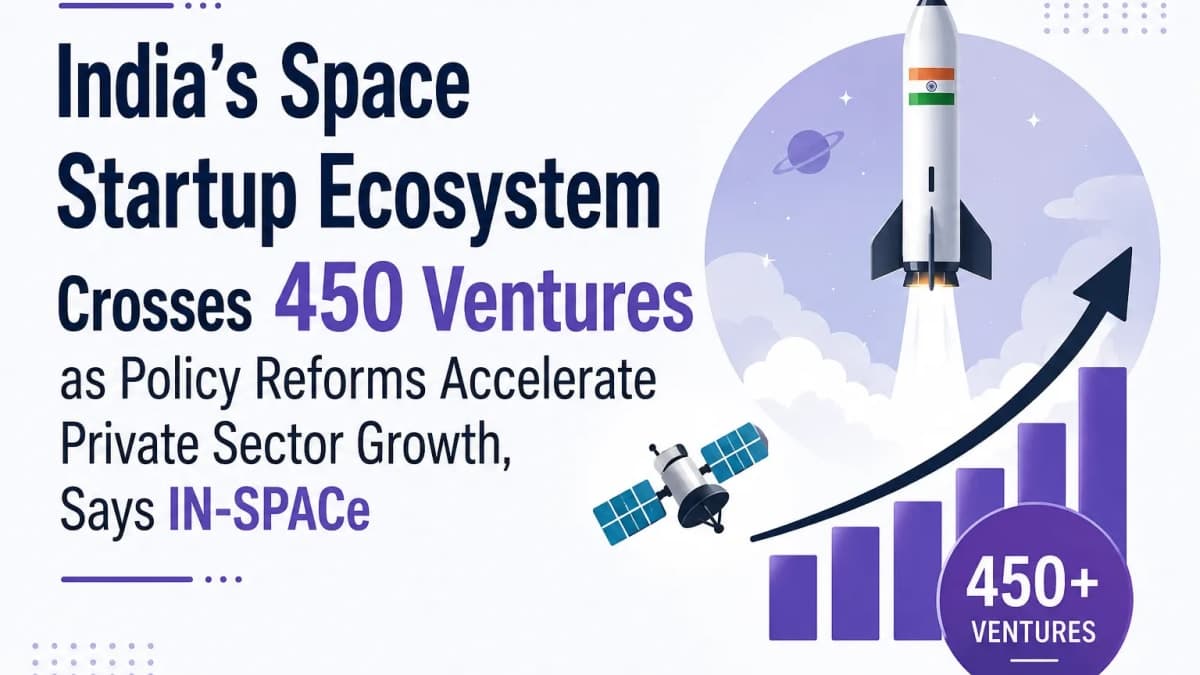
India’s Space Startup Ecosystem Crosses 450 Ventures as Policy Reforms Accelerate Private Sector Growth
India's Space Industry Enters a New Phase of Expansion
India's space technology ecosystem is experiencing remarkable momentum, with more than 450 startups now operating across various segments of the industry. According to the Director of the Indian National Space Promotion and Authorization Center (IN-SPACe), recent policy reforms have played a crucial role in encouraging private companies to enter the country's rapidly evolving space sector.
The milestone reflects how India's once government-dominated space industry is steadily transforming into a collaborative ecosystem where startups, private enterprises, research institutions, and public agencies work together to develop innovative technologies and commercial space services.
Policy Changes Opened New Opportunities
The rapid increase in startups follows a series of reforms aimed at making India's space sector more accessible to private players.
Over the past few years, regulatory changes have simplified market access, encouraged entrepreneurship, and enabled startups to participate in satellite manufacturing, launch services, Earth observation, communication technologies, space applications, and downstream data solutions.
IN-SPACe has emerged as a key facilitator by supporting private participation while coordinating access to infrastructure, technical expertise, and regulatory approvals.
These measures have lowered entry barriers and encouraged entrepreneurs to explore commercial opportunities that were previously difficult to access.
Startups Expanding Across Multiple Space Segments
India's growing space startup ecosystem is no longer limited to launch vehicles.
Companies are now developing:
Small satellite technologies
Satellite communication solutions
Earth observation platforms
Space-based analytics
Navigation applications
Launch systems
Space manufacturing technologies
AI-driven geospatial services
Defense and strategic space applications
This diversification demonstrates the maturity of India's emerging commercial space ecosystem.
Government Support Strengthening Innovation
Industry experts believe that consistent government support has significantly improved investor confidence.
Beyond regulatory reforms, startups have benefited from improved access to testing facilities, incubation programs, research partnerships, and collaboration opportunities with established space organizations.
These initiatives have encouraged domestic innovation while helping attract venture capital and strategic investments into India's growing space economy.
Global Space Economy Creates New Opportunities
The international space economy continues to expand rapidly, creating fresh opportunities for countries capable of delivering affordable and innovative space technologies.
India has increasingly positioned itself as a competitive destination thanks to its engineering talent, cost-efficient development capabilities, and successful record in satellite missions and launch services.
As commercial demand grows worldwide, Indian startups could find opportunities in satellite services, remote sensing, communications, climate monitoring, agriculture, logistics, and defense-related applications.
Why This Growth Matters
The expansion of India's space startup ecosystem represents more than an increase in company numbers.
A vibrant private space industry can contribute to:
High-skilled employment generation
Advanced manufacturing capabilities
Technology commercialization
Increased foreign investment
Export opportunities
National technological self-reliance
Stronger participation in the global space economy
The sector also encourages innovation that can benefit industries beyond aerospace, including telecommunications, agriculture, disaster management, transportation, and environmental monitoring.
Balanced Analysis
The rapid growth of startups highlights the effectiveness of recent policy reforms, but sustaining this momentum will require continued support.
Access to long-term funding, global market opportunities, skilled talent, regulatory clarity, and reliable commercialization pathways will remain critical challenges for emerging companies. Competition from established international space firms is also expected to intensify.
If policymakers, investors, and industry stakeholders continue working together, India's expanding startup ecosystem could become one of the country's strongest technology success stories over the coming decade.
Conclusion
With more than 450 startups now operating in the sector, India's commercial space industry has entered a period of accelerated growth. Backed by supportive policies and increasing private participation, the country's space ecosystem is steadily evolving into a globally competitive innovation hub capable of driving technological advancement, investment, and long-term economic growth.