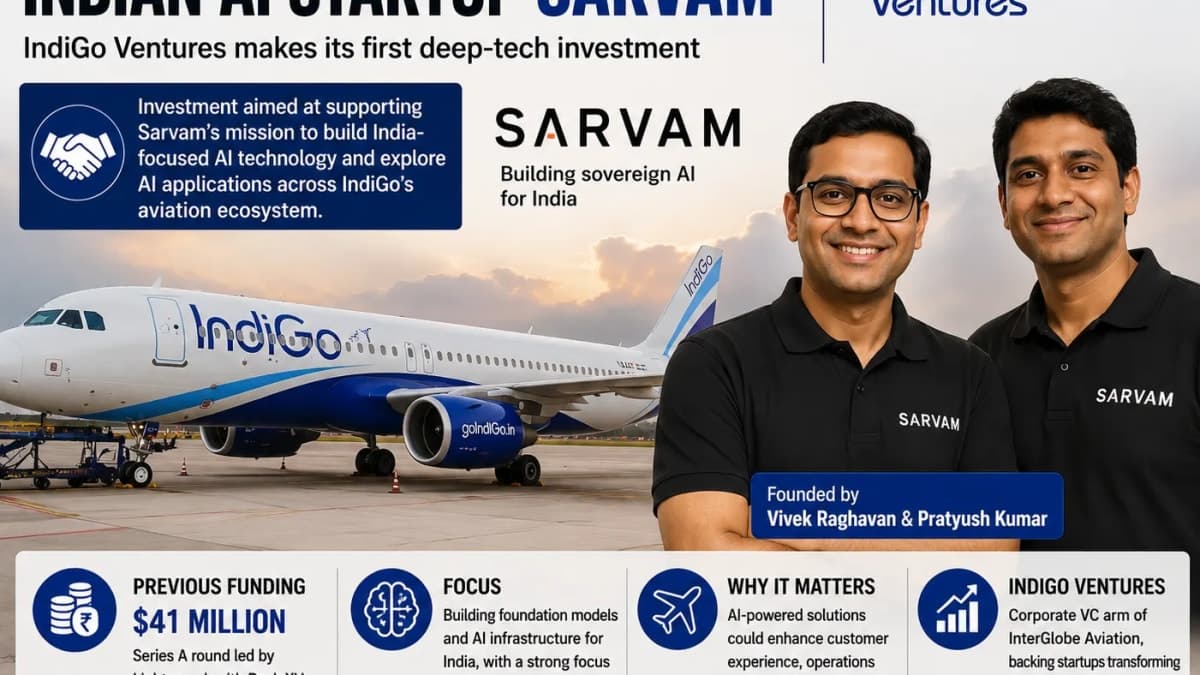
IndiGo Ventures Backs Indian AI Startup Sarvam, Marks First Deep-Tech Investment
NEW DELHI, August 31, 2026: IndiGo Ventures, the corporate venture capital arm backed by InterGlobe Aviation, has invested in Indian artificial intelligence startup Sarvam, marking the fund’s first investment in the deep-tech sector.
The investment is aimed at supporting Sarvam’s development of India-focused artificial intelligence technology while creating opportunities to explore AI applications within IndiGo’s aviation ecosystem.
For India’s largest airline by domestic market share, the deal represents more than a conventional startup investment. It potentially gives IndiGo access to homegrown AI capabilities that could eventually be applied across customer interactions, operational processes and other parts of the aviation business.
For Sarvam, the investment adds a major strategic corporate partner as it works to build AI models and infrastructure designed for Indian languages and use cases.
IndiGo Ventures Makes Its First Deep-Tech Bet
IndiGo Ventures said its investment in Sarvam represents the fund’s entry into deep technology.
The fund has been established to invest in early-stage companies working in areas that can potentially complement or transform aviation, travel and related sectors.
Sarvam fits that strategy differently from a traditional travel startup.
Instead of offering an airline-specific product, the Bengaluru-based company is developing foundational AI technology that could potentially support multiple applications across large enterprises.
The partnership therefore gives IndiGo an opportunity to explore AI closer to the technology layer rather than relying exclusively on finished software products built by third parties.
Sarvam Is Building AI for India
Sarvam has positioned itself as a full-stack sovereign AI company focused on building artificial intelligence infrastructure for India.
A central part of its strategy involves developing models capable of handling India's linguistic diversity.
That matters because many leading global AI systems were initially developed primarily around English and other widely represented languages. Building systems designed for Indian languages can potentially improve how AI is deployed across customer service, government services, education and enterprise applications.
Sarvam's work spans foundation models, language technology and enterprise AI infrastructure.
The startup was founded by Vivek Raghavan and Pratyush Kumar, both of whom have backgrounds in building language-focused AI systems.
Why Sarvam Could Matter to IndiGo
The strategic logic becomes clearer when viewed through the scale of an airline operation.
Airlines generate enormous volumes of customer and operational interactions every day. These range from booking enquiries and flight-status questions to disruption management, baggage issues and internal workflows.
AI systems capable of understanding multiple Indian languages could eventually help airlines communicate with passengers in a more natural and accessible manner.
Potential applications could include conversational customer assistance, multilingual support, employee tools, automated information retrieval and operational decision support.
However, these should be treated as potential applications rather than confirmed deployments unless specifically announced by IndiGo or Sarvam.
The investment establishes a strategic relationship; it does not mean every possible AI use case has already been implemented across IndiGo.
IndiGo Sees AI as Part of Aviation’s Future
The investment reflects a broader shift across global aviation.
Airlines are increasingly examining how artificial intelligence can improve customer service, forecasting, scheduling, maintenance planning and internal productivity.
India creates a particularly interesting environment for such technology because airlines serve passengers across a large number of cities, languages and customer segments.
A domestic AI platform designed around Indian linguistic and cultural contexts could therefore offer different advantages from a generic global system.
For IndiGo, investing directly in an AI company gives it an opportunity to participate in that technological development rather than simply purchasing AI services later.
Strategic Capital Can Offer More Than Funding
Corporate venture investments differ from purely financial startup investments in one important respect: the investor can potentially become a customer, technology partner or testing environment.
IndiGo operates one of India's largest consumer-facing travel platforms and handles substantial passenger volumes.
That scale could give Sarvam exposure to complex real-world enterprise requirements if the companies move from investment to technology deployment.
For an AI startup, such environments can be valuable because enterprise adoption depends on more than model performance.
Security, reliability, latency, cost, privacy, regulatory requirements and integration with existing systems can all determine whether an AI product succeeds commercially.
A relationship with a large airline could therefore provide strategic value beyond the investment itself.
Sarvam Has Attracted Major Investor Interest
Sarvam has emerged as one of the most prominent companies in India's rapidly expanding generative-AI ecosystem.
The startup previously raised $41 million in Series A funding, in a round led by Lightspeed with participation from Peak XV Partners and Vinod Khosla's Khosla Ventures.
That funding was notable because it placed Sarvam among the better-funded Indian companies attempting to build foundational generative-AI technology.
Rather than focusing solely on applications built on top of models developed abroad, Sarvam has pursued the more capital-intensive goal of developing its own AI capabilities for India.
The IndiGo Ventures investment adds a strategic corporate dimension to that investor base.
India’s Sovereign AI Push Adds Context
Sarvam's growth also needs to be viewed against India's broader effort to develop domestic artificial intelligence capabilities.
The country has been working to expand access to computing infrastructure, datasets and AI models through initiatives including the IndiaAI Mission.
One major policy objective is reducing dependence on technology developed entirely outside India while encouraging systems designed for the country's languages and requirements.
Sarvam has become an important participant in that broader ecosystem.
The idea of “sovereign AI” does not necessarily mean isolating Indian technology from global AI development. Instead, it generally refers to ensuring that a country has meaningful domestic capability across areas such as computing, models, data and deployment.
That context makes investment from a major Indian corporate group particularly significant.
Why Indian-Language AI Could Be Commercially Important
India's linguistic diversity represents both an opportunity and a technical challenge for AI companies.
Hundreds of millions of consumers are more comfortable communicating in languages other than English.
For businesses serving a nationwide customer base, that means an AI assistant that performs well only in English may have limited reach.
Air travel is a clear example.
A passenger travelling between regional cities may prefer interacting with an airline in Hindi, Tamil, Telugu, Marathi, Bengali, Kannada or another Indian language.
AI capable of handling such conversations reliably could expand digital self-service while reducing friction for passengers.
The commercial opportunity therefore goes beyond simply translating English responses. Effective Indian-language AI must understand context, mixed-language conversations, accents and culturally specific ways of communicating.
Aviation Offers a Demanding Test for Enterprise AI
Airlines could also provide an important proving ground for generative AI.
Unlike casual consumer applications, aviation systems operate in an environment where incorrect information can have immediate consequences.
An AI assistant giving inaccurate flight, baggage or travel information could create significant customer-service problems.
That means any serious deployment would require strong safeguards, integration with authoritative airline systems and clear rules governing when AI can respond autonomously.
The same applies to operational uses, where human oversight and reliable data remain critical.
For Sarvam, successfully operating in such environments could demonstrate that its technology is capable of moving beyond experimental AI products into large-scale enterprise systems.
What the Investment Signals
The most important aspect of IndiGo Ventures' investment may be what it says about corporate India's approach to artificial intelligence.
Large companies increasingly have three options: buy AI products from established global vendors, build capabilities internally, or invest in emerging technology companies and develop solutions collaboratively.
IndiGo's investment in Sarvam points toward the third approach.
It gives the airline exposure to a domestic AI company while allowing Sarvam to work more closely with a major enterprise operating at national scale.
The ultimate impact will depend on whether the relationship produces meaningful commercial deployments.
Conclusion
IndiGo Ventures' investment in Sarvam brings together two rapidly evolving sectors in India: aviation and artificial intelligence.
For IndiGo Ventures, the deal marks its first deep-tech investment and creates an opportunity to explore how India-focused AI could contribute to airline operations and passenger experiences.
For Sarvam, the investment adds a strategic corporate backer as the startup continues developing foundation models and AI infrastructure designed around India's languages and requirements.
The investment itself is only the starting point. The more important question will be how effectively Sarvam's technology moves from AI development into practical, reliable applications inside a complex enterprise such as an airline.
If that transition succeeds, the partnership could become an example of how India's established corporations and emerging AI companies can work together to build locally developed technology for large-scale real-world use.