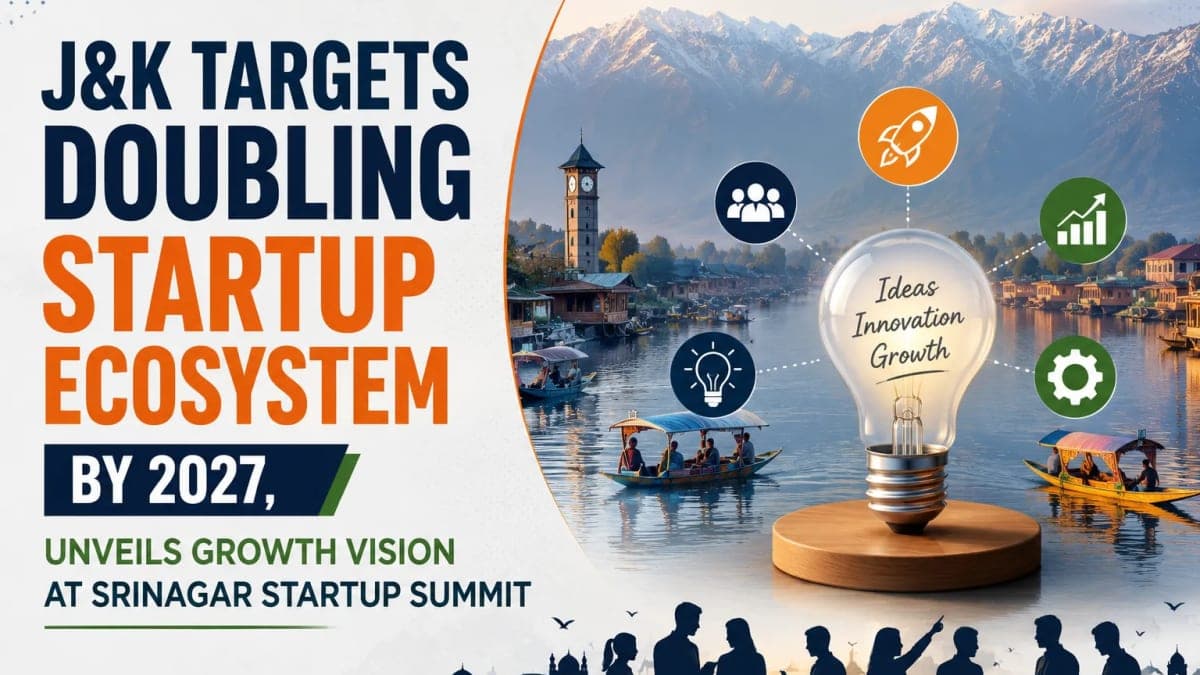
J&K Sets Ambitious Goal to Double Startup Base by 2027 at Srinagar Startup Summit
Jammu and Kashmir has outlined an ambitious plan to significantly expand its startup ecosystem over the next two years, with policymakers targeting a doubling of the region’s startup base by 2027. The announcement came during the Srinagar Startup Summit, where government representatives, entrepreneurs, investors, academic institutions, and industry experts gathered to discuss the future of innovation-driven growth in the Union Territory.
The summit highlighted entrepreneurship as a key pillar of economic development, with authorities emphasizing the importance of creating an environment where startups can thrive across sectors ranging from technology and tourism to agriculture, handicrafts, healthcare, and clean energy.
Government Focuses on Innovation-Led Economic Growth
Officials at the event stressed that strengthening the startup ecosystem is central to creating sustainable employment opportunities for the region's youth. The proposed roadmap includes encouraging innovation, simplifying support mechanisms for entrepreneurs, improving mentorship networks, and expanding access to incubation centres and financial resources.
The government also reiterated its commitment to working closely with educational institutions, industry bodies, and private investors to build a stronger entrepreneurial culture throughout Jammu and Kashmir.
Building an Ecosystem Beyond Technology
While technology startups remain an important focus, policymakers indicated that entrepreneurship in Jammu and Kashmir extends beyond software and digital services. Local businesses working in tourism, horticulture, food processing, handicrafts, renewable energy, and manufacturing are also expected to benefit from startup-focused initiatives.
By supporting innovation in traditional industries alongside emerging sectors, the administration hopes to create broader economic opportunities while preserving the region's unique strengths.

Why the Startup Goal Matters
Doubling the startup base would represent a significant milestone for Jammu and Kashmir's evolving business landscape. A larger startup ecosystem could help generate employment, encourage skilled professionals to build businesses locally, and reduce dependence on conventional government jobs.
A stronger entrepreneurial network may also attract greater private investment, improve technology adoption, and encourage collaboration between universities, research institutions, and industry.
If successfully implemented, the initiative could contribute to long-term economic diversification and enhance the region's competitiveness within India's rapidly expanding startup ecosystem.
Challenges That Remain
Despite growing momentum, entrepreneurs in Jammu and Kashmir continue to face several challenges, including limited venture capital availability, access to larger markets, scaling support, infrastructure gaps, and the need for experienced mentorship.
Industry experts believe achieving the 2027 target will depend not only on policy announcements but also on consistent implementation, easier regulatory processes, stronger investor participation, and continuous support for startups beyond their early stages.
Balanced Analysis
The government's vision reflects increasing confidence in entrepreneurship as a driver of regional development. Setting a measurable target provides direction for policymakers and stakeholders, but success will depend on translating commitments into tangible outcomes for founders. If incubation facilities, funding access, mentorship, and market connectivity improve alongside policy reforms, Jammu and Kashmir could emerge as a stronger innovation destination. However, sustained execution, private-sector collaboration, and long-term ecosystem development will ultimately determine whether the ambitious 2027 objective is achieved.