Kepler Aerospace Raises $8 Million in Maiden External Funding Round
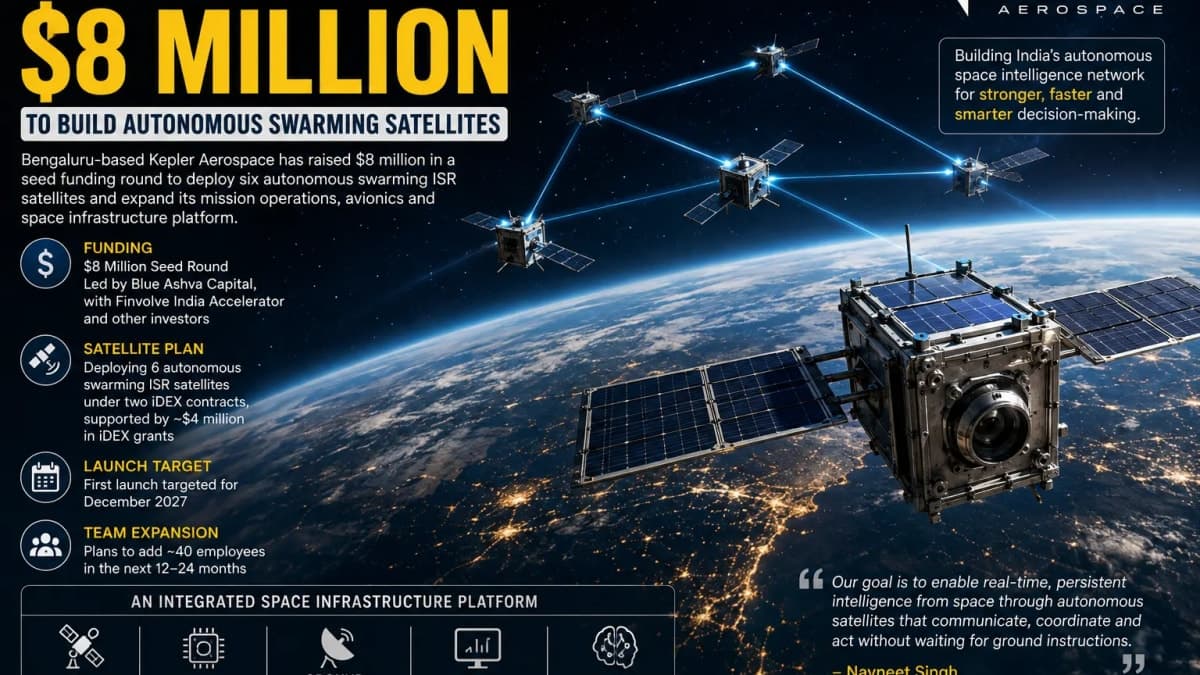
Bengaluru-based space infrastructure startup Kepler Aerospace has raised $8 million in a seed funding round, marking its first external fundraise since the company was founded in 2018.
The round was led by Blue Ashva Capital, with Finvolve India Accelerator and other investors participating. The fresh capital will primarily support Kepler's plans to develop and deploy space-based intelligence, surveillance and reconnaissance (ISR) capabilities, including its first fleet of autonomous swarming satellites.
The investment comes as India's private space industry expands beyond rockets and conventional satellites into defence applications, satellite subsystems, ground infrastructure and space-based intelligence services.
Six Swarming ISR Satellites Planned
A major portion of the new funding is expected to support the deployment of Kepler Aerospace's first six swarming ISR satellites.
Kepler has secured two prime contracts under India's Innovations for Defence Excellence (iDEX) programme to provide swarming ISR constellations for the country's defence space ecosystem. The programmes are also supported by approximately $4 million in iDEX grants.
Unlike conventional satellite operations that can depend heavily on instructions transmitted from ground stations, Kepler is developing an architecture intended to allow satellites to communicate and coordinate with one another in orbit.
According to the company, satellites within the proposed constellation would be able to detect targets and autonomously cue other spacecraft to collect or update information without first waiting for instructions from a ground station.
These capabilities remain part of Kepler's planned system and should not be interpreted as evidence that the six-satellite constellation is already operational.
First Launch Targeted for December 2027
Kepler CEO Navneet Singh told The Times of India that the company has cleared its preliminary design review and mission design review, while a critical design review is targeted for January.
The company has not yet finalised a launch provider and is in discussions with domestic and international launch companies.
Its first satellite launch is currently targeted for December 2027, according to Singh.
The planned satellites are intended for the Defence Space Agency and are expected to carry electronic-warfare, electro-optical and thermal sensing capabilities.
Kepler's objective is to build a constellation capable of providing more persistent surveillance and reducing the delay between detecting an object from space and delivering useful intelligence.
From Ground Stations to Space-Based Intelligence
Kepler's strategy extends beyond manufacturing satellites.
The company is building an integrated infrastructure stack covering satellite systems, avionics, ground infrastructure, mission operations and intelligence delivery.
Its existing network includes more than 70 ground stations, providing services such as satellite communications, tracking, telemetry, command and mission operations.
Kepler also develops satellite hardware and military avionics.
Singh told The Times of India that the company's existing satellite-component, communications, military-avionics and mission-operations businesses accounted for around 90% of its roughly $1 million in revenue last year, with its newer satellite-intelligence business contributing the remainder.
Once the six satellites are operational, Singh expects intelligence services to account for approximately 60% to 70% of revenue within three years, with the transition potentially becoming significant around mid-2028.
These figures represent management expectations rather than guaranteed future financial performance.
Kepler Already Works Across India's Space and Defence Ecosystem
Kepler's satellite hardware customers include organisations and companies such as ISRO, L&T, Bellatrix Aerospace and Take Me To Space, according to reporting on the funding round.
Its avionics customers include Hindustan Aeronautics Limited (HAL) and the Aeronautical Development Establishment of DRDO.
The company's avionics work includes a communications system used on the Abhyas high-speed expendable aerial target.
Kepler was founded by Navneet Singh, its chief executive officer, and Kiran V. Sharma, its chief strategy officer.
The founders met while working at the Indian Space Research Organisation (ISRO). Singh worked on India's nanosatellite programme, while Sharma was associated with a lunar nano-rover project at Delft University of Technology in the Netherlands.
Kepler Plans to Add 40 Employees
The funding will also support an expansion of Kepler's engineering and operational capabilities.
Over the next 12 to 24 months, the company plans to add approximately 40 employees and move into a new integration and mission-control facility in Bengaluru's Whitefield area.
Alongside the satellite constellation, Kepler intends to scale its Mission Operations as a Service and Avionics as a Service businesses.
Navneet Singh said the immediate priority is executing the company's iDEX programmes and deploying the first six satellites while continuing to develop infrastructure for persistent, low-latency intelligence.
Why Autonomous Satellite Swarms Matter
Traditional Earth-observation missions can involve several stages: a satellite collects information, data is transmitted when ground connectivity is available, operators process the information and new instructions are subsequently sent to spacecraft.
A sufficiently autonomous constellation could shorten parts of that process by allowing spacecraft to react to information collected by other satellites.
For defence applications, that could be particularly important when monitoring moving objects or rapidly changing situations.
Kepler says its planned system could allow one satellite detecting a target—such as a ship or mobile air-defence system—to alert and task other satellites in the constellation.
Blue Ashva Capital founder Satya Bansal described Kepler's approach as an autonomous architecture in which satellites can communicate, task one another and act in orbit without waiting for a ground station.
The practical performance of that architecture will ultimately depend on successful satellite development, launch, deployment and in-orbit operations.
India's Private Space Sector Moves Deeper Into Defence Technology
Kepler's funding highlights a broader shift underway in India's private space ecosystem.
Private companies are increasingly targeting areas beyond launch vehicles, including satellite components, propulsion, Earth observation, ground-station networks, mission management and defence-focused space intelligence.
India opened the space sector to greater private participation in 2020, while IN-SPACe subsequently became an important authorisation and promotion body for non-government space activities.
Government data cited by YourStory put cumulative private investment in India's space sector at $618.5 million by March 2026, while the number of registered space-tech startups had reached approximately 440 by August 2026.
Kepler's $8 million round therefore represents more than another startup financing announcement. It reflects growing investor interest in companies seeking to build infrastructure and services around the entire satellite lifecycle rather than focusing on a single piece of hardware.
If Kepler successfully deploys its planned six-satellite constellation, the project could provide an important real-world test of autonomous satellite coordination for India's defence and strategic space requirements.