Maharashtra Considers New Rules for Delivery Platforms
Maharashtra is considering expanding its regulatory oversight of app-based delivery businesses, potentially bringing food delivery, quick-commerce and ecommerce platforms within the scope of its bike-taxi framework.
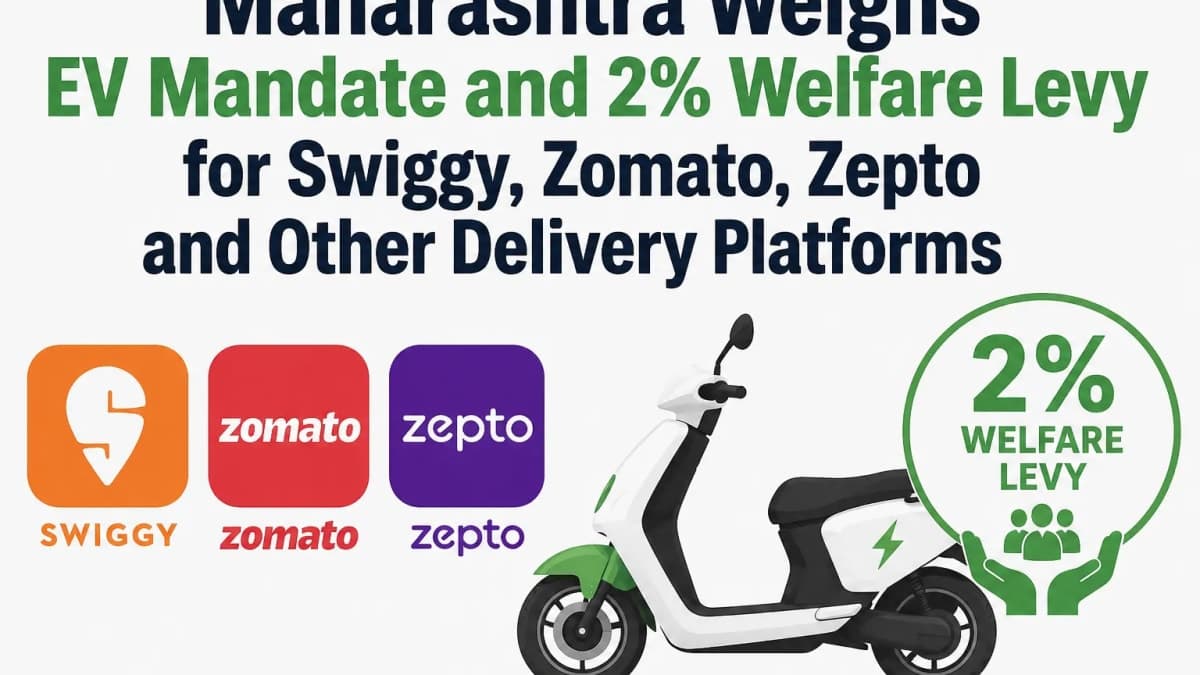
The proposed changes could have significant implications for companies including Swiggy, Zomato, Zepto and Meesho, as well as for thousands of delivery partners operating across the state.
Under the proposal, covered platforms would be required to use electric vehicles for qualifying operations. Other requirements being considered include GPS-based tracking of riders and vehicles, insurance protection and contributions toward a welfare fund for delivery workers.
The proposal is currently being examined by Maharashtra's law and judiciary department and has yet to secure final approval.
Proposed 2% Contribution for Rider Welfare
One of the most significant elements of the proposed framework is a welfare contribution equivalent to 2% of each trip's fare.
The money collected would be directed toward a welfare fund intended to support delivery and platform workers. Proposed benefits include pensions, accident insurance, financial assistance for purchasing electric vehicles and educational support for drivers' children.
However, applying a trip-based levy to delivery platforms presents a practical challenge.
Unlike conventional bike-taxi businesses, where customers pay a clearly defined fare for a journey, food and grocery delivery platforms operate under different payment structures. It therefore remains unclear whether the proposed contribution would be calculated using the delivery partner's payment for an order, the distance travelled or another metric.
That issue is likely to be important when the government finalises the regulatory mechanism.
EV Requirement Could Reshape Delivery Fleets
The proposal would also require platforms covered by the framework to deploy electric vehicles.
Maharashtra Transport Minister Pratap Sarnaik has said the proposed system would cover bikes undertaking trips of less than 15 kilometres, with the new EV and related compliance requirements becoming applicable if the amendments receive approval.
Such a requirement could accelerate the transition toward electric two-wheelers in one of India's largest urban delivery markets.
For delivery companies, however, the transition could involve additional costs associated with vehicle acquisition or financing, charging infrastructure and fleet management. The practical impact would depend heavily on how quickly the mandate is introduced and what support is available to individual riders.
GPS Tracking and Insurance Also Proposed
Electric mobility is only one part of the planned framework.
The proposal also calls for GPS-based monitoring of drivers and vehicles and insurance coverage for riders. Maharashtra additionally plans to create a dedicated portal through the state transport commissioner to track vehicles operating under the bike-taxi framework in real time.
Together, these provisions indicate that the state is looking beyond vehicle regulation and toward a broader system covering worker protection, operational monitoring and accountability.
Why the Proposal Matters
The plan is significant because food delivery and ecommerce platforms currently do not have a dedicated Maharashtra-specific regulatory framework of this kind.
Their activities are primarily governed through central legislation and rules, including the Consumer Protection Act, Consumer Protection (E-Commerce) Rules and the Code on Social Security.
If Maharashtra approves the amendments, delivery and quick-commerce businesses could therefore face an additional state-level layer of compliance.
The development comes as governments across India examine how existing labour, transport and social-security frameworks should apply to the rapidly expanding platform economy.
Gig Worker Welfare Becoming a Bigger Regulatory Issue
The proposed welfare contribution also reflects a broader policy debate over social protection for gig workers.
India's Code on Social Security provides for social-security schemes covering gig and platform workers, including areas such as life and disability protection, accident insurance, health and maternity benefits and old-age protection.
The central framework also provides for aggregator contributions within prescribed limits.
At the state level, governments are developing their own approaches. Karnataka, for example, has introduced legislation establishing a welfare board and fund for platform-based gig workers and a welfare contribution mechanism.
The emergence of different state-level systems has also generated concerns among platform businesses about potentially having to comply with different rules, contribution structures and reporting obligations across India.
Potential Benefits for Workers
From a worker-welfare perspective, Maharashtra's proposal could provide more formal protections to delivery partners who operate in a work environment traditionally characterised by flexible but limited employment-linked benefits.
Insurance, pension support and assistance with EV purchases could reduce some of the financial risks faced by riders.
GPS registration and a centralised monitoring system could also make the delivery ecosystem more traceable, although implementation and data-handling safeguards would be important considerations.
Higher Compliance Costs for Platforms
For platforms, the proposed regulations could increase operating and administrative expenses.
Companies may have to adapt their fleets, technology systems, insurance arrangements and financial reporting processes while making contributions to the welfare fund.
The extent of that burden will depend on the final design of the rules, particularly how the proposed 2% levy is calculated.
There is also a broader question about whether additional regulatory costs would be absorbed by platforms or ultimately influence delivery charges, platform fees or rider compensation. At this stage, there is no confirmed indication of how individual companies would respond.
Balanced Analysis
Maharashtra's proposal highlights the difficult balance governments face as the gig economy expands.
Platforms have created large-scale flexible earning opportunities while transforming how consumers order meals, groceries and other products. At the same time, the employment model has intensified debate over insurance, social security and long-term financial protection for workers.
An EV mandate could advance Maharashtra's clean-mobility objectives, while a welfare fund could strengthen protections for delivery partners. But the effectiveness of both measures would depend on implementation.
Rules introduced too quickly could increase costs for platforms and riders, particularly if workers must finance new vehicles without sufficient support. On the other hand, a carefully phased transition accompanied by affordable EV financing and clearly defined welfare benefits could help modernise the delivery ecosystem while providing workers with greater protection.
The most important unresolved issue is the final structure of the proposed levy. Delivery platforms do not operate like traditional passenger bike taxis, meaning regulators will need a calculation method suited to their business model.
For now, the proposals should be treated as potential requirements rather than confirmed obligations because the amendments remain under review.
Conclusion
Maharashtra's proposed expansion of its bike-taxi framework could mark a major shift in how food delivery, ecommerce and quick-commerce platforms are regulated in the state.
Mandatory electric vehicles, GPS tracking, insurance and a 2% welfare contribution could strengthen environmental and worker-protection objectives, but they could also introduce new financial and operational obligations for platforms.
The final impact on companies, delivery partners and consumers will become clearer only after the government completes its review and determines whether—and in what form—the proposed amendments will be approved.
This article is based on reporting published by Inc42.