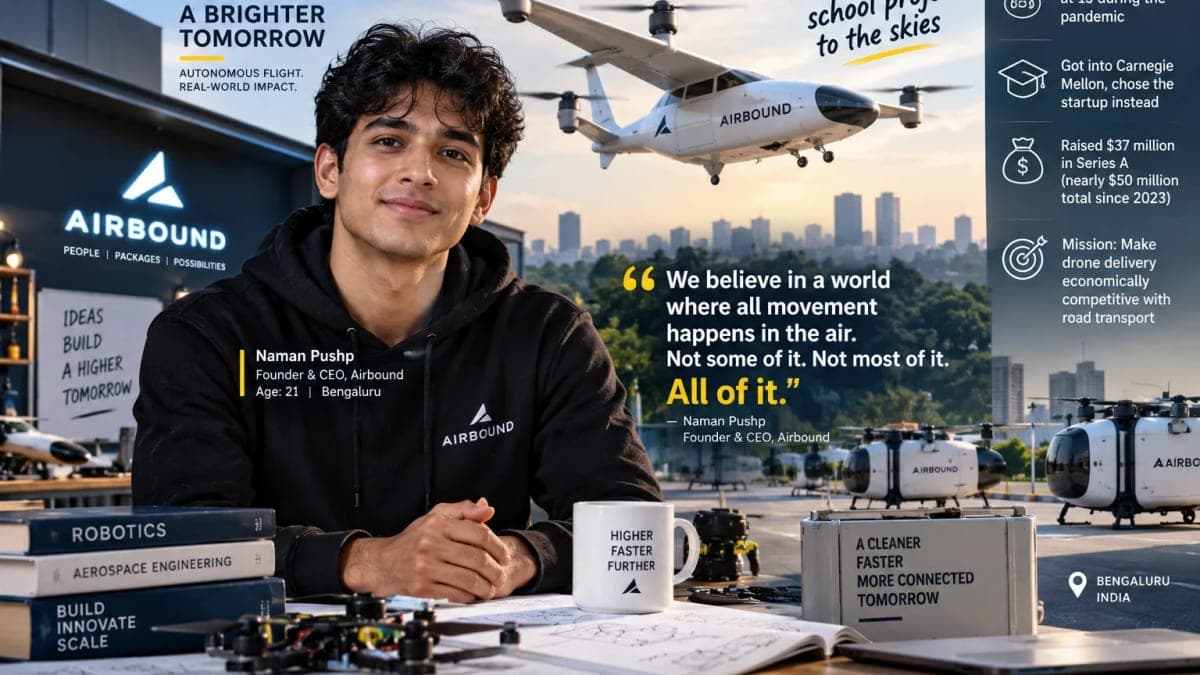
From a $500 Hackathon Prize to Nearly $50 Million: Naman Pushp’s Airbound Takes on Drone Delivery
Naman Pushp was still in school when he began wrestling with a problem that continues to trouble the drone industry: flying a package is possible, but doing it cheaply enough to compete with transportation on the ground is much harder.
During the 2020 lockdown, the then-15-year-old spent his time experimenting with drones. A $500 hackathon prize gave him more money to put into the project. What began as teenage engineering work eventually developed into Airbound, a Bengaluru aerospace startup attempting to redesign aircraft around one demanding objective — making aerial delivery economically practical at scale.
Pushp is now 21 and Airbound has considerably more capital behind that ambition.
The company recently raised $37 million in a Series A round led by Greenoaks, with participation from DoorDash, Lachy Groom, Lightspeed and Humba Ventures. Airbound says it has raised nearly $50 million since launching in 2023.
The figure is sometimes easy to misread. It represents the amount of capital Airbound has raised, not a confirmed $50 million valuation.
The financing gives Pushp's company room to move beyond prototypes and limited delivery operations. It also raises the standard by which Airbound will now be judged. The question is no longer whether a teenager can build an interesting drone. It is whether the company he created can manufacture aircraft reliably, operate them safely and make their economics work thousands of times a day.
The idea began before Airbound existed
Pushp's interest in building machines started well before the pandemic.
Born in Mumbai, he spent parts of his childhood in Hyderabad and Malaysia. While living in Malaysia, he began making simple robots when he was in Classes 5 and 6 and later competed in robotics events.
Then schools shut during the pandemic.
With more time to experiment, Pushp moved deeper into drones. He developed a project called Open Drone and entered a hackathon, winning $500. Rather than treating the prize as the end of the project, he put the money back into his engineering work.
An early prototype from that period is now displayed at Airbound's office.
The important step was not simply learning how to build a drone. Pushp began questioning why flying small amounts of cargo remained so expensive.
His conclusion was that too much energy was being spent transporting the aircraft itself.
That became the engineering premise behind Airbound.
Airbound wants the aircraft to stop dominating the equation
Aircraft have an unavoidable weight problem.
A machine capable of transporting a passenger or a substantial cargo load also has to carry its own structure, propulsion system and energy source. Much of the energy consumed during flight therefore goes towards keeping the vehicle airborne rather than moving the payload that generates economic value.
Airbound is trying to shift that balance.
The startup is developing lightweight autonomous aircraft using carbon-fibre structures, with the aim of reducing vehicle mass relative to payload.
The theory is uncomplicated: a lighter aircraft should require less energy to move the same package. Lower energy requirements could, in turn, improve the economics of each delivery.
Making that calculation work outside a prototype is considerably more complicated.
Aircraft have to survive repeated operations. They need maintenance, manufacturing consistency and reliable autonomous systems. Commercial operations must also fit within aviation regulations and the physical infrastructure needed to launch, recover and manage fleets of vehicles.
Those constraints will determine whether Airbound's weight advantage translates into a durable business advantage.
Pushp chose the startup over Carnegie Mellon
The founder's unconventional path continued as the project became more serious.
Pushp received his first venture investment at 16 from GradCapital. Because he was still a minor, his father had to be involved in the process.
He later secured admission to Carnegie Mellon University in the United States but chose not to attend, continuing instead with the work that would become Airbound.
The decision is inevitably part of the company's founder story. But it matters less to Airbound's future than the choices the company is making now.
Aerospace startups operate in an unforgiving industry. Capital requirements are high, development cycles can be long, and an aircraft that performs well in controlled testing still has to prove itself through repeated real-world use.
Airbound's latest financing gives it more capacity to confront those problems.
A $37 million round changes the scale of the company
Greenoaks led Airbound's $37 million Series A, while DoorDash, Lachy Groom, Lightspeed and Humba Ventures also participated.
The investment marked DoorDash's entry as an investor in India.
Airbound plans to direct the new capital towards aircraft engineering, manufacturing at commercial scale and expansion of its operations.
It has already moved into real-world delivery work.
Recent reporting says Airbound has been conducting as many as 20 flights a day on a clinic-to-hospital route. The company has also been working towards a wider network connecting Amaravati, Vijayawada and Guntur in Andhra Pradesh.
Twenty flights a day can demonstrate that a system functions. Airbound's ambitions require something entirely different.
The company wants to reach 10,000 flights per day.
Closing that gap will test nearly every part of the business.
Ten thousand daily flights require more than a good aircraft
Scaling an aviation network from tens of flights to thousands is not simply a matter of producing more drones.
Aircraft have to be manufactured consistently. Batteries and other components need supply chains. Fleets require maintenance. Autonomous operations need monitoring and communications infrastructure, while take-off and delivery points have to function without introducing excessive labour or operating costs.
Regulatory approvals add another layer.
Each of those requirements affects the cost of moving a package. If the infrastructure surrounding the aircraft becomes too expensive, gains achieved through lighter engineering can disappear elsewhere in the system.
Airbound therefore has two intertwined problems to solve: the physics of the aircraft and the economics of the network around it.
Pushp's manufacturing ambitions suggest he understands the scale required.
“In the grand scheme of things, 100 aircraft a day will start to feel very small,” he said.
“We really want to get to a world where the rate at which we’re producing aircraft is comparable, if not exceeding, the rate at which we produce cars and scooters.”
That is an extraordinary production benchmark for aerospace.
It is also central to Airbound's thesis.
Airbound wants to manufacture aircraft more like vehicles
Traditional aerospace manufacturing is built around relatively expensive machines produced in much smaller numbers than cars or two-wheelers.
Airbound is pursuing a different model.
If lightweight autonomous aircraft are to handle everyday deliveries rather than specialised aviation tasks, they cannot remain rare, individually expensive pieces of equipment. The company would need to produce them at volumes far closer to mass transportation.
That changes the manufacturing problem.
Airbound would have to preserve the reliability expected of aircraft while pushing production towards the speed and economics associated with consumer transportation.
The company has previously discussed reaching production of 100 aircraft a day. Pushp's latest comments suggest he sees that as an intermediate milestone rather than an endpoint.
The ambition is enormous, but so is the market Airbound is ultimately trying to challenge: the movement of goods by road.
DoorDash's investment adds strategic interest
The participation of DoorDash is particularly relevant because Airbound is not building aircraft in isolation from the delivery industry.
Delivery platforms understand the cost of moving individual orders over the final kilometres to customers. Those economics are shaped by driver availability, distance, traffic, order density and the amount of time each delivery consumes.
For aerial delivery to become more than a specialised service, it eventually has to compete against that established system on cost and reliability.
Airbound believes better aircraft physics can help get it there.
Pushp has framed the company's long-term ambition in sweeping terms.
“We believe in a world where all movement happens in the air. Not some of it. Not most of it. All of it,” he said in Airbound's Series A announcement.
He connects that vision directly to economics.
“Better physics leads to better economics, which unlocks the potential to move people and goods for a fraction of a cent,” Pushp said. “That is what we’re building at Airbound.”
For now, the company is much closer to transporting packages than remaking all transportation. That difference between long-term vision and present capability is worth preserving.
The founder story is becoming an execution story
There is an obvious reason Pushp attracts attention.
Few 21-year-olds run aerospace companies backed by tens of millions of dollars. Fewer still can trace the company to drones they were building at 15 with money from a $500 competition.
But Airbound has reached the point where the founder's age is becoming less important than what happens inside the company.
Nearly $50 million in funding gives it the resources to hire engineers, refine aircraft, build manufacturing capacity and expand operations. It also creates expectations that cannot be satisfied by prototypes alone.
The next evidence will come from production rates, operating costs, safety and reliability, regulatory progress and the number of deliveries the system can sustain.
Pushp began with a question about why aircraft spend so much energy carrying themselves.
Airbound has now raised enough capital to pursue its answer seriously.
Whether that answer can compete with a truck, scooter or delivery rider on the ground is the test that comes next.