Ola Electric Unveils Three New Energy Storage Products as It Expands Beyond EVs
Bengaluru, August 16, 2026: Ola Electric has widened its presence in the energy sector with the introduction of three battery energy storage system (BESS) products, strengthening its strategy to use its battery manufacturing capabilities across applications beyond electric vehicles.
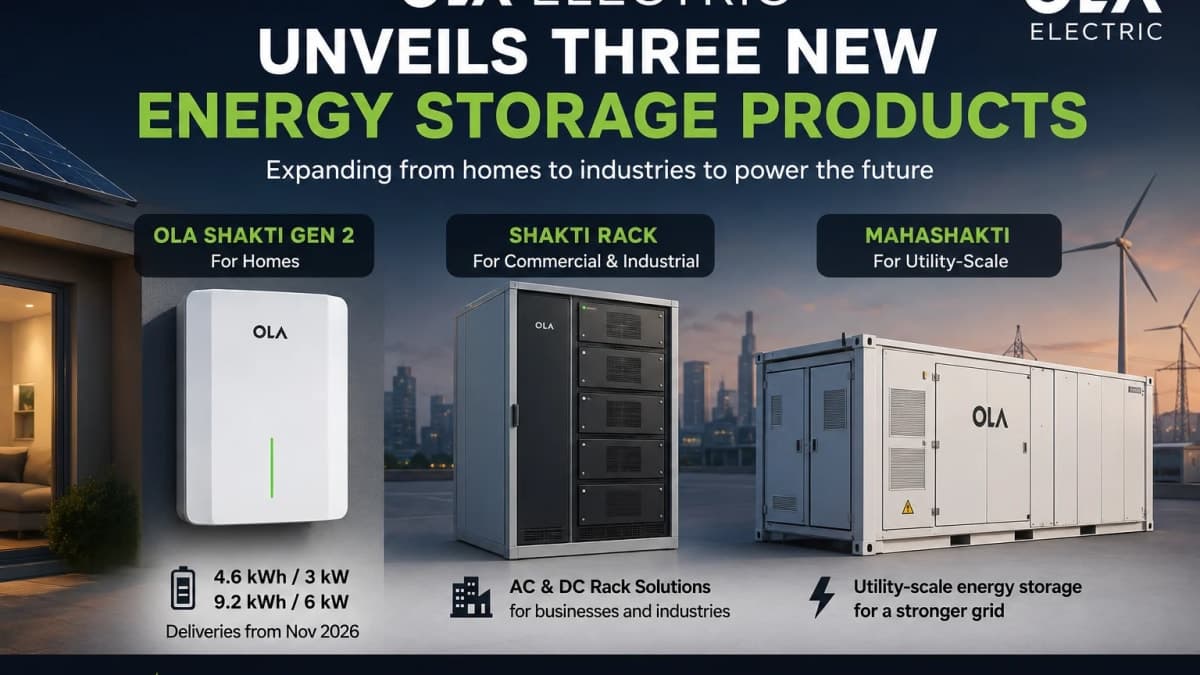
The new portfolio comprises Ola Shakti Gen 2, designed for residential use; Shakti Rack, targeted at commercial and industrial customers; and Mahashakti, intended for larger utility-scale energy storage requirements.
The expansion gives the company products spanning different levels of the electricity ecosystem—from household backup to industrial energy management and grid-scale storage.
Ola Shakti Gen 2 Targets Home Energy Storage
Ola Shakti Gen 2 builds on the company's earlier move into residential battery storage. The new system is being offered in two configurations: a 4.6 kWh battery paired with 3 kW of power and a 9.2 kWh battery paired with 6 kW. Both are designed to provide around 1.5 hours of backup when operating at full load.
The 3 kW version has initially been priced at ₹99,000, while the 6 kW model is priced at approximately ₹1.75 lakh. Deliveries are expected to start in November 2026. The products use Ola Electric's in-house 4680 Bharat lithium-ion cells.
The residential offering could serve households seeking an alternative to conventional inverter batteries while also supporting the growing use of rooftop solar systems, where batteries can store excess electricity for later consumption.
Shakti Rack Takes Ola Into Commercial and Industrial Storage
The second part of the expansion is Shakti Rack, developed for commercial and industrial applications. Ola has introduced AC and DC rack-based solutions, opening a route into energy storage requirements that are significantly larger than those of individual households.
Commercial battery systems can potentially help businesses manage backup power, integrate renewable electricity and reduce dependence on diesel generators or conventional lead-acid battery systems.
Ola has previously identified demand for lithium-based storage from businesses such as telecom towers, petrol stations, dark stores and organised retail chains. During its FY26 earnings discussion, the company said scaling its Gigafactory would allow it to increase production for stationary storage alongside its automotive requirements.
Mahashakti Targets Utility-Scale Energy Storage
At the largest end of the portfolio is Mahashakti, Ola Electric's push into utility-scale storage.
The product extends the company's battery strategy toward applications where large quantities of electricity can be stored and supplied back when required. Such systems are becoming increasingly important as electricity grids incorporate more intermittent renewable sources such as solar and wind.
Ola had earlier identified grid storage as a major future pillar of its battery business and said Mahashakti would be developed around its prismatic LFP platform.
Why Ola Electric Is Expanding Beyond Electric Vehicles
The latest launches illustrate an important shift in Ola Electric's business strategy.
The company has invested heavily in domestic cell manufacturing through its Gigafactory. Using those cells across electric vehicles, household storage and larger energy systems could allow the manufacturing facility to serve several markets rather than depending primarily on demand from Ola's two-wheelers.
Ola previously said its automotive operations would provide a foundational source of demand for internally manufactured cells while stationary storage could become another major growth engine. The company has also outlined plans to expand cell-manufacturing capacity as its mobility and energy businesses grow.
Its original Ola Shakti launch in October 2025 represented the company's first major step outside automotive applications. At the time, Ola said it expected battery energy storage consumption to become a substantial source of demand for its Gigafactory.
Energy Storage Becomes More Important for India's Power Transition
Battery storage is increasingly important to India's broader clean-energy transition.
Unlike conventional power sources that can generally be dispatched according to demand, solar and wind generation varies with weather and time of day. Battery systems can capture electricity when generation is high and release it later, helping households, businesses and utilities manage fluctuations.
That creates opportunities across several segments: residential solar storage, commercial backup systems, industrial energy management and large grid-connected installations.
For Ola Electric, participating across these categories could create additional revenue streams while improving utilisation of its cell-manufacturing infrastructure.
Opportunities Come With Execution Challenges
The strategy nevertheless carries significant execution requirements.
Residential energy products need competitive pricing, reliability and effective after-sales support. Commercial buyers typically demand predictable performance and attractive lifetime economics, while utility-scale projects involve more complex requirements around safety, financing, integration and long-duration operating performance.
Ola must also balance battery demand from its vehicle operations with the needs of its expanding stationary-storage business as production scales.
If the company can achieve sufficient manufacturing volume and maintain product quality, vertical integration could become an advantage. But success in electric mobility does not automatically guarantee success in stationary energy storage, where customers, purchasing cycles and competitive dynamics can be substantially different.
What the Launch Means for Ola Electric
The introduction of Ola Shakti Gen 2, Shakti Rack and Mahashakti signals that Ola Electric increasingly sees itself not simply as an electric two-wheeler manufacturer, but as a broader battery and energy technology company.
The common link is its battery manufacturing platform. By deploying cells across vehicles, homes, businesses and potentially the electricity grid, Ola is attempting to extract greater value from its investment in domestic battery production.
The coming quarters will show whether that strategy can translate into meaningful sales outside the EV segment. If adoption grows, stationary storage could give Ola an important second growth engine and reduce its dependence on the highly competitive electric two-wheeler market.