Peeko Secures Fresh Capital for Expansion
India's quick-commerce sector is moving beyond groceries and everyday household essentials, and babycare startup Peeko is looking to capture a specialised part of that opportunity.
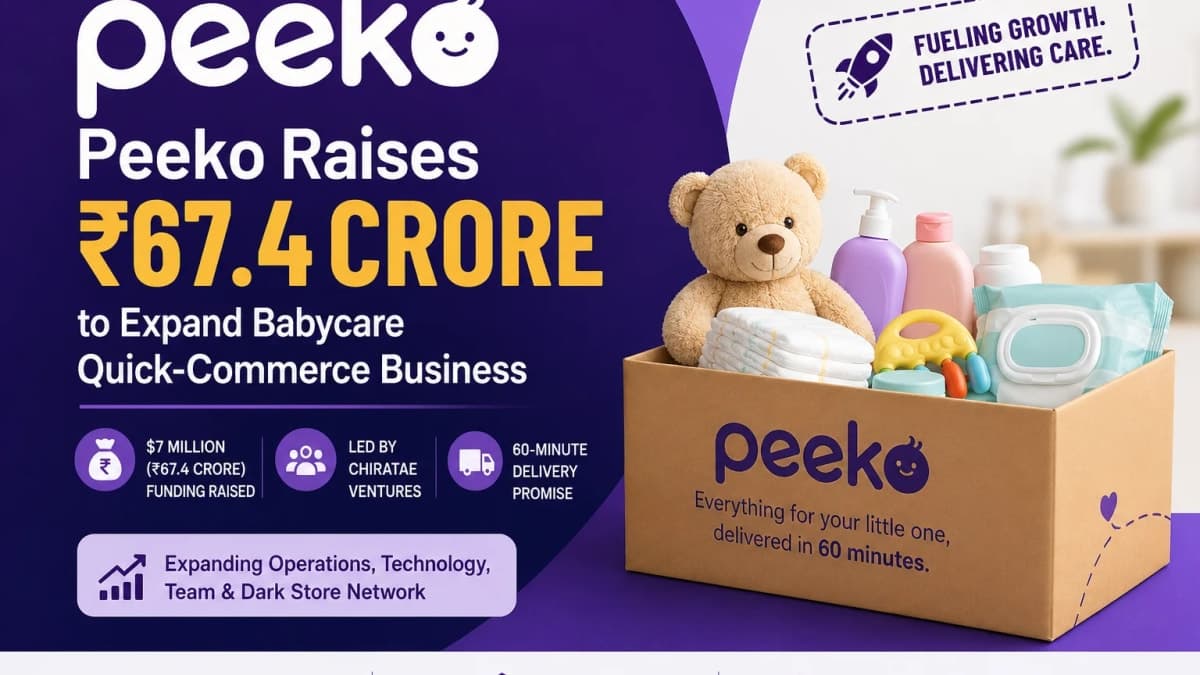
The Bengaluru-based company has secured $7 million (around ₹67.4 crore) in a funding round led by Chiratae Ventures. The fresh capital is expected to support expansion of the business, technology development and team building as Peeko prepares for its next stage of growth.
The investment comes roughly a year after Peeko raised $3.2 million in a seed round led by Stellaris Venture Partners. That earlier round also included several angel investors and was aimed at strengthening the startup's product experience, supply network and workforce.
What Is Peeko?
Peeko is a Bengaluru-based vertical quick-commerce company focused specifically on products for babies and young children. The business was founded by Chetan Sharma, Vivek Khetan and Abhijit Gairola and was created around the idea that parents may value a specialised platform offering both product depth and fast fulfilment.
Unlike broad quick-commerce services that carry products across numerous categories, Peeko concentrates on baby and kids' needs. Its assortment includes categories such as apparel, accessories, toys, baby gear and everyday consumables.
The company promises deliveries within 60 minutes, positioning speed as one part of a broader experience centred on convenience, product selection and trust.
Peeko is the consumer brand of Zippycubs Private Limited, according to the company's website.
Peeko Expands Its Quick-Commerce Infrastructure
Peeko's operational footprint has grown since its earlier funding round. The company now has around 30,000 stock-keeping units (SKUs) across three dark stores in Bengaluru, according to the latest report on the funding. It is also planning to enter additional cities.
That represents an important step up from its earlier stage. In August 2025, Peeko was operating through a single 4,000-square-foot dark store serving 10 Bengaluru pincodes.
Scaling dark stores can allow a specialised quick-commerce company to keep inventory closer to customers and shorten delivery times. However, expansion also raises operational requirements, including inventory planning, warehousing costs, delivery density and maintaining sufficient order volumes in each service area.
Why Babycare Could Work as a Quick-Commerce Category
Babycare presents an interesting opportunity for rapid delivery because many purchases can be both recurring and time-sensitive.
Items such as diapers and other daily-use products may require frequent replenishment, while apparel, toys, accessories and baby gear can increase the overall value and variety of a customer's basket.
Peeko's strategy goes beyond delivering only urgent essentials. Its model has been built around carrying a deeper babycare assortment while experimenting with features such as try-and-buy and instant returns. The startup has also explored AI-driven recommendations to make product discovery more personalised.
This category-focused approach is part of a broader shift in India's quick-commerce ecosystem. Specialised platforms are emerging in areas including fashion, medicines, food, home services and babycare as startups test whether consumers want the convenience of rapid delivery combined with category-specific selection.
Why the ₹67.4 Crore Funding Matters
The new investment is significant for Peeko because the company is moving from proving its concept in Bengaluru toward building a larger operating network.
More capital can help the startup invest in technology, deepen inventory, recruit employees and establish infrastructure in additional markets.
It also indicates continued investor interest in vertical quick commerce—businesses that focus on one category rather than attempting to compete with large platforms across every type of purchase.
Research published in the India Venture Capital Report 2026 highlighted vertical quick commerce as an emerging investment theme, with specialised platforms using curated assortments and category-focused models to differentiate themselves.
Competition Will Be a Major Test
Peeko's opportunity also comes with considerable competitive pressure.
Large horizontal quick-commerce platforms already possess extensive delivery networks, consumer traffic and dark-store infrastructure. If babycare becomes a sufficiently attractive rapid-delivery category, larger competitors could increase their own assortments.
Peeko therefore needs to demonstrate that specialisation provides something customers cannot easily receive from a general quick-commerce application—whether through deeper product selection, stronger curation, better recommendations, easier returns or a shopping experience specifically designed for parents.
Competition can also come from established baby and kids' retailers that already have significant customer relationships and supply networks.
The Challenge of Quick-Commerce Economics
Fast delivery alone does not guarantee a sustainable business.
Dark stores, inventory, logistics and last-mile delivery can create substantial operating expenses. A specialised platform must generate enough orders within each service area to justify maintaining a broad catalogue close to customers.
Industry observers have consequently raised questions about how rapidly niche quick-commerce companies can scale while maintaining viable unit economics. Different categories have different purchasing frequencies, basket sizes and supply-chain requirements, meaning that the grocery quick-commerce model cannot necessarily be copied directly.
For Peeko, the challenge will be balancing its large assortment with inventory efficiency while building repeat purchasing among parents.
What Comes Next for Peeko?
The latest funding gives Peeko resources to move beyond its early Bengaluru-focused phase.
Expansion into new cities could test whether the demand demonstrated in Bengaluru can be replicated across other metropolitan markets. Technology and personalisation may also become increasingly important as the company manages a catalogue running into tens of thousands of products.
The larger strategic question is whether babycare can become a standalone quick-commerce vertical at meaningful scale.
If Peeko can combine fast fulfilment with trusted products, deeper assortment and a smoother shopping experience, it could establish a differentiated position in India's rapidly evolving online retail market. If customer demand proves insufficient to support specialised dark-store economics, however, the company could face pressure from larger platforms capable of spreading infrastructure costs across many categories.
The ₹67.4 crore funding round therefore represents more than additional growth capital—it will help fund the next test of whether category-specific quick commerce can develop into a durable business model in India.
Balanced Analysis
Peeko's latest funding highlights investor confidence in specialised quick commerce, particularly in categories where customers value convenience, trust and product availability. Babycare has attractive characteristics such as recurring purchases and a broad range of products, giving Peeko opportunities to build long-term customer relationships.
However, rapid expansion brings risk. Maintaining 30,000 SKUs while operating fast-delivery infrastructure can make inventory management and unit economics challenging. Peeko must also differentiate itself sufficiently from established babycare retailers and India's larger quick-commerce platforms.
Its long-term success is therefore likely to depend less on delivery speed alone and more on whether specialisation produces higher customer loyalty, repeat purchases and sustainable economics.
This article is based on reporting published by Moneycontrol.