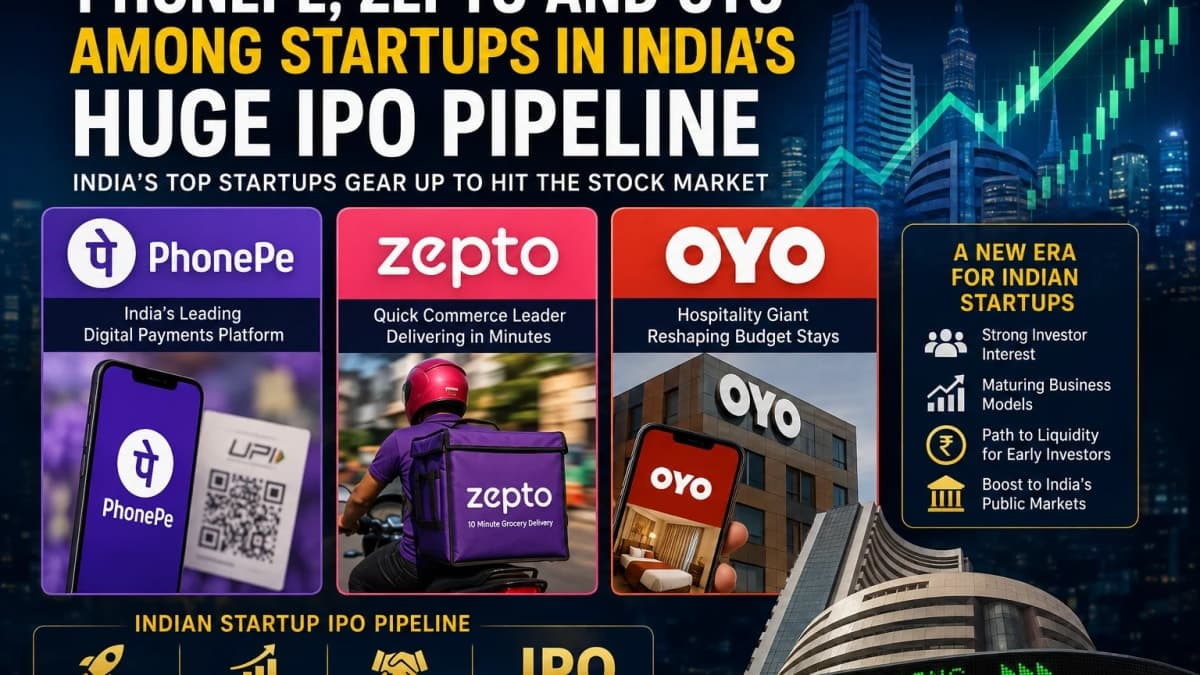
PhonePe, Zepto and OYO Among Startups in India's Huge IPO Pipeline
India's startup ecosystem could be entering another important phase as some of the country's most recognisable technology-driven companies move closer to the public markets.
Major names including PhonePe, Zepto and OYO are among startups associated with India's expanding IPO pipeline, highlighting how a generation of privately funded companies is increasingly looking at domestic stock exchanges as a route to their next stage of growth.
The development is significant not simply because of the individual brands involved. A sustained wave of startup listings could reshape the relationship between India's technology companies, private investors and public-market shareholders.
PhonePe Emerges as One of the Biggest Names to Watch
Digital payments company PhonePe is one of the highest-profile businesses in the prospective listing pipeline.
The company has become a major participant in India's digital payments ecosystem, particularly through the Unified Payments Interface, or UPI. Its scale makes any eventual IPO an important event for investors tracking India's fintech sector.
A public listing would also put greater focus on PhonePe's ability to translate its enormous consumer reach into sustainable revenue and profits across payments and other financial services.
The company's journey reflects the broader development of India's fintech industry, which has benefited from rapid smartphone adoption, digital identity infrastructure and the enormous expansion of UPI-based transactions.
Zepto Could Test Investor Appetite for Quick Commerce
Quick-commerce company Zepto represents a very different part of India's technology economy.
The company built its brand around rapid delivery of groceries and everyday products, competing in a market where speed, logistics infrastructure and customer convenience have become key differentiators.
Quick commerce has expanded rapidly in major Indian cities, but the sector also faces questions about profitability, delivery economics, discounting and the capital required to build and maintain dense fulfilment networks.
That makes a potential Zepto IPO particularly interesting.
Public investors would have an opportunity to assess whether India's fast-growing quick-commerce model can produce sustainable long-term returns rather than relying primarily on rapid expansion.
OYO Keeps Hospitality Technology in the IPO Conversation
Hospitality company OYO is another major startup associated with India's IPO pipeline.
The company became one of the most internationally recognised startups to emerge from India, expanding its technology-led hotel network across multiple markets.
OYO's route toward a public listing has attracted attention over the years as the business has navigated rapid expansion, restructuring and changing market conditions.
Its presence in the broader IPO pipeline demonstrates another important feature of India's startup market: companies approaching public markets are arriving from very different sectors and at different stages of corporate development.
India's Startup IPO Story Is Becoming More Diverse
Earlier phases of India's technology-listing boom were dominated by a relatively small collection of internet businesses.
The emerging pipeline is considerably broader.
Fintech, quick commerce, hospitality technology, consumer internet, software and other digitally enabled industries are increasingly represented among companies exploring public-market opportunities.
This diversification could help India's stock market develop a larger publicly traded technology ecosystem.
For investors, it could also provide exposure to businesses that previously remained accessible mainly to venture-capital firms, private-equity investors and other institutional backers.
Why So Many Startups Are Looking Toward IPOs
Several structural factors help explain the growing interest in listings.
India has developed deep domestic equity markets supported by institutional investors and a rapidly expanding base of retail participants. At the same time, startups that spent years raising money privately are reaching stages where early investors may seek liquidity.
An IPO can address several objectives simultaneously.
It can provide a company with fresh capital, create an exit route for existing shareholders, strengthen its public profile and establish a transparent market valuation.
However, becoming publicly traded also fundamentally changes the expectations placed on management.
Quarterly performance, governance, disclosure standards, margins and capital allocation become far more visible.
The Shift From Growth to Sustainable Economics
One of the biggest changes facing India's startup sector is the growing emphasis on financial discipline.
During periods when venture capital was abundant, many technology companies prioritised expansion, customer acquisition and market share.
Public-market investors can be less forgiving.
Revenue growth remains important, but investors increasingly examine profitability, cash generation, competitive advantages and the amount of additional capital required to maintain expansion.
That transition could prove especially important for companies operating in highly competitive industries such as quick commerce and consumer technology.
Big IPO Pipeline Does Not Guarantee Big Listings
The size of an IPO pipeline should also be interpreted carefully.
A company preparing for or considering an IPO is not the same as a company completing one.
Listing plans can be delayed, resized or abandoned depending on market volatility, regulatory processes, company performance and disagreements over valuation.
This means the presence of PhonePe, Zepto, OYO and other startups in the broader pipeline should not automatically be treated as confirmation that every proposed IPO will happen on an expected timetable.
Market conditions at the time of each offering will remain critical.
Valuation Will Be a Major Test
Valuation could become one of the most closely watched issues surrounding upcoming startup IPOs.
Private-market valuations are typically established through relatively infrequent funding rounds involving a limited group of investors.
Public markets operate differently.
Once listed, companies are continuously priced by a much wider investor base responding to earnings, economic conditions, competitive developments and expectations about future growth.
Startups seeking ambitious valuations may therefore need to demonstrate that their financial performance justifies those expectations.
Companies that price their IPOs realistically could potentially attract stronger long-term participation, while aggressive pricing could increase the risk of weak post-listing performance.
Why This IPO Wave Matters for India's Startup Ecosystem
Successful public listings can have effects far beyond the companies directly involved.
Early employees and investors may gain liquidity. Venture-capital firms can return capital to their investors. Founders can access a broader source of financing, while new entrepreneurs may benefit from increased confidence in the startup ecosystem.
A functioning path from startup formation to private funding and eventually to public ownership is an important part of a mature technology economy.
If India's next generation of IPO candidates performs well after listing, it could encourage additional startups to pursue domestic public offerings.
Poorly priced or underperforming IPOs, however, could have the opposite effect by making investors more cautious about technology companies.
PhonePe, Zepto and OYO Represent Three Different Startup Eras
The three headline companies also illustrate how India's startup ecosystem has evolved.
OYO emerged during an earlier wave of aggressive internet-startup expansion. PhonePe grew alongside India's digital-payment revolution and UPI adoption. Zepto represents the newer quick-commerce generation built around ultra-fast urban fulfilment.
Their potential presence in the public markets therefore tells a broader story about India's technology sector.
The industry is no longer represented by one dominant startup model.
Instead, companies from multiple generations and business categories are reaching the scale where an IPO becomes a realistic strategic option.
What Investors Will Watch Next
Attention will now turn to regulatory filings, IPO sizes, valuations, financial disclosures and proposed listing timelines.
For investors, brand recognition alone will not determine which offerings succeed. Revenue quality, margins, competitive positioning, governance and credible paths to sustainable profitability are likely to receive intense scrutiny.
The expanding pipeline nevertheless marks an important moment.
If companies such as PhonePe, Zepto, OYO and other Indian startups successfully make the transition from privately financed businesses to publicly traded corporations, the next IPO cycle could become a major test of how far India's startup ecosystem has matured.
This article is based on reporting published by Business Standard.