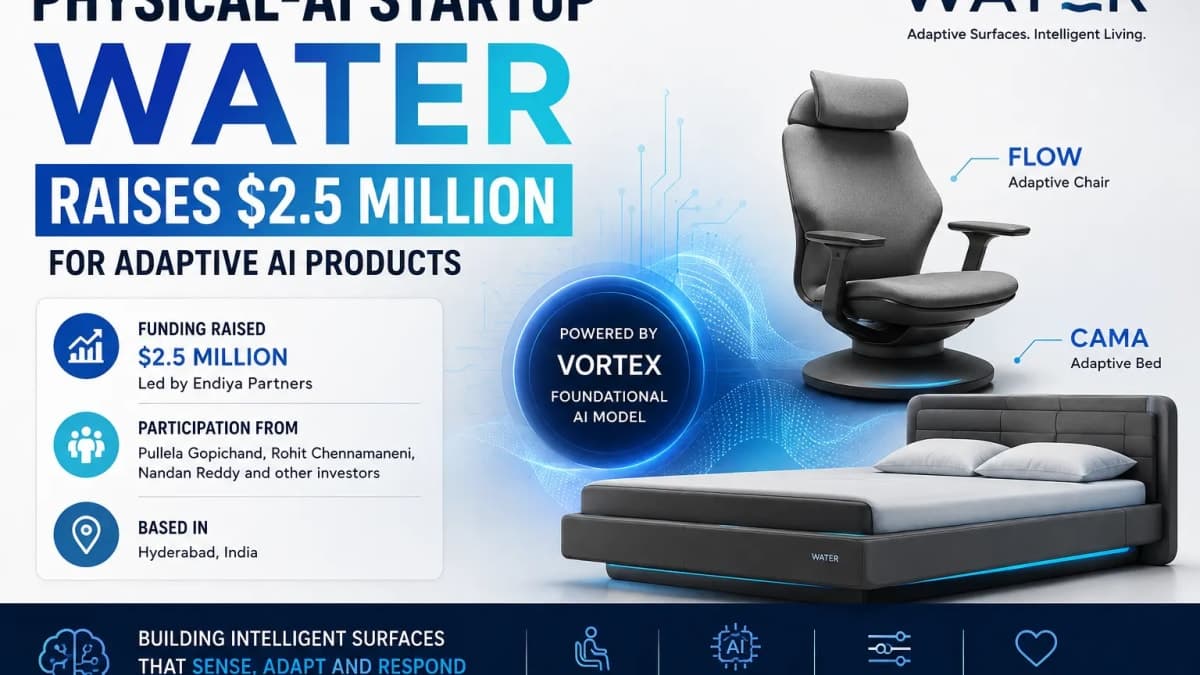
WATER Raises $2.5 Million to Push Physical AI Into Everyday Products
India's emerging Physical AI ecosystem has received another funding boost as Hyderabad-based startup WATER secured $2.5 million to advance technology that aims to make everyday physical surfaces capable of sensing and responding to people.
The funding round was led by Endiya Partners, with participation from Indian badminton coach Pullela Gopichand, Darwinbox co-founder Rohit Chennamaneni, Swiggy co-founder Nandan Reddy and other angel investors.
Rather than concentrating primarily on conversational or screen-based artificial intelligence, WATER is working on AI that directly interacts with the physical environment. Its initial focus is on surfaces people use for extended periods, particularly chairs and beds.
WATER Is Building FLOW and CAMA
Founded by Teja Vinukollu and Haneesh Mourya Desu, WATER is developing two flagship products: FLOW, an adaptive chair, and CAMA, an adaptive bed.
FLOW is being designed around posture, movement and the distribution of load while a person is seated. Instead of functioning simply as a connected chair that collects information, the concept is to enable the surface itself to adapt to the user's physical interaction.
CAMA applies a similar approach to sleep. Its development is focused on factors including sleep, recovery and respiration. WATER has also developed a near-production-ready adaptive sleep system, according to information reported about the funding round.
The two products therefore serve as early demonstrations of a broader technological ambition rather than isolated pieces of smart furniture.
VORTEX Forms the Intelligence Layer
At the centre of WATER's technology is VORTEX, a shared foundational model designed to sense and model interactions with the human body and translate that information into physical responses.
This distinction is important.
Many existing connected products are designed mainly to measure behaviour, generate data or provide recommendations through an app. WATER is attempting to create a closed loop in which a physical surface can collect signals, interpret them and then adjust itself accordingly.
If successfully validated, such an architecture could potentially allow the same underlying intelligence to work across several categories of physical products instead of requiring completely separate AI systems for each device.
Funding Will Focus on Technical Validation
The $2.5 million investment is expected to support WATER's continued technical validation.
A major question the company intends to address is whether VORTEX's understanding can transfer effectively between different products and different users.
That challenge could prove crucial to WATER's wider strategy.
An adaptive system that works only with a narrowly defined product or limited group of users would have fewer opportunities to scale. A model capable of learning principles that remain useful across chairs, beds and eventually other environments could create a much broader technology platform.
Why WATER's Funding Matters for Physical AI
Artificial intelligence investment has largely been associated with software platforms, generative AI models and enterprise automation. Physical AI represents a different direction: connecting intelligence with machines and environments capable of taking action in the real world.
WATER's approach brings that idea into objects that people interact with every day.
Instead of limiting Physical AI to conventional robots, autonomous vehicles or industrial machinery, adaptive furniture demonstrates how the technology could eventually become embedded into ordinary environments.
A chair could potentially respond continuously to changes in posture. A sleeping surface could adapt as a person's position or breathing patterns change. The broader concept is an environment that does not simply collect information about its user but changes its physical behaviour in response.
WATER Sees Opportunities Beyond Furniture
The startup's ambitions extend beyond seating and sleeping products.
WATER sees potential for its technology to eventually move into areas such as automotive and aviation environments, where people also spend substantial periods interacting with seats and other physical surfaces.
That expansion would represent a significant shift in WATER's positioning—from a company producing adaptive furniture to one providing an intelligence layer for human-responsive environments.
If the underlying technology proves transferable, applications could eventually emerge wherever physical surfaces need to understand and dynamically respond to their users.
A Promising Idea Still Facing Real-World Tests
WATER's funding highlights investor interest in AI systems that extend beyond screens, but the company's ambitions also come with substantial technical and commercial challenges.
Physical products must meet standards that software-only businesses generally do not face. Reliability, manufacturing costs, durability and safety can all become critical once AI begins controlling objects that directly interact with people.
The startup will also need to demonstrate that adaptive behaviour provides enough practical improvement for consumers or businesses to justify potentially higher hardware costs.
Technical transferability is another key question. Demonstrating that VORTEX can reliably interpret different users across multiple physical products will be important if WATER wants to turn its technology into a scalable platform.
The company has filed a foundational patent related to its safety approach, while its new funding gives it additional resources to test the underlying technology and its ability to operate across products.
What Comes Next for WATER?
The immediate priority is likely to be proving that the technology behind FLOW and CAMA can work reliably outside controlled demonstrations and across a diverse range of users.
Success could give WATER an opportunity to establish an early position in India's emerging Physical AI market.
More importantly, the startup is testing a larger idea: whether AI can move from simply understanding human behaviour to continuously reshaping the physical environments around people.
The $2.5 million round provides WATER with capital to pursue that vision, but the next phase will depend on technical validation, product reliability and evidence that adaptive surfaces deliver meaningful benefits in everyday use.
For now, WATER represents an interesting example of how India's AI startup ecosystem is beginning to expand beyond software and into technologies where artificial intelligence directly interacts with the physical world.