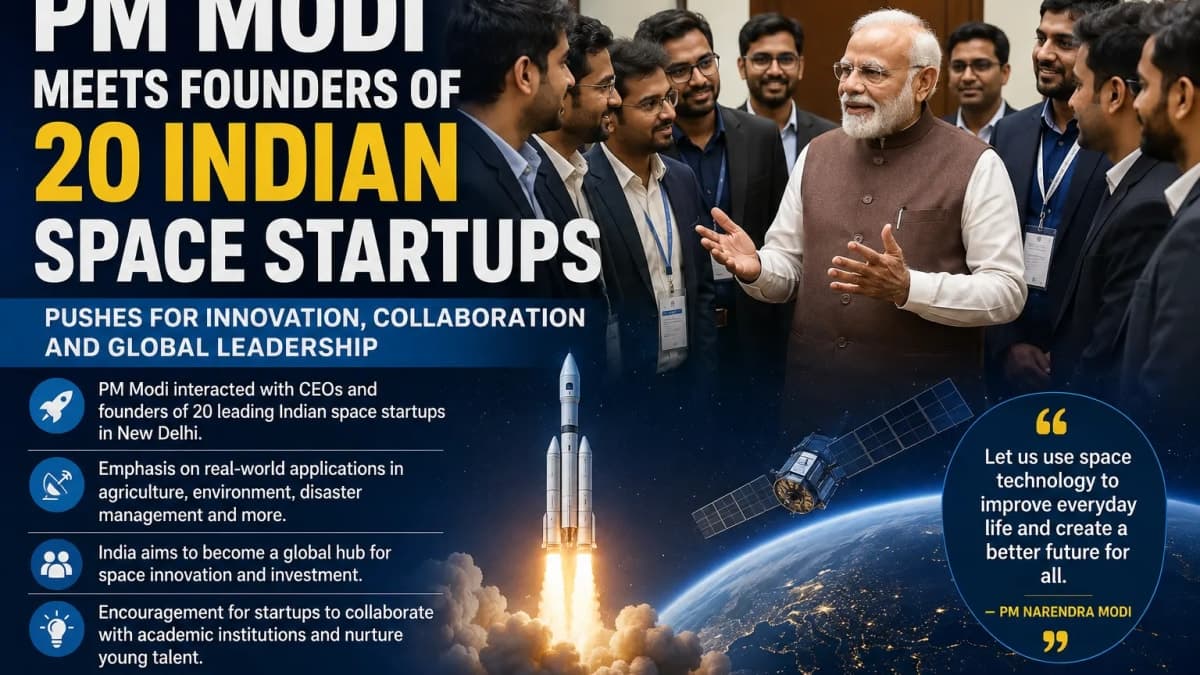
PM Modi Meets Leaders of 20 Indian Space Startups
Prime Minister Narendra Modi interacted with the CEOs and founders of 20 Indian space startups at Seva Teerth in New Delhi on August 21, 2026, highlighting the growing role of private companies in India's rapidly evolving space ecosystem.
The interaction brought together entrepreneurs working across different parts of the space economy, including launch systems, satellites, propulsion, avionics, space intelligence, debris management, and weather and climate technologies.
During the discussions, Modi praised entrepreneurs for entering a technically demanding and capital-intensive sector and encouraged the industry to look beyond conventional space missions. His message placed particular emphasis on turning space-based capabilities into practical solutions that can improve people's everyday lives.
Space Technology Beyond Rockets and Satellites
A major theme of the meeting was expanding the application of space technology into sectors that directly affect citizens.
Modi encouraged entrepreneurs to explore stronger connections between space technology and fields such as agriculture, livestock management, dairy and environmental protection. The idea is that satellite data, Earth observation, geospatial intelligence and other space-based technologies can increasingly support decisions on the ground.
For example, companies developing agricultural applications could work more closely with agricultural universities and government institutions so that space-derived information can help farmers make better decisions. The Prime Minister also suggested collaboration between companies working on space-debris solutions and organisations involved in environmental issues.
This approach reflects a broader shift in how India's space economy is being viewed: not simply as a sector focused on exploration and launches, but as a technological infrastructure capable of supporting industries across the economy.
India's Private Space Ecosystem Continues to Expand
The meeting comes against the backdrop of major changes in India's space sector since it was opened more widely to private participation in 2020. The creation of the Indian National Space Promotion and Authorization Centre, or IN-SPACe, provided a framework for private companies to participate in activities that had traditionally been dominated by government institutions.
The scale of the startup ecosystem has expanded significantly since those reforms. According to information presented by the Department of Space in Parliament in August 2026, around 440 space-technology startups are registered on the DPIIT Startup India portal. IN-SPACe had granted 113 authorisations to 52 non-government entities for different space activities, including 18 startups.
The figures illustrate how India's private space industry has moved from an emerging experiment toward a broader commercial ecosystem.
Building India Into a Global Space Hub
Another important part of Modi's message was India's potential to attract international talent, companies and investment.
He called for an ecosystem in which India becomes one of the countries that immediately comes to mind when businesses and investors think about space. Startup leaders at the meeting also highlighted increasing international interest in technologies being developed by Indian companies.
This ambition goes beyond increasing the number of domestic startups. Becoming a major global space hub would require Indian companies to compete internationally in areas ranging from launch services and satellite manufacturing to Earth observation, propulsion, analytics and downstream applications.
Encouraging the Next Generation of Space Entrepreneurs
The discussion also touched on building a longer-term pipeline of scientific and entrepreneurial talent.
Modi suggested greater interaction between space companies and Atal Tinkering Labs, with the aim of encouraging curiosity about space, engineering and technology among younger students.
Connecting startups with schools and innovation programmes could help expose students to commercial space technology at an earlier age while creating a larger talent base for India's future space industry.
Why This Meeting Matters
The significance of the meeting lies partly in the changing structure of India's space ambitions.
For decades, the country's biggest space achievements were largely associated with the government-led programme. The expansion of private participation means India's next phase could increasingly involve a combination of public institutions, startups, established businesses, universities and investors.
Private companies can potentially shorten development cycles, experiment with specialised technologies and create commercial services around satellite data and other space infrastructure. At the same time, government institutions remain important for regulation, research infrastructure, strategic programmes and enabling access to the wider space ecosystem.
The meeting therefore signals an effort to deepen cooperation between these different parts of the industry rather than treating public and private space activity as separate tracks.
Balanced Analysis: Opportunity Comes With Challenges
India's growing space-startup ecosystem offers substantial opportunities, but rapid growth in the number of companies alone will not guarantee global competitiveness.
Space businesses often require large amounts of capital, lengthy research and development cycles, specialised infrastructure and highly skilled workers. Commercial success also depends on reliable customers and the ability to turn technically impressive products into sustainable businesses.
For Indian startups, the next challenge will therefore be scaling technologies, attracting long-term investment, developing international customers and proving that space-based products can solve commercially valuable problems.
Government support can reduce some barriers, but successful companies will ultimately need viable business models and competitive technology.
The encouraging development is that India's ecosystem is becoming increasingly diverse. Companies are now working across launches, satellites, propulsion, Earth observation, space situational awareness and other specialised technologies, giving the country opportunities to participate in several layers of the global space economy rather than focusing on a single segment.
Conclusion
Prime Minister Narendra Modi's meeting with founders and CEOs of 20 Indian space startups represents another step in India's attempt to build a larger private space economy.
The focus on agriculture, environmental management and other everyday applications suggests that the government's vision extends beyond headline-making launches. The broader objective is to make space technology useful across industries while creating Indian companies capable of competing internationally.
With hundreds of space-tech startups now registered in India, the ecosystem has expanded rapidly. The more difficult phase will be converting that momentum into scalable businesses, globally competitive technologies and applications that deliver measurable economic and social value.
If that transition succeeds, India's emerging private space industry could become an increasingly important part of both the country's technology economy and the global commercial space market.
This article is based on reporting published by TOI.