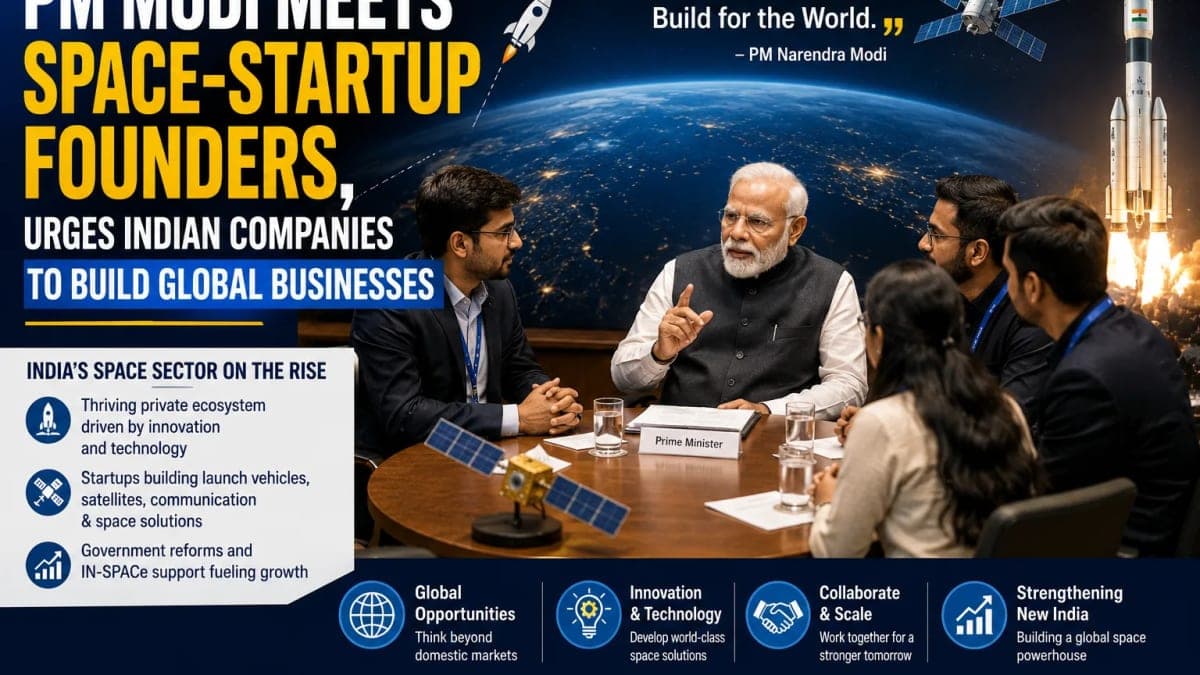
PM Modi Meets Space-Startup Founders, Calls on Indian Companies to Build Global Businesses
Prime Minister Narendra Modi held an interaction with founders of India's space startups, urging entrepreneurs to create companies capable of competing on the global stage. The meeting reflected the government's continued focus on strengthening private participation in the country's rapidly expanding space sector.
During the discussion, Modi encouraged innovators to pursue ambitious goals, develop world-class technologies, and position Indian businesses as international players rather than limiting their vision to domestic opportunities.
The interaction comes at a time when India's private space industry is experiencing significant growth following policy reforms that opened the sector to greater private participation.
India’s Space Ecosystem Enters a New Phase
For decades, India's space programme was largely driven by the Indian Space Research Organisation (ISRO), which built a reputation for cost-effective missions, satellite launches, and planetary exploration.
In recent years, however, the country's space landscape has changed dramatically. Regulatory reforms, the creation of IN-SPACe as a facilitator for private companies, and increased investment have enabled startups to enter areas such as:
Launch vehicle development
Satellite manufacturing
Earth observation
Space-based communications
Navigation technologies
Deep-space innovation
The Prime Minister's meeting signals continued political support for this transition toward a more commercially driven space economy.
A Call to Build Global Companies
A key message emerging from the interaction was the importance of creating businesses with international ambitions.
Rather than focusing only on serving India's market, entrepreneurs were encouraged to design products and services that can compete globally. This approach aligns with the broader vision of transforming India into a major technology exporter across advanced industries.
The emphasis on building global businesses also reflects growing international demand for affordable satellite services, launch solutions, and space-based technologies.
Why the Space Sector Matters
The global space economy is expanding rapidly, with private companies playing an increasingly important role in innovation.
India has several advantages that could strengthen its position:
Cost-efficient engineering capabilities
A large pool of skilled technical talent
Strong experience through ISRO's missions
Growing venture capital interest
Expanding international partnerships
If Indian startups successfully scale internationally, they could contribute not only to exports but also to high-skilled employment, manufacturing, and technological leadership.
Government Support and Industry Momentum
The interaction follows a period of increased government efforts to encourage private participation in space activities.
Policy changes have made it easier for startups to collaborate with ISRO, access testing infrastructure, and participate in commercial missions. Investors have also shown growing interest in India's space-tech ecosystem, with multiple companies developing reusable rockets, satellite constellations, and advanced aerospace technologies.
This combination of policy support and private innovation has positioned the sector as one of India's fastest-growing technology segments.
Challenges Ahead
Despite strong momentum, India's space startups continue to face several hurdles.
These include:
Access to long-term funding
Scaling manufacturing capabilities
Competing with established international companies
Navigating regulatory requirements
Developing sustainable commercial markets
Addressing these challenges will be important if Indian companies are to convert technological promise into lasting global success.
Why This Meeting Matters
The Prime Minister's interaction sends a broader signal that India's private space industry is becoming an increasingly important part of the country's innovation strategy.
As global competition in the commercial space sector intensifies, encouraging startups to think internationally could help Indian companies move beyond serving local markets and establish themselves as influential players in the worldwide space economy.
The meeting also reinforces the growing partnership between government institutions and private innovators, a relationship that may shape the next chapter of India's space journey.
This article is based on reporting published by The Economic Times.