PM Modi Backs a Global Vision for Indian Space Startups
India’s private space industry is being encouraged to move into its next phase — from building promising technologies at home to establishing a meaningful presence in the international space economy.
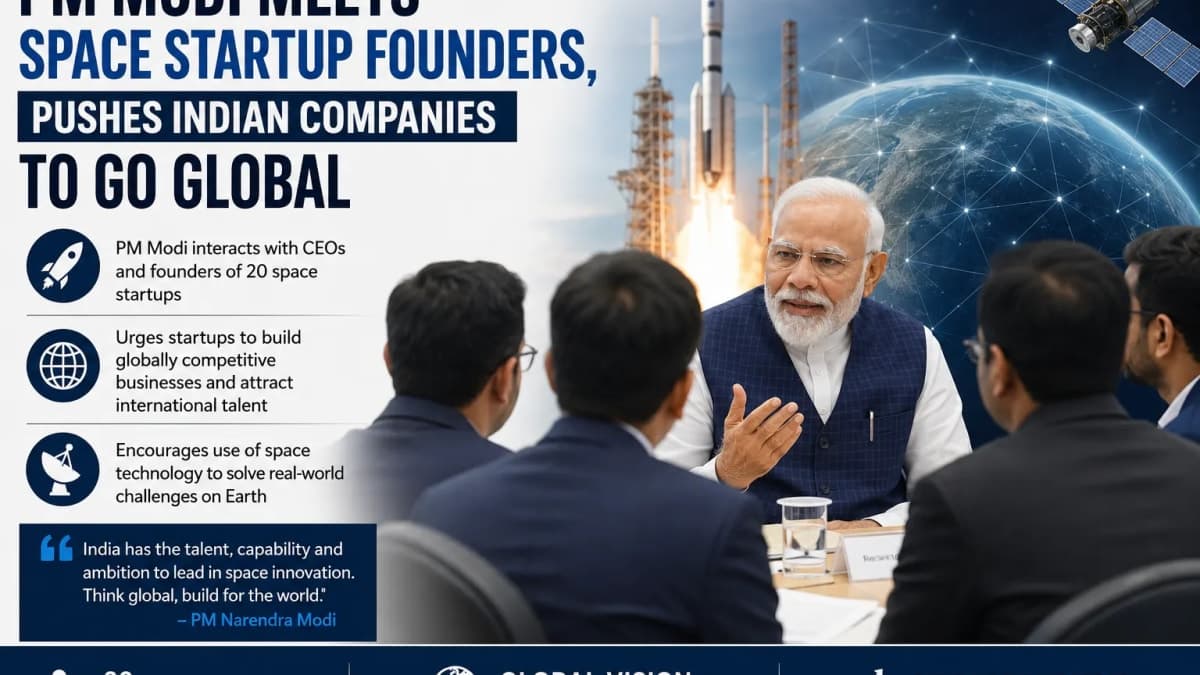
Prime Minister Narendra Modi met CEOs and founders representing 20 Indian space startups as part of an interaction focused on the development of the country’s rapidly expanding commercial space ecosystem. The discussion covered innovation, business growth and the wider use of space-based technologies.
A central message from the Prime Minister was that Indian companies should develop ambitions that extend well beyond the domestic market. He urged entrepreneurs to build globally competitive businesses while creating an innovation ecosystem strong enough to attract skilled professionals from other countries.
India Wants to Become a Magnet for Global Space Talent
Modi’s message went beyond exports and international customers. He argued for building an ecosystem with enough opportunity and momentum to make India an attractive career destination for global space professionals.
The ambition is significant because competition in the global space industry is increasingly about more than rockets and satellites. Countries are competing for engineers, scientists, entrepreneurs, investors and intellectual property.
For India, attracting that talent could help domestic companies scale faster while strengthening the country's position in areas such as launch services, satellite manufacturing, Earth observation, propulsion and space-data applications.
Some startup representatives told the Prime Minister that the opening of India’s space industry to private participation has already encouraged Indians working in the United States and Europe to consider returning home.
Space Technology Should Solve Problems on Earth
The interaction was not limited to ambitious missions beyond Earth. Modi also stressed that space technology should deliver practical benefits to ordinary people.
He encouraged startups to explore applications connected with agriculture, livestock, dairy and environmental management. He also called for greater collaboration between space companies and organizations working in social-development sectors.
This approach could broaden the commercial opportunity for Indian space companies. Satellite imagery, geospatial intelligence and other space-derived services can potentially support crop monitoring, disaster management, infrastructure planning and environmental observation.
Turning advanced space technology into affordable everyday services could therefore become an important part of the industry's next stage of growth.
Why the Meeting Matters
The meeting signals how dramatically India's space ecosystem has changed.
For decades, the country’s space story was dominated by government-led missions and the achievements of ISRO. Policy reforms beginning in 2020 opened a larger role for private enterprises, while institutions such as IN-SPACe were created to facilitate and regulate private participation.
The government has subsequently introduced policy measures intended to encourage private investment and expand commercial participation in the sector.
That shift has helped create a growing generation of Indian companies working across launch vehicles, satellites, propulsion systems, space situational awareness, Earth observation and downstream data services.
The latest message from the government suggests that simply building successful Indian startups is no longer the final objective. The larger ambition is to develop companies that can win international customers, attract global capital and talent, and establish recognizable Indian technology brands in the worldwide space market.
From Indian Startups to Global Space Companies
Going global, however, will require more than technological capability.
Space businesses often need substantial capital, long development cycles and extensive testing before reaching commercial scale. Indian startups will also have to navigate international regulations, export controls, insurance requirements and intense competition from established aerospace companies.
At the same time, India possesses potential advantages, including a large engineering workforce, relatively competitive development costs and decades of experience accumulated through the country's national space programme.
If startups can combine those strengths with dependable products, strong intellectual property and international partnerships, India could capture a larger share of the expanding commercial space economy.
Balanced Analysis: Opportunity Is Large, but Execution Will Decide the Outcome
Political support and policy reforms can create favourable conditions, but they cannot guarantee global commercial success.
Indian space startups will ultimately be judged by their ability to deliver reliable technology, secure repeat customers, raise sufficient long-term capital and compete on performance rather than cost alone.
Another challenge will be ensuring that the industry's growth is sustainable. Space companies frequently require years of investment before producing predictable revenue, meaning access to patient capital could become increasingly important as startups move from prototypes and demonstration missions to large-scale commercial operations.
The government will also need to maintain regulatory clarity and predictable policies if India wants companies and international investors to make long-term commitments.
Still, Modi’s interaction with startup founders reflects an important change in India's space ambitions: private companies are increasingly being viewed not merely as suppliers to the national space programme, but as independent businesses capable of competing in the international market.
If that transition succeeds, India's next major space milestone may not come only from a government mission. It could also come from an Indian startup becoming a globally recognized space-technology company.