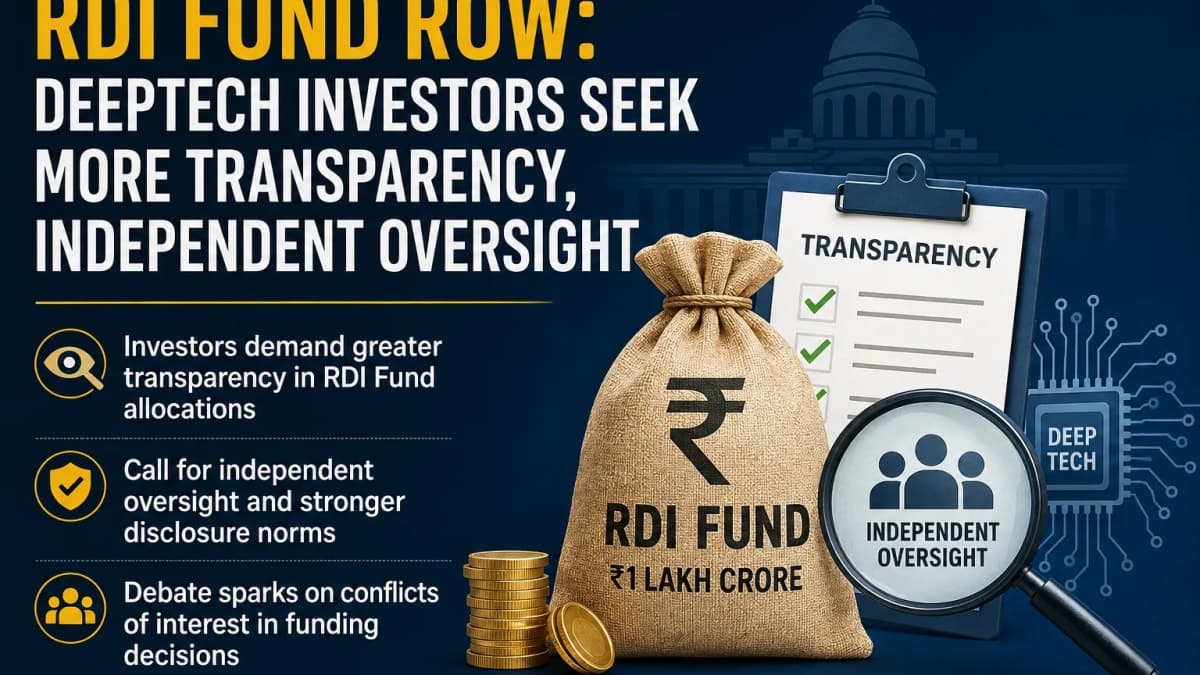
RDI Fund Faces Governance Questions as Deeptech Investors Seek Greater Transparency
India’s effort to strengthen domestic research and deep-technology development has entered a governance debate, with investors seeking more transparency and independent scrutiny in the allocation of capital under the ₹1 lakh crore RDI Fund.
The controversy centres on the first major round of funding routed through the Technology Development Board (TDB). According to reports, 22 companies were approved for assistance totalling ₹2,192 crore from 124 applicants. Questions arose after it was reported that 15 of those 22 companies had investment links with seven members of the 12-member investment committee. Those 15 companies accounted for more than ₹1,377 crore, or roughly 62% of the amount approved in the round.
The existence of such links does not by itself establish wrongdoing. Committee members involved have said relevant interests were disclosed and recusals took place where necessary, while the government has defended the process as merit-based and compliant with its conflict-of-interest framework.
Why Deeptech Investors Are Raising Concerns
The debate is increasingly focused not only on whether formal rules were followed, but also on whether the funding system provides sufficient public visibility and institutional independence.
Some deeptech investors and fund managers fear that a programme intended to broaden access to patient capital could unintentionally reinforce established investment networks if decision-making is not sufficiently transparent. Calls from the ecosystem include greater disclosure, clearer evaluation criteria, stronger independent oversight and better access for emerging fund managers and startups.
This issue is particularly significant because deeptech companies often require large amounts of capital over long development cycles before generating commercial returns. Technologies in areas such as artificial intelligence, biotechnology, semiconductors, space, advanced manufacturing, energy and climate technology can therefore struggle to attract conventional financing.
What Is the ₹1 Lakh Crore RDI Fund?
The Research, Development and Innovation scheme was created to stimulate private-sector investment in research and high-risk technology development.
Its implementation follows a two-tier structure. The ₹1 lakh crore corpus is housed through a special purpose fund under the Anusandhan National Research Foundation, while financing is channelled through second-level fund managers and institutions. Official implementation guidelines also indicate a ₹20,000 crore budgetary allocation for FY2025-26.
The broader objective is to address a persistent challenge in India's innovation economy: private-sector participation in research remains relatively limited compared with government support. In May 2026, the government highlighted this imbalance while urging industry to increase direct R&D investment and deepen collaboration with research institutions.
Government Defends Conflict-of-Interest Safeguards
The government has rejected suggestions that the funding process lacked safeguards.
Its position is that having experienced investors and technology specialists involved in decision-making inevitably creates the possibility of professional connections within India's relatively concentrated deeptech ecosystem. Rather than excluding such expertise entirely, the framework seeks to manage potential conflicts through disclosure and recusal requirements.
The Centre has maintained that members with relevant interests had no involvement in evaluating or sanctioning the affected proposals and that the institutional framework contains stringent conflict-of-interest protections.
That distinction is important. A professional or investment connection does not automatically demonstrate preferential treatment, particularly when disclosure and recusal procedures are properly enforced.
Why Independent Oversight Could Matter
The debate nevertheless illustrates a wider challenge for government-backed innovation financing.
Deeptech ecosystems are often relatively small, meaning investors, founders, advisers and technical experts frequently have overlapping professional relationships. Completely eliminating those connections from investment committees could deprive funding bodies of valuable specialist knowledge.
At the same time, public capital requires a high level of accountability. Independent reviewers, detailed disclosure of conflicts, documented recusals and greater clarity around evaluation standards could help reduce doubts about whether established networks receive an advantage.
Such measures could therefore strengthen the programme without necessarily removing industry specialists from the decision-making process.
Why the RDI Fund Debate Matters for Indian Startups
The stakes extend well beyond the first ₹2,192 crore allocation.
India is attempting to build globally competitive companies in sectors where research cycles are long, technological uncertainty is high and commercial financing may arrive only after substantial development. Government-backed patient capital can help bridge that gap.
But the effectiveness of a ₹1 lakh crore programme depends partly on whether entrepreneurs and investors believe they have a fair opportunity to participate.
If smaller startups or emerging fund managers perceive the system as dominated by established networks, potentially promising technologies could struggle to gain access to capital. Conversely, excessive restrictions designed to eliminate every professional connection could make it harder to recruit people with the technical and investment expertise needed to evaluate sophisticated projects.
Balanced Analysis
The RDI Fund controversy presents two legitimate considerations.
On one side, the government has stated that conflict-management mechanisms were applied and that connections between committee members and beneficiaries should not automatically be treated as evidence of misconduct. Experienced investors are also likely to have previous relationships with prominent companies in a relatively interconnected deeptech sector.
On the other side, the scale of public money involved makes transparency particularly important. Even when formal procedures are followed, publishing clearer information about conflicts, recusals, evaluation methodology and independent review could strengthen public confidence.
The key test for the RDI Fund will therefore be whether it can combine industry expertise with demonstrable independence and accountability.
If that balance is achieved, the scheme could become an important source of patient capital for India's emerging technology companies. If questions over governance persist, however, uncertainty could weaken confidence in a programme designed to accelerate the country's deeptech ambitions.