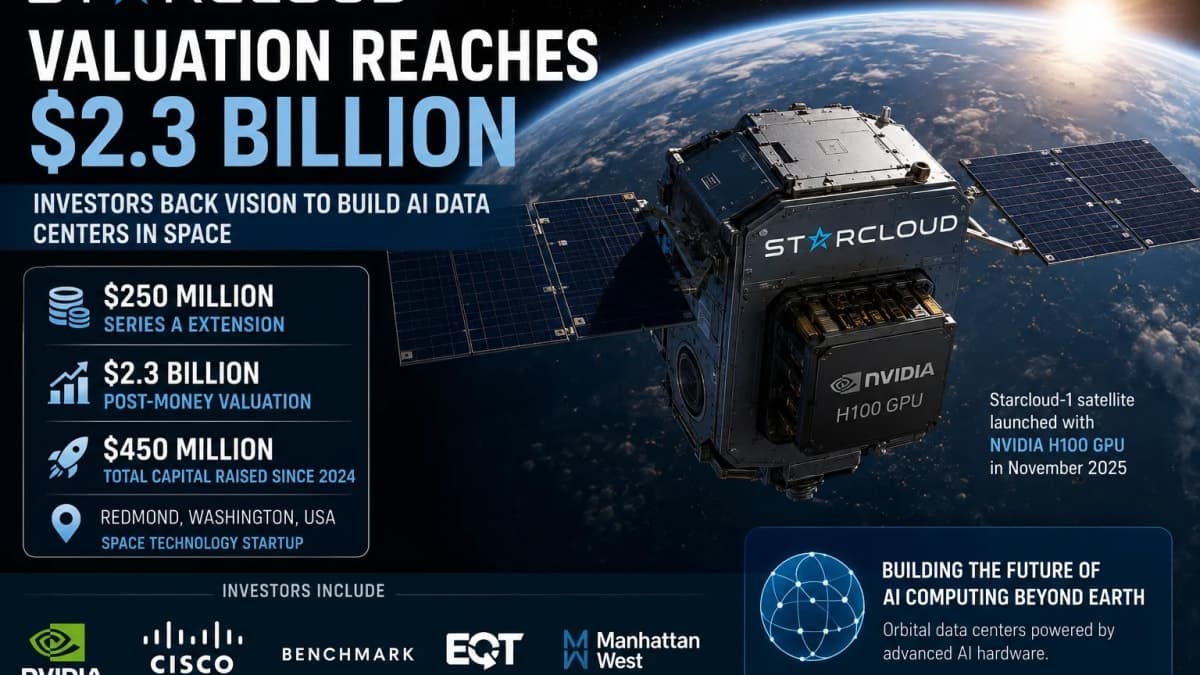
Starcloud Secures $250 Million in New Funding
Starcloud has taken another major step toward its vision of operating large-scale computing infrastructure beyond Earth.
The Redmond, Washington-based startup announced a $250 million extension to its Series A financing, valuing the company at $2.3 billion after the investment. The latest deal brings Starcloud's total capital raised since its founding in 2024 to approximately $450 million.
The funding round was led by Manhattan West, while new strategic investors included NVIDIA and Cisco Investments. Existing investors including Benchmark and EQT also participated.
The financing is particularly notable because Starcloud's valuation has risen rapidly. Earlier in 2026, the company raised $170 million at a valuation of approximately $1.1 billion. The latest transaction therefore represents a substantial increase in investor expectations for the company's technology and commercial potential.
What Is Starcloud Building?
Starcloud is pursuing an unconventional solution to one of the technology industry's biggest infrastructure challenges: finding enough power and physical capacity to support rapidly expanding artificial intelligence workloads.
Instead of building all AI data centers on Earth, the company wants to place high-performance computing infrastructure in orbit.
Its concept involves satellites equipped with powerful processors capable of handling AI inference and other computing workloads while operating in space.
The strategy could potentially provide access to abundant solar energy while reducing some of the land and power-grid pressures associated with conventional terrestrial data centers.
However, operating sophisticated computing equipment in orbit introduces an entirely different collection of engineering challenges, including radiation exposure, thermal management, communications, maintenance and launch expenses.
NVIDIA Relationship Strengthens Starcloud's AI Ambitions
One of the most significant aspects of Starcloud's development is its relationship with NVIDIA.
Starcloud launched its Starcloud-1 satellite in November 2025 carrying an NVIDIA H100 GPU. The company says the mission enabled several orbital computing demonstrations, including AI training, inference and fine-tuning.
Starcloud and NVIDIA are also collaborating on the NVIDIA Space-1 Vera Rubin Module, designed to help bring more advanced AI computing hardware into space.
NVIDIA's participation in the latest investment round adds another dimension to that relationship. Beyond providing technology, its financial involvement signals strategic interest in exploring how advanced accelerators might eventually operate outside conventional Earth-based data centers.
Why Starcloud Needs Another $250 Million
Building orbital computing infrastructure requires considerably more than designing powerful satellites.
Starcloud plans to use its new capital to increase manufacturing capacity, advance engineering programs and secure future launch opportunities.
Launch availability may prove particularly important.
Orbital data centers cannot expand without reliable and economically viable transportation to space. Starcloud's larger future spacecraft are expected to depend heavily on next-generation heavy-lift rockets capable of carrying substantially greater payloads.
The company is developing Starcloud-3, a much larger orbital data center spacecraft intended to eventually fly aboard SpaceX's Starship.
That dependence also represents a major business risk. Delays in new launch systems, limited launch availability or unexpectedly high transportation costs could slow the deployment of orbital computing infrastructure even if Starcloud successfully develops the underlying hardware.
From $1.1 Billion to $2.3 Billion
Starcloud's rapid increase in valuation illustrates how aggressively investors are betting on new infrastructure supporting artificial intelligence.
The company raised roughly $170 million in March 2026 at a $1.1 billion valuation. Only months later, its latest financing places the company at $2.3 billion.
Such growth reflects optimism surrounding the intersection of two capital-intensive industries: artificial intelligence and commercial space.
AI companies are searching for increasingly large amounts of computing power, while improvements in reusable rockets and satellite technology have made previously unrealistic space-based business models more plausible.
Starcloud sits directly at the intersection of those trends.
Why Orbital Data Centers Are Attracting Attention
AI infrastructure currently requires enormous quantities of electricity.
Modern data centers must power thousands of advanced processors while simultaneously operating extensive cooling systems. As AI adoption expands, securing electricity, land and grid connections has become an increasingly important challenge for technology companies.
Space-based computing proposes a radically different approach.
Satellites can potentially collect solar energy for extended periods and operate without competing directly for terrestrial land or grid capacity.
But the concept is far from proven at commercial scale.
Cooling is particularly complicated because conventional air- or water-based cooling methods cannot simply be transferred to the vacuum of space. Heat must instead be managed largely through radiation, requiring specialized thermal systems and potentially very large radiators.
Hardware must also survive radiation, launch vibrations and long operating periods where physical maintenance may be extremely difficult.
Starcloud's Biggest Opportunity — and Biggest Risk
The company's $2.3 billion valuation shows investors see significant potential in orbital computing.
If launch costs continue declining and Starcloud demonstrates that powerful AI processors can operate reliably in space, orbital data centers could eventually become another layer of global computing infrastructure.
The technology might complement rather than replace terrestrial facilities, particularly for workloads where energy availability or specialized infrastructure creates advantages.
But substantial uncertainty remains.
Starcloud must prove that the economics work after accounting for satellite manufacturing, launch costs, communications infrastructure, cooling systems and replacement cycles.
Terrestrial data centers are also improving quickly. More efficient processors, renewable energy projects, advanced cooling technologies and purpose-built AI facilities could reduce some of the advantages promised by orbital systems.
That means Starcloud is not merely racing other space-computing startups. It is competing against continuous innovation within the enormous existing data center industry.
What Happens Next?
The new funding gives Starcloud additional financial resources to move beyond early demonstrations toward much larger orbital computing systems.
Its progress will likely be judged by several milestones: whether future satellites launch successfully, whether next-generation GPUs operate reliably in orbit, whether manufacturing can scale efficiently and whether the company can secure sufficient launch capacity.
The $2.3 billion valuation therefore represents both investor confidence and heightened expectations.
Starcloud has demonstrated that advanced AI computing hardware can operate in orbit. The much larger challenge is proving that those demonstrations can evolve into infrastructure capable of competing economically with data centers on Earth.
If the company succeeds, computing could eventually become another major commercial industry extending beyond the planet.
This article is based on reporting published by The Economic Times.