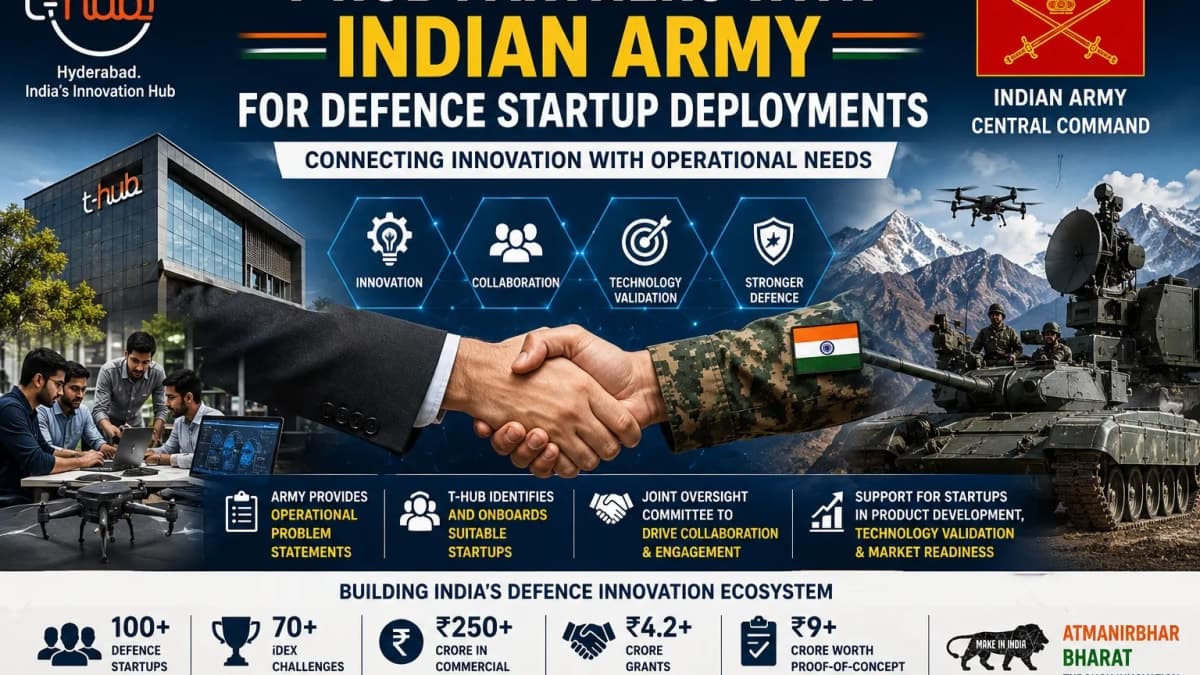
T-Hub and Indian Army Central Command Join Forces
India’s defence startup ecosystem is getting a new bridge between emerging technology and real-world military requirements.
T-Hub has entered into a strategic partnership with the Indian Army’s Central Command aimed at helping defence technology startups work more directly on operational challenges faced by the armed forces.
Under the arrangement, Central Command will provide active problem statements based on military requirements. T-Hub will then identify and select startups whose technologies and expertise could potentially address those challenges.
The model is designed to address one of the most difficult stages for defence startups: moving from a promising prototype to a technology that has been tested, refined and prepared for practical deployment.
How the T-Hub–Indian Army Partnership Will Work
The collaboration establishes a structured process connecting military users with startup founders.
Central Command will share operational problem statements with T-Hub, after which suitable startups will be identified to work on potential solutions.
A joint oversight committee will supervise the programme and coordinate engagement between the selected companies and Army stakeholders.
T-Hub is expected to assist participating startups with areas including product development, technology validation and market readiness.
Importantly, Army personnel will be able to provide operational feedback during development, giving founders an opportunity to modify their products around actual deployment requirements rather than relying solely on assumptions made in laboratories.
Why Direct Access to Army Users Matters
For defence technology companies, building an innovative product is only the beginning.
Military technologies frequently have to operate in environments far more demanding than ordinary commercial products. Reliability, ruggedness, security, interoperability and performance under difficult conditions can determine whether an innovation is genuinely useful to soldiers.
Direct interaction with military end users can therefore shorten the feedback loop between development and deployment.
Instead of spending years developing a technology before discovering that it does not fully meet operational requirements, startups can potentially receive feedback earlier and redesign their systems accordingly.
T-Hub CEO Kavikrut has highlighted this end-user connection as a central advantage of the partnership, arguing that founders need engagement with users to ensure technologies perform under real deployment conditions.
Partnership Expands T-Hub’s Existing Army Engagement
The Central Command agreement is not T-Hub’s first direct collaboration with the Indian Army.
The Hyderabad innovation hub already has an association with the Army’s Western Command. The latest agreement therefore expands its Command-level defence network and gives the organisation a broader role in connecting startups with military requirements.
That expansion could become important if different Army formations are able to expose startups to varied operational requirements.
India’s armed forces operate across diverse terrain and climatic conditions, meaning technologies designed for defence applications may need to perform under significantly different circumstances.
Access to multiple military stakeholders could consequently give startups a better understanding of the complexity involved in developing systems suitable for defence use.
T-Hub’s Role in India’s iDEX Ecosystem
T-Hub already has substantial involvement in government-backed defence innovation.
It is one of 28 organisations selected to implement the Ministry of Defence-led Innovations for Defence Excellence (iDEX) initiative.
According to information released around the partnership, T-Hub has engaged with more than 100 defence startups and hosted more than 70 iDEX challenges.
Startups operating within its defence ecosystem have also secured more than ₹250 crore in commercial defence orders, while receiving over ₹4.2 crore in grants and delivering approximately ₹9 crore worth of proof-of-concept projects, according to figures cited by T-Hub.
Those numbers indicate that the new Army collaboration is being built on an existing defence-startup pipeline rather than beginning from scratch.
From Prototype to Deployment: The Bigger Challenge
India has witnessed significant growth in deep-tech and defence entrepreneurship, but military innovation faces challenges that differ considerably from those of consumer technology startups.
A conventional software company can launch a product, collect customer feedback and release frequent updates.
Defence systems often face a much higher threshold.
Technologies may need extensive validation, security evaluation, environmental testing, integration with existing systems and approval through procurement processes before meaningful deployment becomes possible.
That creates what can effectively become a gap between successful demonstration and actual military adoption.
The T-Hub partnership is significant because it attempts to narrow that gap by introducing operational requirements and military feedback earlier in the startup development cycle.
Supporting India's Push for Indigenous Defence Technology
The partnership also fits into India's broader effort to strengthen domestic defence manufacturing and reduce dependence on imported technologies.
Initiatives such as iDEX have sought to bring startups, innovators and smaller technology companies into an industry traditionally dominated by established defence manufacturers and government organisations.
Startups can potentially contribute in areas where rapid experimentation is particularly valuable, including artificial intelligence, autonomous platforms, drones, robotics, communications, surveillance, cybersecurity, sensors and advanced materials.
The Central Command partnership does not guarantee that every participating technology will ultimately be procured or deployed.
However, creating structured access to operational problems could improve the chances that companies build solutions around genuine military demand.
Why the Collaboration Could Benefit Startups
For young defence companies, access to an actual military user can be almost as valuable as funding.
The partnership potentially gives selected founders three important advantages: clearer problem definitions, direct technical feedback and opportunities to validate solutions under realistic requirements.
It can also help startups establish credibility.
A technology successfully validated with military stakeholders may be better positioned when approaching investors, defence manufacturers or future procurement opportunities.
For deep-tech founders facing long development cycles and substantial research costs, reducing uncertainty around customer requirements can significantly influence business viability.
Potential Benefits for the Indian Army
The Army, meanwhile, gains access to a wider pool of entrepreneurs and emerging technologies.
Traditional defence procurement remains essential for major platforms and mature systems, but startup collaborations can offer a complementary mechanism for exploring technologies developing rapidly in the commercial sector.
This is particularly relevant in fields such as artificial intelligence, unmanned systems, computer vision and advanced electronics, where technological development can move faster than conventional acquisition cycles.
Providing clearly defined operational problems could encourage founders to direct engineering talent toward specific military requirements.
Challenges Will Determine the Partnership’s Long-Term Impact
Despite its potential, the real measure of the collaboration will not be the number of startups participating.
It will be the number of technologies that successfully move through testing, validation and eventual adoption.
Defence startups often encounter long procurement cycles, demanding certification requirements, limited initial order volumes and the high cost of hardware development.
There are also legitimate security and confidentiality considerations when private companies work closely with sensitive military requirements.
A successful programme will therefore require clear governance, realistic testing pathways and efficient communication between entrepreneurs and defence stakeholders.
The creation of a joint oversight committee provides a mechanism for managing those interactions, but execution will ultimately determine the programme's impact.
Why This Partnership Matters for India's Defence Startup Ecosystem
The T-Hub–Central Command partnership reflects an important shift in the relationship between India's military establishment and emerging technology companies.
Rather than expecting startups to independently develop products and later search for defence customers, the model begins with problems identified by the end user.
That approach can make innovation more demand-driven.
If the programme consistently converts Army requirements into tested technologies and ultimately deployable products, it could provide a useful template for deeper collaboration between India's startup ecosystem and armed forces.
The opportunity is significant, but so is the test ahead: transforming promising Indian defence technology into systems capable of performing reliably where they matter most—the field.
This article is based on reporting published by TOI.