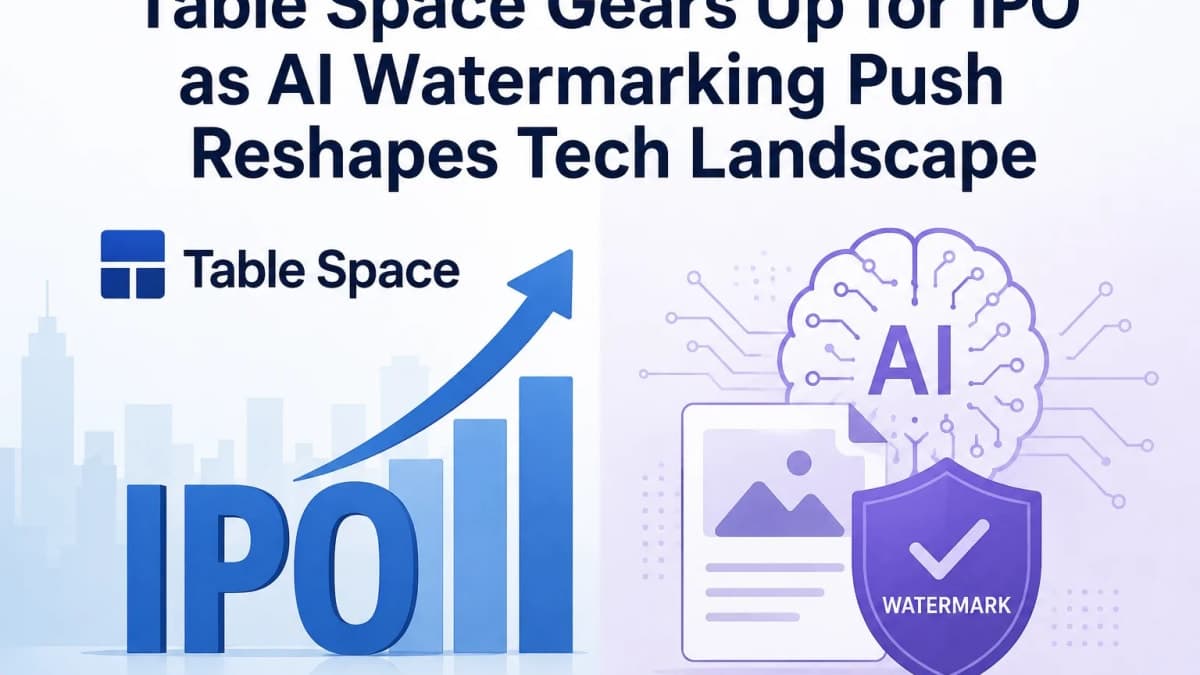
Table Space Moves Closer to IPO
Managed workspace company Table Space Technologies is preparing for a potential initial public offering as it seeks to build on the expansion of India's flexible and enterprise office market.
Reports in late July indicated that the company was preparing to file its Draft Red Herring Prospectus and could seek to raise roughly $350 million through an IPO. The final structure, valuation, timing and size of any offering remain subject to the formal filing process and market conditions.
Table Space has expanded rapidly since its establishment in 2017. According to company information, its leasable portfolio reached approximately 11.46 million square feet as of March 2026.
Its growth reflects a broader shift in India's commercial property market, where large companies increasingly want offices that can be deployed quickly without requiring them to manage every aspect of conventional long-term leasing and workplace development.
GCC Growth Is Supporting the Managed Workspace Market
One important factor behind demand is the expansion of Global Capability Centres (GCCs) in India.
Multinational corporations are continuing to build technology, engineering, finance, analytics and other strategic operations in cities including Bengaluru, Hyderabad, Mumbai, Pune, Chennai, Gurugram and Noida.
Managed workspace providers can benefit from this trend because they offer companies ready-to-use office infrastructure combined with greater flexibility.
Table Space has specifically focused on enterprise customers rather than positioning itself solely as a traditional coworking operator.
The company says it serves more than 315 enterprise clients across eight Indian cities.
Its Hyderabad expansion provides an example of this strategy. In 2026, Table Space added close to 500,000 square feet in the city as demand from GCCs and enterprises continued to grow.
Why a Table Space IPO Would Matter
A successful listing could become another important test of investor appetite for India's flexible workspace industry.
The sector has evolved considerably from its early coworking image. Large operators increasingly compete for multinational corporations and domestic enterprises that require sophisticated offices without necessarily wanting to develop and manage those facilities themselves.
For Table Space, access to public capital could provide additional financial flexibility for expansion, new workspace acquisitions and investment in technology and services.
An IPO would also expose the company's performance to greater scrutiny.
Public investors are likely to focus on occupancy, profitability, lease commitments, cash generation, customer concentration and the sustainability of expansion.
AI Watermarking Becomes a Major Technology Issue
At the same time, another important transformation is taking place within artificial intelligence: watermarking AI-generated content.
AI companies and technology platforms are facing increasing pressure to provide ways of distinguishing synthetic material from human-created or authentic content.
Watermarking can involve embedding signals into generated text, images, audio or video so that specialized systems can later identify the content as AI-generated.
The issue has become particularly significant as generative AI makes realistic synthetic material cheaper and easier to produce.
Claude Introduces Watermarking Measures
Anthropic has announced watermarking measures for content produced by its Claude AI systems.
For text, the company is introducing an imperceptible watermark intended to remain detectable after common actions such as copying, pasting and relatively minor edits.
For generated images, provenance information can be attached using C2PA, an industry standard designed to provide information about the origin and editing history of digital media.
The initiative comes as technology companies respond to expanding transparency requirements, particularly in Europe.
AI watermarking is therefore moving beyond a purely experimental technology and becoming part of the wider debate about accountability in generative AI.
Why AI Watermarking Matters
The explosion of generative AI has created a difficult authenticity problem.
Images can be generated that resemble photographs. Voices can be cloned. Videos can be manipulated or created artificially, while AI-generated text can increasingly resemble human writing.
Watermarks and provenance systems attempt to create an additional layer of transparency.
Potential applications include identifying synthetic political content, reducing impersonation risks, helping publishers assess AI-generated submissions and allowing online platforms to label machine-generated media.
The technology could also help organizations establish clearer rules around AI use.
Watermarking Is Not a Perfect Solution
Despite its potential, watermarking should not be treated as a universal solution to AI misinformation.
Some watermarking systems may become less reliable after substantial editing, translation, cropping, compression or other transformations.
Metadata-based provenance systems can also face difficulties when information is removed during processing or when content passes through platforms that do not preserve it.
There is another important limitation: failing to detect a watermark does not necessarily prove that something was created by a human.
For that reason, watermarking is more useful as one component of a broader authenticity framework rather than as definitive proof of authorship.
Two Trends, One Changing Technology Economy
Table Space's IPO preparations and the growing adoption of AI watermarking may appear unrelated, but they illustrate two important forces influencing modern businesses.
The first is scale.
Companies operating in fast-growing sectors are increasingly looking toward public markets to fund expansion and provide liquidity to investors.
The second is trust.
As artificial intelligence becomes embedded in communication, entertainment, education and professional work, technology companies are being pushed to make generated content more transparent and traceable.
Both trends can ultimately influence how investors evaluate technology-oriented businesses.
Growth remains important, but governance, regulatory readiness and credibility are becoming equally difficult to ignore.
Balanced Analysis
Table Space's expansion gives the company exposure to India's growing enterprise office and GCC market. However, managed workspace businesses also carry risks associated with real-estate commitments, economic cycles and occupancy levels.
The IPO process will provide investors with more detailed financial information once formal offer documents become available, allowing a clearer assessment of those strengths and risks.
AI watermarking faces a different challenge.
Stronger provenance systems could improve transparency and discourage some forms of deceptive AI use. But watermarking technology has technical limitations and can create debates over privacy, authorship and how AI-assisted work should be treated.
Neither development represents a guaranteed solution to the challenges facing its respective industry.
Instead, both illustrate how businesses are adapting as India's corporate economy expands and the global technology sector enters a more regulated phase.
Conclusion
Table Space's preparations for a potential IPO highlight the increasing maturity of India's managed workspace industry, supported in part by enterprise expansion and the continuing growth of GCCs.
Meanwhile, the push toward AI watermarking shows how quickly the generative-AI debate is shifting from simply improving model capabilities toward establishing authenticity, transparency and accountability.
For investors, companies and consumers alike, the next phase of the technology economy may therefore be defined not only by how quickly businesses grow, but also by how effectively they establish trust while doing so.
This article is based on reporting published by Inc42.