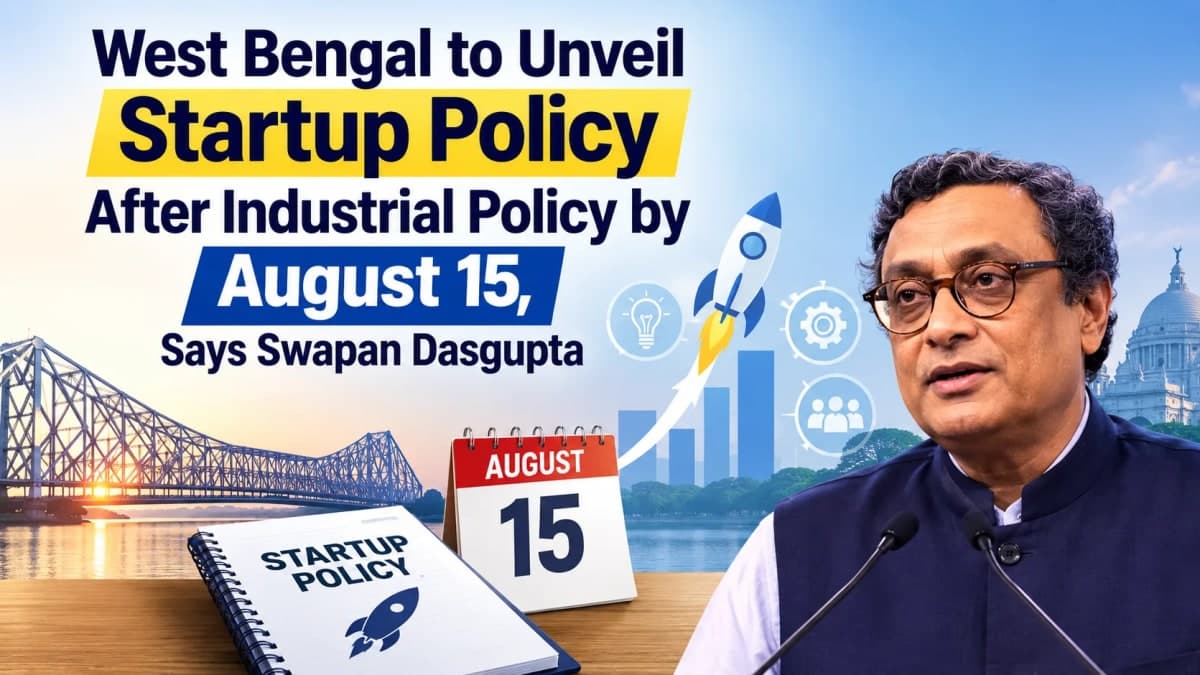
West Bengal Plans Dedicated Startup Policy Following New Industrial Policy Rollout
West Bengal is set to take another step toward strengthening its business ecosystem with plans to formulate a dedicated startup policy after the state tables its new industrial policy by August 15, according to Swapan Dasgupta.
The announcement indicates that the government intends to build a comprehensive framework for entrepreneurs after establishing broader industrial priorities. The proposed startup policy is expected to complement the industrial roadmap by encouraging innovation-driven enterprises, improving access to funding opportunities, and creating an environment that supports new businesses.
The move reflects growing recognition that startups have become an important driver of economic development, technological innovation, and employment generation across India.
Industrial Policy to Lay the Foundation
Industrial policies generally define a state's long-term economic priorities by identifying key sectors for investment, manufacturing expansion, infrastructure development, and business facilitation.
Once the industrial policy is introduced, the startup policy is expected to build upon those priorities by focusing specifically on emerging businesses, technology ventures, innovation hubs, and entrepreneurship.
This phased approach could help ensure that startup incentives are aligned with the state's broader economic objectives.
Focus on Innovation and Entrepreneurship
A dedicated startup policy could introduce measures designed to support entrepreneurs at different stages of business development.
Possible focus areas may include startup incubation, mentorship, skill development, access to venture capital, research collaborations, simplified regulatory processes, and stronger industry-academia partnerships.
Such initiatives can encourage innovation while helping young companies scale their operations more effectively.
Growing Competition Among States
Several Indian states have introduced startup-focused policies over the past decade to attract entrepreneurs, technology companies, and private investment.
As competition intensifies to become preferred destinations for innovation-led businesses, states are increasingly offering infrastructure support, funding assistance, tax incentives, and incubation facilities to strengthen their startup ecosystems.
West Bengal's proposed policy could position the state more competitively in this evolving landscape if implemented with clear execution mechanisms.
Why the Policy Matters
Startups contribute to economic diversification by creating new products, services, and business models while generating employment opportunities across multiple sectors.
A dedicated startup framework can help improve investor confidence, encourage local entrepreneurship, support innovation-led manufacturing, and accelerate digital transformation across industries.
For young entrepreneurs, a well-designed policy can reduce barriers to entry and provide greater institutional support during the early stages of business growth.
Challenges Ahead
While announcing a startup policy represents an important step, its effectiveness will ultimately depend on implementation.
Industry experts often emphasize that policy success requires efficient execution, timely approvals, easier access to financing, high-quality incubation networks, skilled talent availability, and continuous collaboration between government, academia, investors, and private industry.
Ensuring that startups beyond major urban centers also benefit from the policy will be another important consideration.
Why This Matters
West Bengal's decision to formulate a startup policy following its industrial policy signals a broader effort to strengthen the state's innovation economy. By combining industrial development with entrepreneurship-focused initiatives, the government aims to attract investment, create jobs, encourage technology-led growth, and enhance the state's competitiveness within India's expanding startup ecosystem.
Balanced Analysis
A dedicated startup policy has the potential to improve West Bengal's attractiveness for entrepreneurs and investors by providing a structured support system. However, the policy's long-term impact will depend less on its announcement and more on practical implementation, ease of doing business, funding accessibility, infrastructure development, and sustained engagement with the startup community.