Updated: September 26, 2026
What Is a Marriage Certificate?
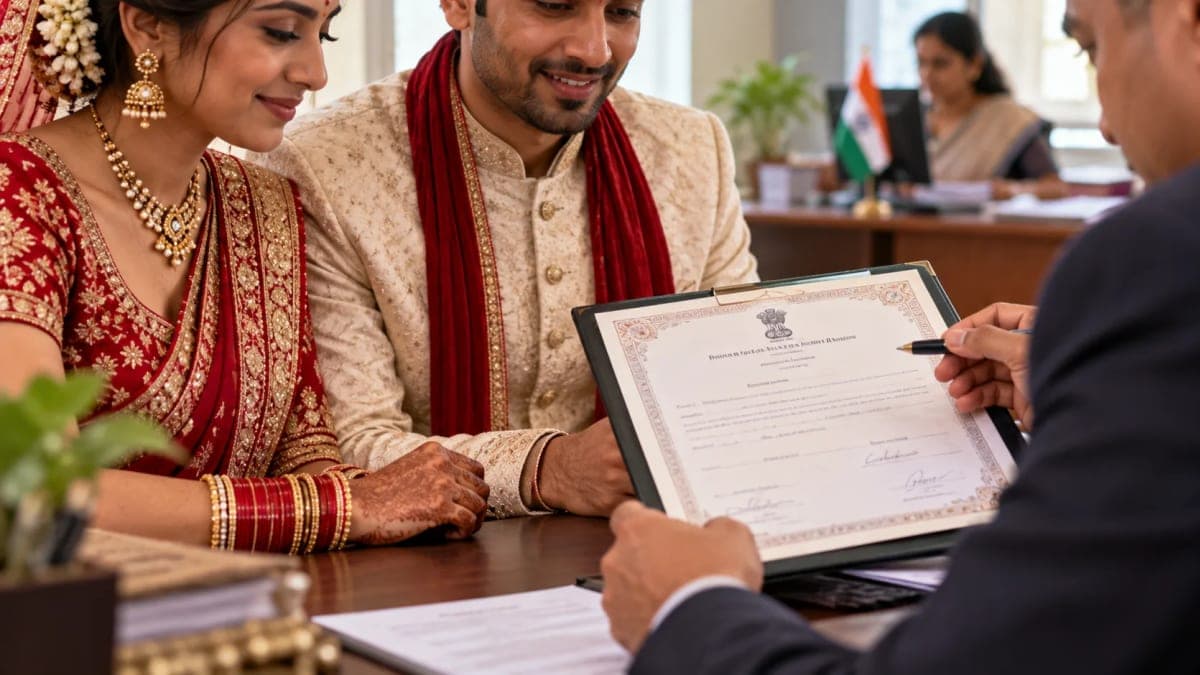
A marriage certificate is an official document issued after a marriage has been registered with the competent government authority.
It records the marriage and typically identifies the spouses and other registration particulars. It should not be confused with wedding photographs, a wedding invitation, or a certificate issued solely by a religious institution; those may sometimes serve as supporting evidence, but the government-issued registration certificate is the formal civil record.
India does not have one single registration workflow applicable in exactly the same way everywhere. The relevant law and registration authority can depend on factors including the couple's circumstances and the state or Union Territory in which registration takes place. NIC specifically notes that marriage registration is governed by rules framed by states.
Why Is a Marriage Certificate Important?
A wedding ceremony establishes the marriage according to the applicable personal or civil law, but having the marriage officially registered provides documentary evidence that can be produced before government departments and other institutions.
The National Informatics Centre identifies marriage registration as relevant for matters including passport applications, property and inheritance issues, and claims involving bank deposits or insurance benefits of a spouse.
It can therefore become particularly useful when spouses need to establish their marital relationship for administrative or legal purposes.
Depending on the authority and circumstances, a marriage certificate may also be requested in processes involving visas or immigration, adding or updating a spouse's details in official records, financial matters, succession or other legal proceedings.
The exact document requirements for each of those services should always be checked separately; possession of a marriage certificate does not automatically determine a person's entitlement to a visa, inheritance, insurance payment or any other benefit.
Is Marriage Registration Compulsory in India?
The legal framework needs some explanation.
In Seema v. Ashwani Kumar, the Supreme Court directed that marriages of Indian citizens belonging to different religions should be compulsorily registered in the states and Union Territories where they are solemnised, with states/UTs framing appropriate rules.
Registration procedures consequently operate through the applicable central legislation together with state-specific laws and rules.
For example, Maharashtra has the Maharashtra Regulation of Marriage Bureaus and Registration of Marriages Act, 1998 and Maharashtra Marriage Rules, 1999. The state's Law and Judiciary Department continues to list the 1998 Act, while the Department of Registration and Stamps publishes the applicable marriage-registration rules.
This is why couples should not assume that an online guide written for Delhi, Maharashtra, Gujarat or another state automatically applies throughout India.
Marriage Registration in India: Step-by-Step Process in 2026
The following is a general workflow. Your state's official portal or Marriage Registrar's instructions take precedence.
Step 1: Determine the Applicable Registration Route
First establish which law and registration procedure applies to your marriage.
For example, Delhi's Revenue Department states that an already solemnised marriage may be registered under the Hindu Marriage Act, 1955 where the applicable conditions are met. Its guidance identifies the Act as applicable where both spouses are Hindus, Buddhists, Jains or Sikhs, or have converted to one of those religions. Other circumstances may involve the Special Marriage Act, 1954 or another applicable legal framework.
Do not select an Act simply because its online process appears easier. The correct route depends on the marriage and the law applicable to the couple.
Step 2: Find the Official Registration Authority
Visit your state/UT government's official marriage-registration portal or contact the competent Marriage Registrar, Sub-Registrar, municipal authority, gram panchayat or other designated authority.
Some states provide online or partly online applications.
For example, Maharashtra's Aaple Sarkar system lists Marriage Certificate among the public services available online in the relevant local-government category.
Avoid unofficial websites that look like government portals but charge additional service fees merely to submit information you can provide directly to the government.
Step 3: Create an Account Where Online Registration Is Available
Where the state provides an online service, applicants generally need to create an account or log in.
Maharashtra's Aaple Sarkar portal, for example, allows users to create a profile using mobile OTP verification and then attach the required identity, address and other supporting documents when applying for services.
Use the spouses' names exactly as they appear on the supporting documents whenever the form requires them.
Step 4: Prepare the Required Documents
The precise checklist differs by jurisdiction, but commonly requested documents can include:
completed application/marriage memorandum;
identity proof of both spouses;
age/date-of-birth proof;
residence/address proof;
photographs of the spouses;
proof relating to the marriage, such as wedding photographs or an invitation card where required;
witness identity documents;
divorce decree/order if either spouse was previously divorced; and
former spouse's death certificate where a spouse is widowed.
For example, Maharashtra's official registration flow under its 1998 Act lists identity proof, age proof, residence proof, a marriage invitation card—or an affidavit where the invitation is unavailable—as well as documents applicable to divorcees or widows/widowers. It also specifies photographs and witness information.
The list should be treated as an example of Maharashtra's requirements, not as a universal India-wide checklist.
Step 5: Complete the Marriage Registration Application
Enter details carefully, particularly:
Names → dates of birth → addresses → date and place of marriage → marital status → spouse details → witness details.
Errors at this stage can create problems later when the certificate is used for another official process.
Maharashtra's Aaple Sarkar registration guidance specifically advises applicants to carefully recheck spellings because profile information can be used as the basis for government certificates.
Step 6: Upload Documents and Photographs
If your jurisdiction permits online submission, upload clear copies in the prescribed format and size.
Do not digitally alter identity documents, remove information from them or upload documents that do not correspond with the application.
Keep originals available because the Registrar may require them for verification.
Step 7: Submit the Application and Pay the Prescribed Fee
Complete the submission and pay the official government fee where applicable.
Save the acknowledgement, payment receipt and application/reference number.
Some systems allow applicants to use that reference number to track the status of their application. Maharashtra's published procedure, for example, provides for generation of a reference number after submission.
Fees can vary according to the jurisdiction, applicable law, type of application and whether registration is delayed. Applicants should therefore check the current amount on the relevant official portal rather than relying on an old article or social-media post.
Step 8: Attend Verification With Your Spouse and Witnesses If Required
Online application does not necessarily mean the entire process can be completed without appearing before the registration authority.
Depending on the applicable law and state procedure, the spouses and witnesses may have to appear before the Marriage Registrar for verification, signatures, photographs or biometric formalities.
Original identity documents should be carried when required.
Step 9: Registrar Verifies the Application
The designated authority checks the application and supporting evidence.
If information is incomplete or inconsistent, applicants may be asked to correct the application or provide additional documentation.
Approval should therefore not be assumed simply because the online application and fee have been successfully submitted.
Step 10: Marriage Is Registered and Certificate Issued
Once the statutory requirements and verification process have been completed, the competent authority registers the marriage and issues the marriage certificate.
Whether the certificate is delivered digitally, physically or both depends on the relevant government's system.
Couples should immediately check the certificate for spelling errors, dates and other incorrect particulars.
Important Difference: Registering an Existing Marriage vs Getting Married Under the Special Marriage Act
This distinction can prevent considerable confusion.
If a couple has already undergone a valid marriage ceremony and wants documentary registration, that is not necessarily the same process as two people using the Special Marriage Act to solemnise their marriage before a Marriage Officer.
For an intended marriage under the Special Marriage Act, the statutory process includes a notice procedure. Maharashtra's published online procedure, for example, states that the parties proceed to the Marriage Office for solemnisation after 30 days from receipt of the notice, subject to the applicable process.
Therefore, articles that simply tell every newly married couple that they must “wait 30 days for a marriage certificate” can be misleading. The procedure depends on what the couple is applying for and under which law.
Maharashtra Marriage Certificate: Example of the Current Process
For readers in Maharashtra, the state's official material provides a useful example.
Under the registration flow published for the 1998 Maharashtra Act and 1999 Rules, an application is submitted after solemnisation of the marriage through the prescribed marriage memorandum. Supporting documents include identity, age and residence evidence, marriage-related evidence and, where applicable, divorce or death documentation. Witnesses also form part of the process.
Maharashtra's Right to Public Services listing currently shows a five-working-day service limit for a Marriage Certificate in the listed Gram Panchayat service, with the Gram Sevak as designated officer. That service standard should not be interpreted as a universal five-day guarantee for every type of marriage-registration application across Maharashtra.
Maharashtra Aaple Sarkar portal
What If You Married Years Ago but Never Registered the Marriage?
Do not assume that an older marriage can no longer be registered.
Delayed-registration rules, documentary requirements, affidavits and fees depend on the applicable state law and the circumstances of the marriage.
Couples in this situation should contact the competent registrar and provide the available evidence of the marriage rather than entering an incorrect recent marriage date merely to complete an online form.
Common Mistakes to Avoid
The most common practical problems are mismatched spellings between identity documents and the application, incorrect dates, insufficient proof of residence or marriage, missing witness documentation, applying through the wrong legal route, relying on unofficial portals, and assuming requirements from one state apply throughout India.
Most importantly, do not pay an agent merely because someone claims that marriage certificates cannot be obtained directly from the government. Start with your state/UT's official government portal or registration authority.
Bottom Line
A marriage certificate provides an official government record of a marriage and can become important long after the wedding itself—for passports, financial and insurance matters, inheritance and property issues, and other official procedures.
But there is no single step-by-step online process that can accurately cover every couple in India. The applicable legislation, state rules, registration authority, documentation, fees and processing procedure can differ.
For a reliable application, determine the correct legal route, use the official state/UT portal, prepare the prescribed documents, submit the application, complete any required in-person verification with witnesses, and carefully check the issued certificate.
Sources
This guide is based primarily on information from the Supreme Court of India, National Informatics Centre (NIC), National Government Services Portal, Maharashtra Aaple Sarkar portal and official state marriage-registration authorities. Because marriage registration is administered through state/UT systems, applicants should verify the current requirements with the relevant local registrar before applying.