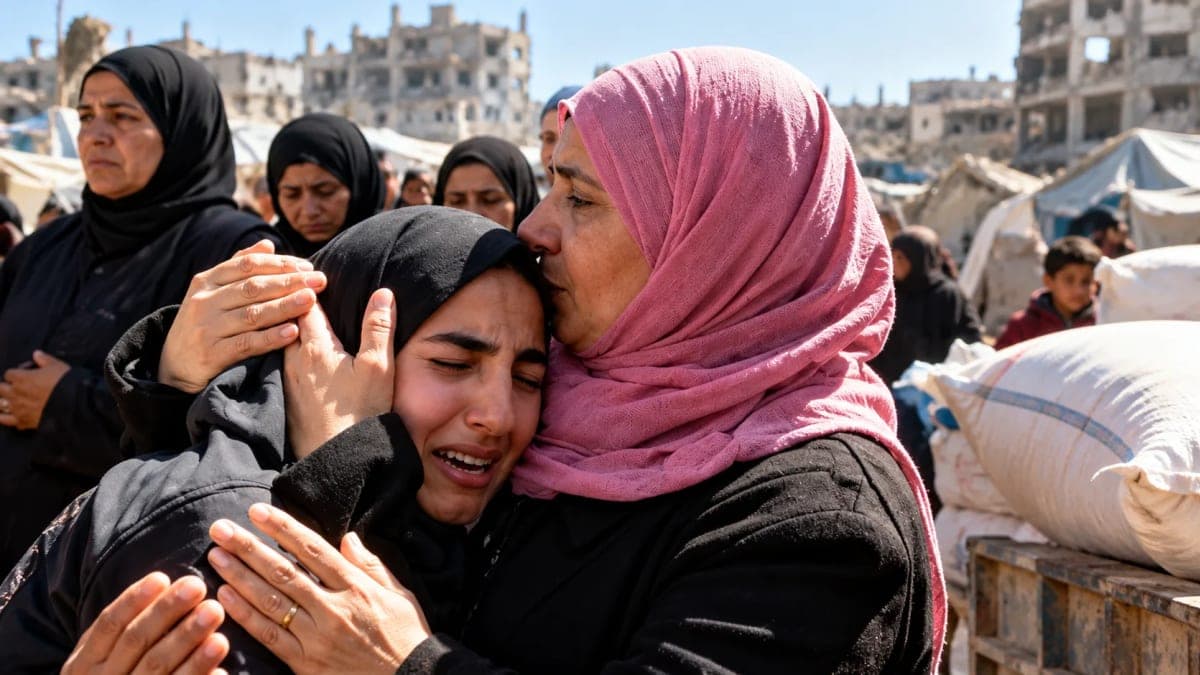
A Disturbing Account Emerges From Gaza
A testimony collected from displaced women in Gaza has described a 14-year-old girl being married in exchange for two bags of flour during a period of severe food insecurity, highlighting the extreme pressures facing families after years of conflict, displacement and economic hardship.
The account appears in research highlighted by the United Nations Population Fund (UNFPA), which has documented a broader rise in reported child and forced marriages in Gaza.
According to testimony reported from a displaced woman, a father married his 14-year-old daughter in exchange for two bags of flour so that he and his other children could eat. Six women living in different displacement camps described similar exchanges.
The individual case should be understood as testimony rather than an independently verified marriage record. However, it appears within a wider body of UNFPA research documenting increasing risks of child marriage and other forms of gender-based violence in Gaza.
Reported Forced and Child Marriages Rise 123%
UNFPA said on September 23 that reported forced and child marriage increased by 123% between January and June 2026.
The agency linked the increase to severe hunger, poverty, loss of income and prolonged disruption to education.
UNFPA also reported that overall recorded gender-based violence incidents increased by 60% during the first six months of 2026. The agency cautioned that this reflects both a worsening protection environment and expanded services that have made it easier for some survivors to report abuse.
That distinction is important: the figures describe reported cases, not a complete count of every child or forced marriage occurring across Gaza.
Testimonies Collected From 230 Displaced Women
A separate UNFPA report, “I Want to Feel Safe Again: Women’s Voices From Displacement Camps in Khan Younis and Gaza City,” is based on the experiences of 230 women living in displacement camps.
Researchers conducted 16 focus-group discussions between December 2025 and January 2026.
The study examines how conflict and displacement have intensified existing gender inequalities and increased risks of gender-based violence while making it harder for women and girls to access protection, assistance and justice.
The account involving the 14-year-old girl is therefore part of qualitative testimony gathered from women affected by displacement, rather than a standalone case independently documented through court or marriage-registration records.
Hunger and Poverty Are Changing Family Decisions
UNFPA says child marriage in Gaza is increasingly being driven by survival pressures.
Families experiencing extreme poverty and displacement may view marriage as a financial coping mechanism or as a way of protecting girls amid insecurity and overcrowded living conditions.
The loss of caregivers, destruction of livelihoods, displacement and disruption of education have further increased girls' vulnerability.
Before the current conflict, child marriage had been declining in Palestine. UNFPA says the proportion fell from 26% in 2009 to 11% in 2022 across Palestine, although separate Gaza-specific registered-marriage data cited by the agency put the share of marriages involving girls under 18 at 17.9% in Gaza in 2022, down from more than 28% in 2009.
The war appears to be reversing that progress.
At Least 400 Girls Aged 14–16 Received Marriage Permissions
Earlier evidence had already indicated a significant shift.
UNFPA reported in April 2026 that emergency court records reviewed by partner organisations showed that at least 400 girls between the ages of 14 and 16 received marriage permissions during just four months of 2025.
The agency warned that even this number may represent only part of the actual situation because Gaza's registration systems have been heavily disrupted and some marriages take place informally.
This makes precise estimates of the total number of child marriages particularly difficult.
Orphaned Girls Face Additional Risks
The loss of parents and caregivers has created another layer of vulnerability.
Women interviewed for the UNFPA-related research described girls being married at young ages after losing their parents, with relatives facing financial and social pressure to care for them.
One woman described two girls in her family, aged 14 and 15, being married by their uncles after their parents had died.
These testimonies reinforce UNFPA's broader finding that loss of caregivers, economic hardship and weakened protection systems can increase pressure for early marriage.
Child Marriage Also Raises Health Concerns
The consequences extend beyond the marriage itself.
UNFPA says increasing child marriage has been accompanied by rising adolescent pregnancy, which can expose girls to greater risks of complications during pregnancy and childbirth.
The agency reported in April that adolescent birth rates had more than doubled compared with pre-war levels, citing 2025 data from the Ministry of Health/UNFPA sexual and reproductive health dashboard.
Girls facing malnutrition, disrupted healthcare and inadequate sanitation may encounter additional risks during pregnancy.
Broader Gender-Based Violence Is Also Rising
The child-marriage findings form part of a larger deterioration in protection for women and girls.
UNFPA's April–June 2026 analysis, based on cases managed by partners in Gaza's Gender-Based Violence Case Management Taskforce, found continuing problems involving denial of resources, physical assault, psychological and emotional violence, forced and early marriage, and sexual violence.
In its September statement, UNFPA said physical assault represented 31% of reported GBV incidents, while psychological and emotional violence accounted for another 31%. Denial of necessities such as food, cash, shelter and other assistance represented about one-third of reported incidents.
Why the “Two Bags of Flour” Story Needs Context
The account of a 14-year-old girl being married for two bags of flour is striking, but there is an important distinction between the testimony and UNFPA's quantitative findings.
The 123% increase in reported forced and child marriage comes from UNFPA's monitoring and partner data. The individual two-bags-of-flour case comes from testimony collected from displaced women.
Presenting the latter as a separately verified transaction would therefore go beyond what the available evidence establishes.
What is firmly documented is the broader pattern: UNFPA says reported child and forced marriages are increasing sharply while hunger, poverty, displacement, interrupted education and weakened protection systems are placing girls under greater pressure.
Primary sources: United Nations Population Fund (UNFPA), including its September 23, 2026 statement on gender-based violence in Gaza, its April–June 2026 GBV Trends Analysis, and its report based on interviews with 230 displaced women in Gaza City and Khan Younis.