FieldAI Targets $700 Million in New Funding
The race to build artificial intelligence that can operate in the physical world is attracting another major investment.
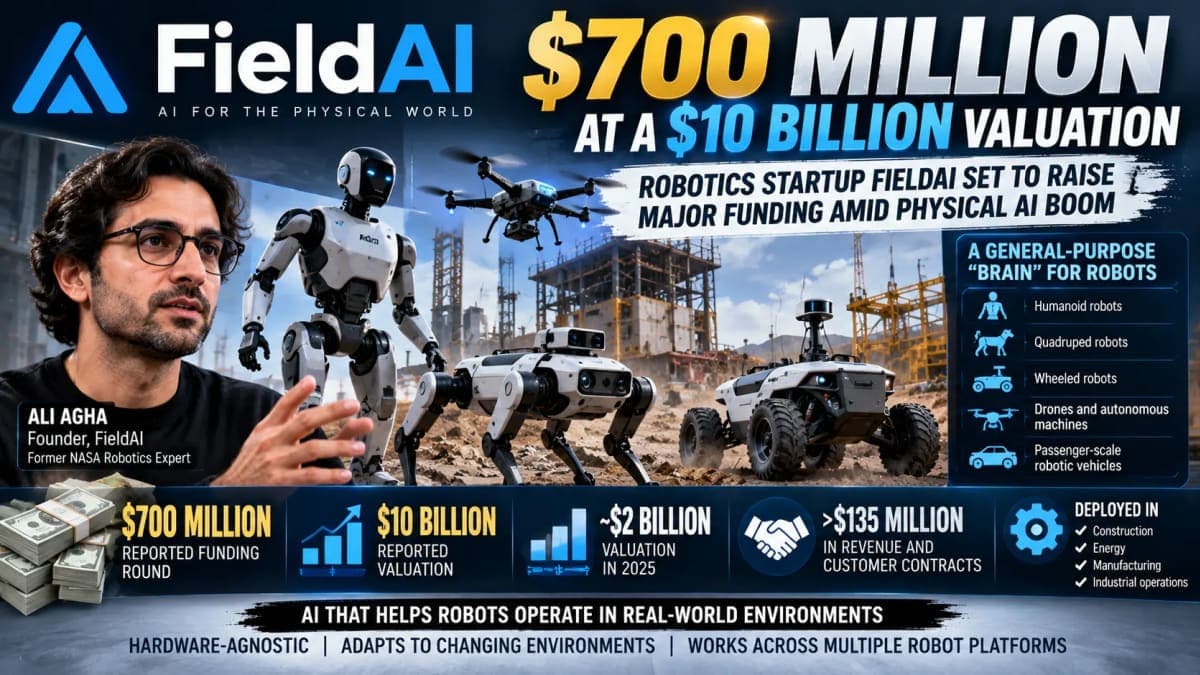
California-based robotics startup FieldAI is reportedly set to secure $700 million in financing at a valuation of approximately $10 billion.
Business Insider first reported the deal, citing a person familiar with the financing. A term sheet has been signed, but the transaction had not formally closed when the report was published. The lead investor was also not identified in the initial reporting.
That distinction is important: the $700 million financing and $10 billion valuation should currently be described as a reported pending transaction, rather than a completed funding round.
Valuation Could Jump Fivefold
If completed on the reported terms, the financing would represent an extraordinary increase in FieldAI's valuation.
The company was valued at approximately $2 billion in 2025, meaning the new transaction would lift its valuation roughly fivefold in a little over a year.
FieldAI announced in August 2025 that it had raised $405 million across two consecutive funding rounds. Its investors included Bezos Expeditions, BHP Ventures, Canaan Partners, Emerson Collective, Intel Capital, Khosla Ventures, Nvidia's NVentures, Prysm Capital and Temasek, while Gates Frontier and Samsung were listed among earlier investors.
The proposed $700 million financing would therefore be significantly larger than the combined amount FieldAI disclosed in those two previous rounds.
What Does FieldAI Actually Build?
Unlike robotics companies focused on manufacturing their own humanoid or industrial robots, FieldAI primarily develops the intelligence that controls robots.
The company calls its technology Field Foundation Models (FFMs).
FieldAI describes these models as a hardware-independent autonomy system designed to work across multiple robotic forms, including:
humanoid robots
quadruped or robot-dog platforms
wheeled robots
industrial rovers
drones and other autonomous machines
passenger-scale robotic vehicles
FieldAI says its models are designed to help robots operate in unpredictable environments without depending on pre-built maps, GPS or fixed paths.
That approach is central to the company's ambition: rather than creating separate intelligence for every robot, FieldAI wants to build a more general software layer capable of operating across different machines.
From Construction Sites to Industrial Operations
FieldAI is concentrating heavily on environments where conventional automation can struggle.
Its technology has been deployed or tested across sectors including construction, energy, manufacturing and industrial inspection. The company said in its 2025 funding announcement that its systems had been tested and deployed across hundreds of complex industrial environments.
Construction sites provide a useful example.
Layouts can change constantly as structures are built, equipment moves and workers enter or leave different areas. A robot dependent entirely on a fixed map can therefore encounter difficulties.
FieldAI's pitch is that its AI models can respond to changing environments while accounting for physical uncertainty and risk.
More Than $135 Million in Reported Revenue and Contracts
Investor interest also appears to be supported by FieldAI's reported commercial progress.
Business Insider reported that the company has accumulated more than $135 million in revenue and customer contracts across more than 30 customers, including businesses operating in construction, data centres and defence-related industries.
The figure reportedly increased by at least $35 million since June.
However, an important financial distinction applies.
The reported $135 million combines revenue with customer contract value. It therefore should not be interpreted as $135 million in recognised annual revenue or recurring revenue. Some contract value may represent work or deployments that have yet to be delivered.
That makes direct valuation-to-revenue comparisons difficult based on currently public information.
Founded by Former NASA Robotics Expert Ali Agha
FieldAI was founded in 2023 by robotics researcher Ali Agha, who previously spent years at NASA's Jet Propulsion Laboratory working on autonomous systems.
The company's wider technical team includes people with experience at organisations including Google DeepMind, Google Brain, Tesla Autopilot, NASA JPL, SpaceX, Zoox, Cruise, Amazon and DARPA, according to FieldAI.
This background helps explain the company's emphasis on “field robotics”—machines expected to operate outside carefully controlled laboratory or factory environments.
Why Investors Are Betting on ‘Physical AI’
The proposed financing is part of a much larger investment trend around physical AI.
Generative AI systems demonstrated that foundation models could perform many digital tasks using a common underlying architecture.
Robotics startups are pursuing a related idea for machines: can sufficiently capable AI models allow different robots to understand their surroundings, make decisions and perform multiple physical tasks?
If that approach succeeds, companies may not need to build completely separate intelligence systems for every robot and every environment.
That possibility has attracted enormous amounts of venture capital.
FieldAI Faces Heavily Funded Rivals
FieldAI is not alone in pursuing general-purpose robotic intelligence.
Other heavily funded startups, including Physical Intelligence and Skild AI, are developing technologies intended to help robots operate across multiple tasks and environments.
Recent reporting places Physical Intelligence at a valuation around $11 billion, while Skild AI has been valued above $14 billion.
A $10 billion valuation would therefore place FieldAI within the same broad group of highly valued physical-AI companies.
The approaches are not identical, however, so headline valuations alone do not provide a direct comparison of their technology or commercial progress.
Why FieldAI's Hardware-Agnostic Strategy Matters
One potentially important element of FieldAI's strategy is that it does not need to win the race to manufacture a dominant robot.
Its software is designed to work across different hardware platforms.
In theory, that could allow FieldAI to become an intelligence layer used by multiple robot manufacturers—similar to how software platforms can operate across many types of computing hardware.
The company says its models have already been demonstrated across quadrupeds, humanoids, wheeled platforms and passenger-scale vehicles.
If that model scales successfully, the potential market could extend well beyond any single category of robot.
But a $10 Billion Valuation Comes With Big Expectations
The reported valuation also introduces significant expectations.
Robotics is fundamentally more difficult than many purely digital AI applications because errors occur in the physical world.
A chatbot producing an incorrect sentence is one type of failure. An autonomous machine incorrectly interpreting a construction site, warehouse or industrial environment can have much more serious consequences.
Robotics companies therefore have to solve challenges involving reliability, safety, perception, dexterity, hardware integration and unpredictable real-world conditions.
The industry's impressive demonstrations also do not necessarily establish that large-scale commercial deployments will deliver attractive returns.
That makes FieldAI's reported $10 billion valuation a substantial bet on both technological progress and future demand.
Why This Funding Story Matters
FieldAI's reported financing highlights a shift occurring in the AI investment cycle.
Much of the first generative-AI investment wave centred on large language models, cloud computing and AI chips.
Increasingly, investors are looking toward the next frontier: AI systems capable of interacting with the physical world.
Industrial robots already play an important role in manufacturing, but many traditional systems operate in structured environments and perform carefully programmed tasks.
The larger opportunity envisioned by physical-AI companies is different: machines capable of adapting to changing environments and handling a broader range of work.
FieldAI is betting that the intelligence powering those machines can become a major technology platform in its own right.
What Happens Next?
The first thing to watch is whether the reported $700 million round formally closes—and whether the final valuation and financing terms remain consistent with the reported term sheet.
Beyond fundraising, FieldAI will ultimately need to demonstrate that its technology can scale from pilots and individual deployments into widespread commercial operations.
Customer growth, recognised revenue, deployment scale, reliability and measurable returns for customers will therefore be more meaningful long-term indicators than valuation alone.
For now, the proposed deal is another powerful sign of investor enthusiasm for physical AI—but a $10 billion price tag also raises the bar considerably for what FieldAI will be expected to deliver.