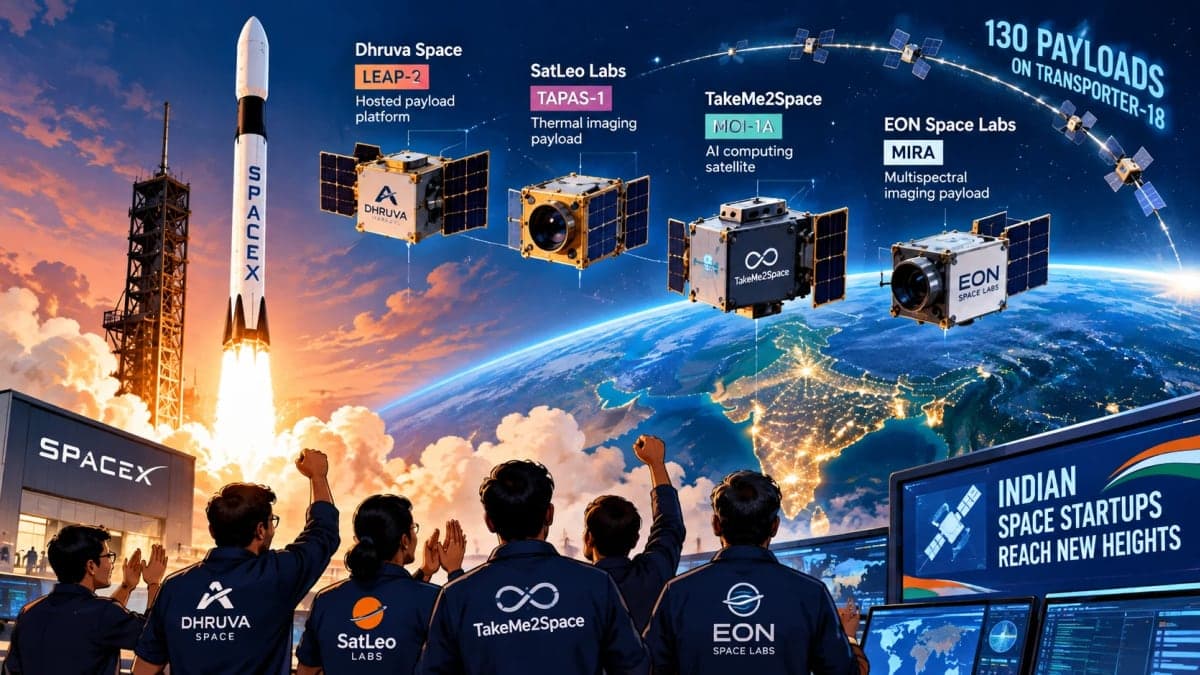
Indian Private Space Technologies Reach Orbit on Falcon 9
India's rapidly expanding private space industry has reached another milestone, with technologies from four Indian startups travelling to orbit aboard SpaceX's Falcon 9 rocket.
The Transporter-18 rideshare mission launched from Space Launch Complex 4E at Vandenberg Space Force Base in California, carrying 130 payloads including CubeSats, microsatellites, hosted payloads and orbital transfer vehicles.
Indian participation included technologies developed by Dhruva Space, TakeMe2Space, SatLeo Labs and EON Space Labs.
The missions are particularly notable because they are not all testing the same type of technology. Instead, the Indian companies are targeting different parts of the emerging commercial space economy: satellite hosting, thermal intelligence, Earth observation and AI-based processing directly in orbit.
Dhruva Space Deploys LEAP-2
Hyderabad-based Dhruva Space successfully deployed LEAP-2, its second commercial mission built around the company's P-30 satellite platform.
LEAP stands for Launching Expeditions for Aspiring Payloads. The programme allows customers to place technologies aboard Dhruva's satellite platform rather than developing an entire spacecraft simply to demonstrate an instrument.
LEAP-2 hosts multiple technologies, including a star tracker developed by France's Sodern and SatLeo Labs' TAPAS-1 thermal-imaging payload.
Dhruva Space also handled the end-to-end integration of LEAP-2 with the Falcon 9 launch vehicle.
That capability is commercially significant because it moves the company beyond manufacturing satellite hardware into areas including launch integration, hosted payload services, mission operations and ground infrastructure.
LEAP-2 was successfully deployed at around 1 a.m. IST on October 2, according to the company.
SatLeo Labs Sends TAPAS-1 Thermal Sensor to Space
Ahmedabad-based SatLeo Labs used the mission to place TAPAS-1 — Thermal Access Platform for Analytics & Solutions — into orbit aboard LEAP-2.
The startup describes TAPAS-1 as India's first dedicated commercial CubeSat-category thermal payload.
Unlike conventional optical cameras that primarily observe reflected light, the payload uses thermal infrared sensing to detect temperature patterns on Earth's surface.
That capability could eventually support applications including urban heat mapping, crop-stress monitoring, wildfire and disaster observation, infrastructure monitoring and analysis of industrial activity.
The mission is intended to demonstrate TAPAS-1's sensing performance, calibration and data-processing capabilities in the space environment before SatLeo expands its commercial thermal-imaging ambitions.
TakeMe2Space Puts AI Computing Into Orbit
Another major Indian technology aboard Transporter-18 is MOI-1A, developed by Hyderabad-based TakeMe2Space.
The 14-kg spacecraft is designed around a different approach to satellite data: rather than transmitting every piece of raw imagery to Earth before analysing it, MOI-1A can process information aboard the satellite itself.
The spacecraft carries computing capacity of approximately 117 trillion operations per second (TOPS), around 2 TB of onboard storage, and imaging capabilities.
Customers can upload AI models that analyse satellite data while the spacecraft is in orbit. The system can then transmit the resulting information rather than requiring the entire raw dataset to be downloaded first.
This approach could reduce communication requirements and accelerate the delivery of useful information for applications such as agriculture, mining, supply-chain monitoring and insurance.
TakeMe2Space has said it has signed 23 customers for the mission.
EON Space Labs' MIRA Joins the Mission
MOI-1A also carries technology developed by another Hyderabad company, EON Space Labs.
Its MIRA imaging system is an ultra-compact, 502-gram multispectral optical instrument designed for Earth observation.
The company says the compact telescope architecture is intended to provide stable, high-quality imaging while reducing the size and mass traditionally associated with satellite optical systems.
Potential applications include agriculture, marine monitoring, mining, supply chains and insurance.
MIRA is also significant because this is not its first attempt to reach operational orbit. An earlier flight opportunity aboard India's PSLV-C62 in January 2026 was affected by an upper-stage anomaly that prevented payload deployment.
The Falcon 9 mission therefore gives the technology another opportunity for orbital demonstration.
Transporter-18 Carries 130 Payloads
The Indian missions formed only one part of the much larger Transporter-18 flight.
SpaceX said the dedicated small-satellite rideshare mission carried 130 payloads, including CubeSats, microsatellites and hosted payloads.
Four orbital transfer vehicles aboard the mission are carrying 41 payloads scheduled for deployment later.
SpaceX says its rideshare programme has now launched more than 1,800 payloads into orbit, demonstrating how shared launches have become an important route to space for smaller satellite operators.
Why the Mission Matters for India's Private Space Sector
The significance for India extends beyond the number of Indian payloads aboard a single rocket.
India's private space ecosystem is increasingly moving from experimental hardware development toward specialised commercial services.
The Transporter-18 payloads illustrate several possible business models simultaneously.
Dhruva Space is developing infrastructure through which other companies can host experiments and payloads. SatLeo is pursuing commercial thermal intelligence. EON Space Labs is developing compact optical systems, while TakeMe2Space is attempting to make orbital computing available as a service.
Together, these approaches demonstrate how India's private space sector is broadening beyond rockets and conventional satellite manufacturing.
India's Space Reforms Opened the Door to Private Players
The growth follows policy changes introduced from 2020 onward that expanded private participation in India's traditionally government-dominated space sector.
IN-SPACe — the Indian National Space Promotion and Authorization Centre — now acts as the government body responsible for promoting and authorising private space activity.
Indian companies have since increased their presence across satellite manufacturing, Earth observation, propulsion, launch vehicles, space situational awareness and downstream data services.
Government data published earlier this year highlighted companies including Pixxel, Digantara, Dhruva Space, Bellatrix, GalaxEye, TakeMe2Space and others that have demonstrated private-sector orbital technologies.
IN-SPACe also maintains working relationships with more than 45 countries, according to the Indian government.
International Launches Highlight Both Opportunity and Challenge
The Falcon 9 mission also illustrates an important reality for India's commercial space industry.
Indian companies are developing increasingly sophisticated spacecraft and payloads, but some continue to rely on international providers for timely access to orbit.
SpaceX's rideshare programme gives small companies the ability to purchase capacity on regularly scheduled missions rather than financing an entire dedicated launch.
For startups, that can reduce both cost and waiting time.
At the same time, India's domestic commercial launch ecosystem is expanding. Indian private companies are developing orbital launch vehicles, while ISRO continues to provide launch opportunities through vehicles including PSLV and SSLV.
The long-term development of the sector will therefore involve both international launch partnerships and increased domestic launch capacity.
From Sending Data to Earth to Processing It in Space
One of the most consequential technologies on the mission could be orbital computing.
Traditional Earth-observation satellites collect data and transmit it to ground stations, where computers process the information.
That model can become inefficient as modern sensors generate increasingly large datasets.
TakeMe2Space's approach seeks to shift part of that processing into orbit. Instead of transmitting hundreds of gigabytes of imagery, an AI system could identify relevant objects or changes and send only the resulting information to Earth.
The technology is still at an early commercial stage, and its economics, reliability and customer demand will need to be demonstrated over multiple missions.
But if successful, orbital edge computing could become an important component of future Earth-observation systems.
A Broader Test for India's NewSpace Ambitions
Transporter-18 should therefore be viewed as more than a successful launch.
The next stage is demonstrating that the Indian technologies work reliably in orbit and can produce services customers are willing to purchase.
Thermal imaging must generate useful and accurately calibrated temperature data. MIRA must demonstrate its compact optical system in operational conditions. MOI-1A must prove that AI processing in orbit can provide meaningful commercial advantages, while LEAP-2 must demonstrate that Dhruva's hosted-payload model can operate reliably for customers.
Success in those areas would give the startups valuable flight heritage — a crucial credential when competing for future commercial and institutional contracts.
For India's private space sector, reaching orbit is an important milestone. Turning those technologies into dependable, scalable businesses will be the more demanding test that follows.