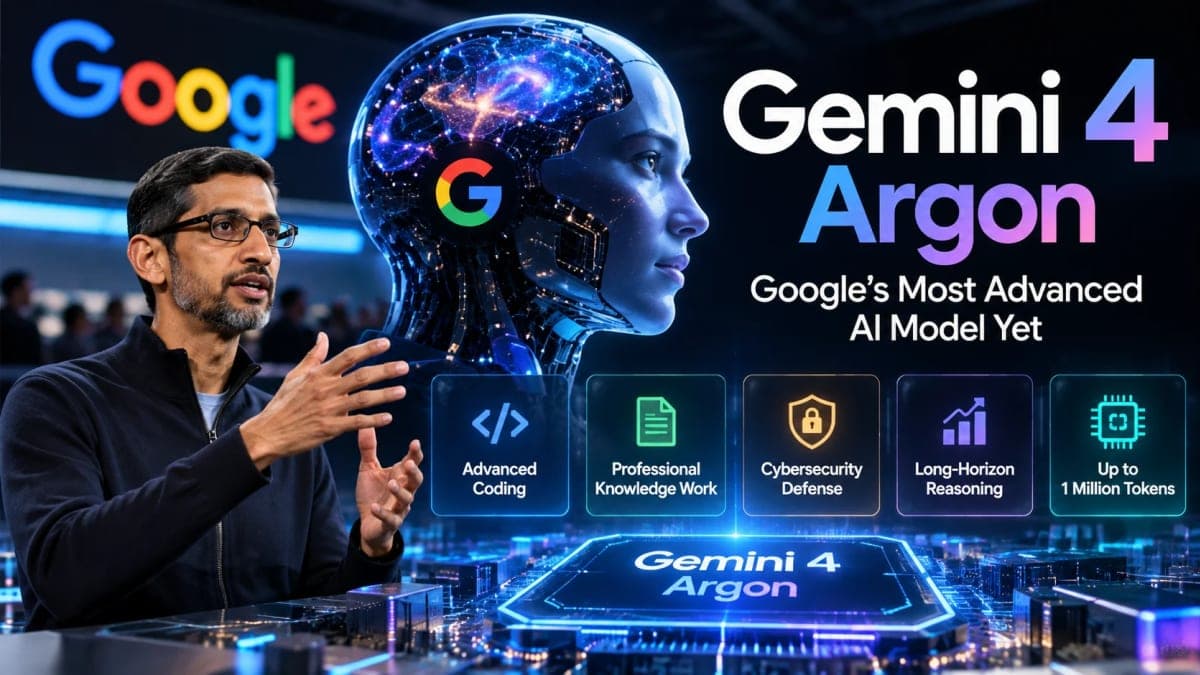
Google Introduces Gemini 4 Argon
Google has unveiled Gemini 4 Argon, opening a new generation of its artificial intelligence models as competition over increasingly capable AI systems continues to accelerate.
Announced on September 30, 2026, Argon is designed to handle demanding tasks that require sustained reasoning rather than simply generating quick answers to individual prompts.
Google describes the system as a frontier model intended for complex, long-horizon workflows spanning software engineering, professional research and cybersecurity.
The launch represents an important shift in the Gemini family following Google's recent focus on faster models such as Gemini 3.7 Flash and Gemini 3.8 Flash.
Built for Long and Complex AI Tasks
A central goal behind Gemini 4 Argon is enabling an AI system to continue working through complicated problems over extended sequences of reasoning and actions.
Google says the model has been developed for areas including:
Real-world software engineering
Coding and debugging
Financial research
Legal and professional knowledge work
Complex research tasks
Defensive cybersecurity
Long-running AI workflows
Rather than positioning Argon primarily as a conventional chatbot, Google is emphasizing its ability to tackle work that may involve multiple interconnected steps.
That direction reflects a broader industry shift toward AI systems capable of functioning more like agents that can work through larger assignments instead of responding only to isolated questions.
One Million Token Output Limit
One of Argon's most notable technical changes is its substantially expanded output capacity.
Google says Gemini 4 Argon supports an output limit of up to one million tokens, giving the model room to sustain exceptionally long computational or reasoning trajectories.
The company argues that this additional capacity can help when a problem requires the model to explore, revise and continue working through many stages before producing a result.
A larger token allowance by itself does not guarantee that every answer will be more accurate. However, it can give advanced models considerably more working space for tasks involving large software projects, research or complicated multi-stage problems.
Google Employees Are Already Using Argon
Gemini 4 Argon is not only an experimental research system.
Google says thousands of its employees have already been using the model internally for specialised coding, deeper research and writing tasks.
Software-engineering applications highlighted by the company include debugging and working with large codebases.
Internal adoption is significant because enterprise AI increasingly depends on whether models can deliver practical productivity improvements beyond controlled benchmark tests.
However, Google's descriptions of internal performance remain company-reported results, and broader independent evaluation will provide additional evidence once Argon becomes more widely accessible.
Cybersecurity Is a Major Focus
Cybersecurity is one of the most important—and potentially sensitive—areas of Gemini 4 Argon's development.
Google says the model has demonstrated an ability to autonomously identify, validate and patch critical software vulnerabilities.
That could potentially allow cybersecurity teams to discover weaknesses more quickly and reduce the time required to investigate and repair vulnerable systems.
But advanced cybersecurity capabilities also create an obvious challenge.
The same improvements that make AI useful for identifying security flaws can increase concerns about how powerful models might be misused.
Google is therefore limiting access during Argon's initial rollout.
Fairwind Program Gets Early Access
Instead of immediately making Gemini 4 Argon available to everyone, Google is initially providing the model to selected cybersecurity defenders through its Fairwind Program.
The restricted deployment gives Google an opportunity to observe how the model behaves in demanding real-world security environments while maintaining tighter controls over access.
Google says it is prioritising additional safety evaluation before broader availability.
The company has not announced an exact date for a full public release.
That makes the September announcement an unveiling and limited rollout rather than unrestricted consumer availability.
Why Gemini 4 Argon Matters
The significance of Argon extends beyond improvements to individual benchmark scores.
AI companies are increasingly trying to build systems capable of completing larger portions of professional work independently.
For software developers, that could mean AI that investigates a problem across an entire codebase rather than merely generating a short function.
For financial and legal professionals, it could involve analysing extensive collections of information and completing longer research workflows.
For cybersecurity teams, increasingly autonomous models could potentially identify vulnerabilities, test whether they are genuine and help develop fixes.
These capabilities could increase productivity, but they also raise questions around reliability, human oversight, security and accountability.
Google Pushes Further Into the Frontier AI Race
Gemini 4 Argon arrives amid intense competition among developers of frontier AI models.
Google is competing with companies including OpenAI and Anthropic as the industry shifts from conventional generative AI toward systems capable of coding, reasoning and carrying out increasingly complex tasks.
Reuters reported that a Google spokesperson described Argon as the company's most performant model for complex workloads and said it was competitive with other frontier systems on important coding and cybersecurity benchmarks.
Such comparisons should nevertheless be interpreted cautiously.
Benchmark results can help measure specific capabilities, but they do not necessarily predict performance across every real-world workload. Independent testing will become particularly important once researchers and developers gain wider access to Argon.
Safety Could Determine How Quickly Argon Expands
Google's controlled rollout highlights one of the central tensions surrounding increasingly capable AI systems.
Models capable of independently finding and repairing software vulnerabilities could provide substantial defensive benefits.
At the same time, stronger reasoning and cybersecurity capabilities require safeguards designed to reduce the possibility of misuse.
Google says Argon is undergoing rigorous safety testing before broader deployment.
The company is also participating in a US government process involving pre-release access to advanced AI models, according to Reuters.
The decision to restrict early access suggests Google is attempting to evaluate both the benefits and risks before making Argon's full capabilities widely available.
From Gemini 3 to Gemini 4
Gemini 4 Argon also marks the beginning of Google's next major Gemini generation.
During 2026, Google expanded the Gemini 3 family through models including Gemini 3.5, Gemini 3.7 Flash and Gemini 3.8 variants.
Those releases increasingly emphasised agentic workflows, coding, multimodal interaction and specialised capabilities.
Argon takes that strategy further by concentrating more computational capacity on difficult tasks requiring sustained reasoning.
The development suggests that the next phase of competition in generative AI may increasingly revolve around how long and reliably models can work on complicated real-world problems—not simply how quickly they can produce an answer.
What Happens Next?
The biggest question surrounding Gemini 4 Argon is when developers and consumers will receive broader access.
Google says the model is rolling out soon, but its initial availability remains restricted to trusted cybersecurity defenders through Fairwind.
Broader deployment will provide a clearer indication of whether the improvements demonstrated in Google's internal evaluations translate into consistent gains for businesses, developers and individual users.
Until then, claims about Argon's performance should be viewed in context: Google has demonstrated considerable advances and positioned the model as its new frontier system, but independent real-world evaluation remains important.
Gemini 4 Argon nevertheless signals Google's direction clearly.
The company is betting that the next generation of AI will be defined not merely by better conversational responses, but by models capable of reasoning, coding, researching and executing increasingly complicated workflows over much longer periods.