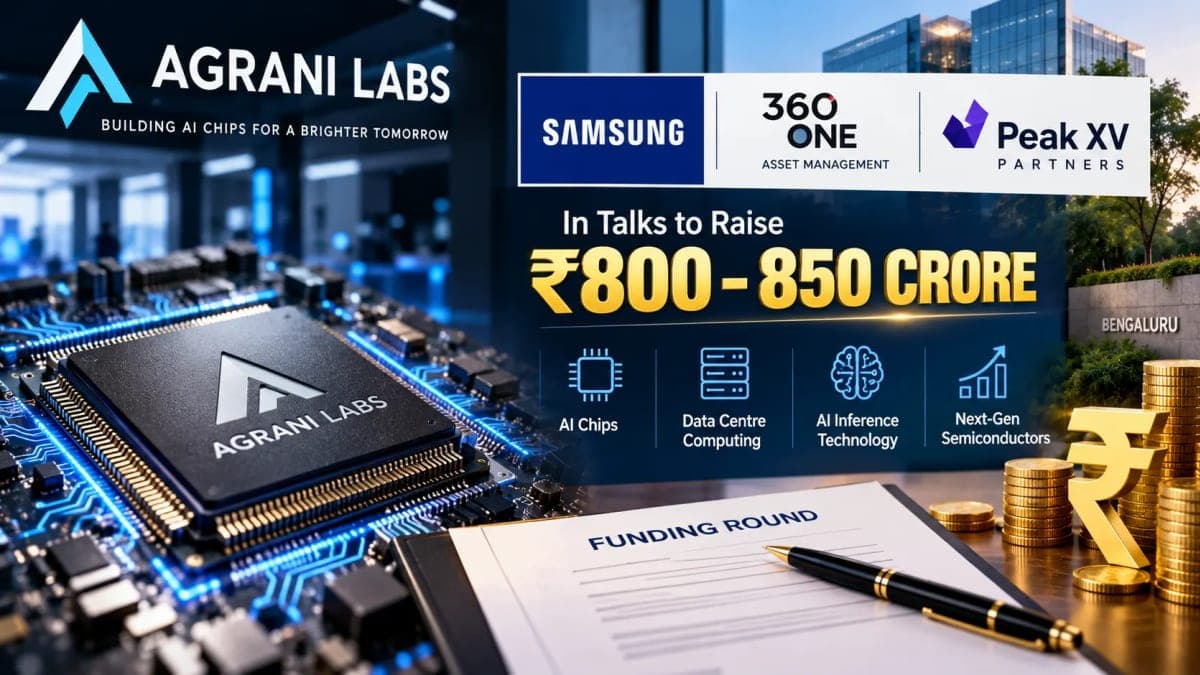
Bengaluru, October 2, 2026: Indian semiconductor startup Agrani Labs is in talks to secure between ₹800 crore and ₹850 crore in fresh capital as it works to develop high-performance chips for artificial-intelligence computing.
South Korean technology group Samsung, 360 ONE Asset Management and existing investor Peak XV Partners are in discussions to participate in the financing, The Economic Times reported, citing people aware of the matter.
The key qualification is that the funding remains under discussion. Neither the reported ₹800–850 crore amount nor the participation of all prospective investors should be treated as a completed transaction until the parties formally announce it.
Funding Could Value Agrani at ₹2,400–2,500 Crore
If completed on the terms currently being discussed, the financing could value Agrani Labs at approximately ₹2,400–2,500 crore on a post-money basis, according to ET's reporting.
The size of the proposed investment reflects the capital requirements of semiconductor development. Unlike many software businesses, chip companies can face substantial expenditure before commercial products reach customers, including engineering, verification, intellectual-property licensing, manufacturing preparation and testing.
The latest discussions also represent an increase from figures reported just a month ago. Moneycontrol reported on September 1 that Agrani was then seeking roughly $50 million, with Peak XV and 360 ONE among the investors in discussions and a valuation of approximately $160–200 million being considered.
That difference illustrates why current numbers should be described as negotiated or proposed terms rather than final financing figures.
Agrani Also Eyes ₹120–130 Crore Under Government RDI Scheme
Private investment is only one part of Agrani's reported financing plans.
The Bengaluru company is also looking at an application for around ₹120–130 crore under the government's Research, Development and Innovation (RDI) scheme, according to the people cited by ET.
Such financing could supplement private capital as Agrani moves through expensive semiconductor research and product-development stages.
Again, the distinction matters: Agrani reportedly plans to apply for the RDI financing. It should not yet be described as having received ₹120–130 crore from the government.
What Does Agrani Labs Build?
Agrani Labs is developing semiconductor technology aimed at AI and data-centre computing.
Earlier reporting by The Economic Times said the company was working on AI inference chips and pursuing compatibility with Nvidia's CUDA software ecosystem. Agrani was founded by four semiconductor industry veterans with backgrounds at Intel and AMD.
The company's work puts it in a technically demanding part of the AI market. While generative-AI applications receive much of the public attention, the underlying computing infrastructure depends heavily on GPUs and other accelerators capable of processing large AI workloads.
That has made AI semiconductor design an increasingly strategic field globally.
From $8 Million Seed Round to Much Larger Capital Plans
Agrani emerged from stealth earlier in 2026 after raising an $8 million seed round led by Peak XV Partners, according to ET's latest report.
By May, reports indicated that the company was exploring a much larger $100 million Series A and had held discussions with potential investors including Qualcomm and Battery Ventures.
The latest ₹800–850 crore figure therefore fits into a broader pattern: Agrani has been exploring substantially more capital as it moves beyond its initial development stage.
However, previous fundraising discussions also demonstrate why negotiations should not be confused with closed rounds. Potential investors, valuations and final amounts can change before agreements are signed.
Why Samsung's Potential Participation Matters
Samsung's reported involvement is noteworthy because the company has extensive operations across semiconductors, memory and advanced chip manufacturing.
A strategic technology company participating in an Indian semiconductor startup's funding round could bring significance beyond financial capital. However, the current reporting establishes only that Samsung is in talks to participate. It does not establish a manufacturing partnership, supply agreement or other commercial arrangement between Samsung and Agrani.
Those distinctions are important because investment discussions do not automatically imply that Samsung would manufacture Agrani's chips or provide other semiconductor services.
Why the Fundraise Matters for India's Semiconductor Ambitions
Agrani's fundraising effort comes as Indian semiconductor startups attempt to move from early design work toward commercially deployable products.
Developing a competitive AI processor requires more than designing the chip itself. Companies also need software that allows developers and data-centre operators to use the hardware effectively. Manufacturing and testing add further technical and financial challenges.
This helps explain why semiconductor startups often require substantially more capital than conventional early-stage software companies.
If Agrani completes the reported financing, the capital could give the company greater resources to pursue its AI-chip roadmap. But funding alone does not guarantee technical or commercial success: the company would still need to translate its designs into working silicon, build a viable software ecosystem and ultimately win customers in a market dominated by established global semiconductor companies.
What Happens Next?
The immediate question is whether the current negotiations result in signed investment agreements and whether the final amount, valuation and investor group match those presently under discussion.
Until that happens, the accurate description is straightforward: Agrani Labs is in talks to raise ₹800–850 crore; it has not been publicly confirmed that the company has completed that round.
For India's deep-tech ecosystem, the negotiations are nevertheless notable because they demonstrate the level of capital being discussed around domestic AI semiconductor development.