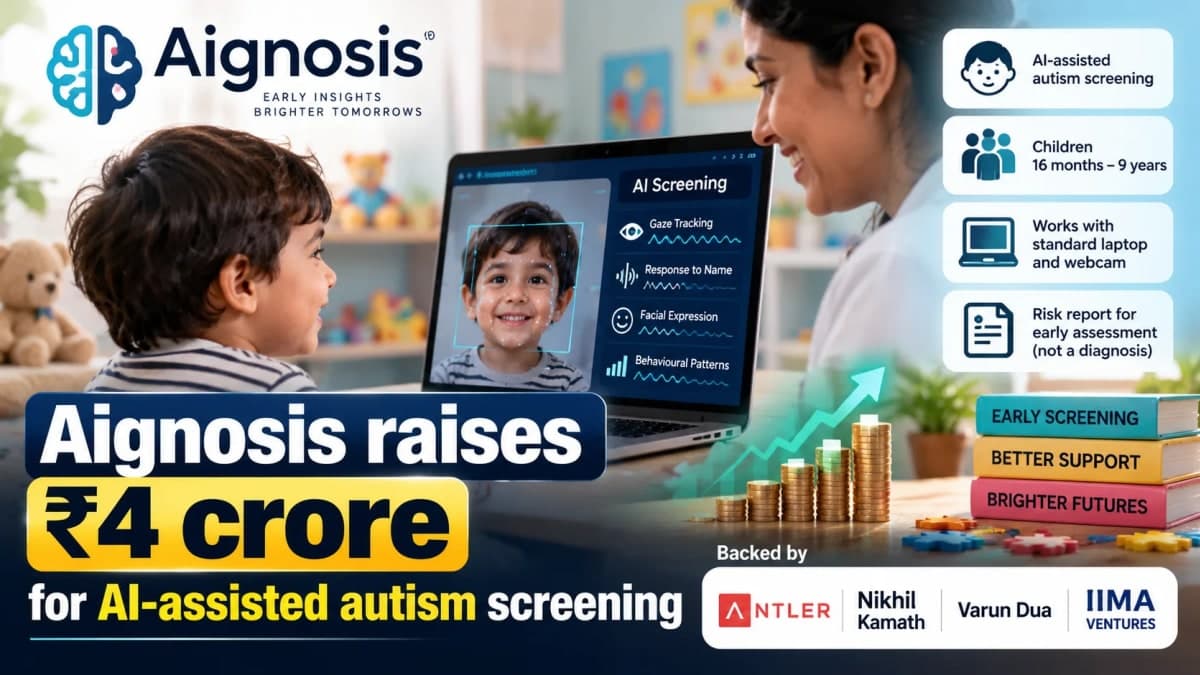
Aignosis Secures ₹4 Crore Seed Funding
Healthtech startup Aignosis has raised ₹4 crore in a seed funding round as it prepares to expand its artificial intelligence-assisted autism and developmental screening platform across India's healthcare ecosystem.
The round included participation from Antler, entrepreneur and investor Nikhil Kamath, Varun Dua and IIMA Ventures.
The new capital marks a shift for the startup from developing and validating its technology toward deploying it more widely across healthcare settings.
Aignosis co-founder Raksheet Jain said the company's next phase will focus on improving access to autism screening, strengthening referral pathways and building a model that can operate across both public and private healthcare systems.
How Aignosis' AI-Assisted Screening Works
Aignosis has developed a screening system intended for children between 16 months and nine years of age.
The system uses equipment that is already widely available — a standard laptop and webcam.
During a screening session, a child watches content organised around nine stimulus modules. Computer-vision technology then evaluates behavioural signals including gaze patterns, response to their name and reactions to facial expressions.
The system generates a risk report indicating whether further clinical assessment may be appropriate.
An important distinction is that the Aignosis screening does not itself diagnose autism.
Aignosis describes its technology as an initial screening layer. Its own reports state that the system is designed to identify potential developmental risks and should not replace a comprehensive clinical evaluation by qualified healthcare professionals.
Why the Screening-versus-Diagnosis Distinction Matters
The difference between screening and diagnosis is particularly important when artificial intelligence is used in healthcare.
A screening system can help identify children who may benefit from further evaluation, potentially allowing healthcare providers to prioritise referrals and reach families earlier.
A clinical diagnosis, however, requires professional evaluation and consideration of a much broader range of information.
Aignosis' model therefore positions AI as an assistive first-stage tool, rather than a substitute for developmental paediatricians, psychologists or other qualified professionals.
That distinction will remain important as the company attempts to deploy its technology across a larger and more diverse population.
Technology Receives CDSCO Class B Certification
According to the company's funding announcement, Aignosis has completed the relevant regulatory process with India's Central Drugs Standard Control Organisation (CDSCO) and received Class B certification for its screening technology.
The startup has also been incubated by IIM Ahmedabad Ventures and was selected for the Google for Startups Accelerator: AI First 2025 cohort.
These milestones have accompanied the company's move from product development toward broader commercial and public-health deployment.
More Than 8,000 Screenings Completed
Aignosis says it has already conducted more than 8,000 screenings.
Its technology has been deployed at more than 20 government primary health centres in Rajasthan, providing an early test of how AI-assisted developmental screening could operate outside major private hospitals.
The startup primarily follows a clinic-in-clinic model.
Instead of relying solely on a standalone consumer product, Aignosis equips paediatricians and healthcare facilities to incorporate developmental screening into their existing clinical workflows.
This distribution strategy could be significant in India, where access to specialised developmental assessment can vary considerably between major cities and smaller communities.
Partnerships With Mankind Pharma and Apollo Shines
Aignosis is also using partnerships to increase the reach of its screening programme.
The startup has partnered with Mankind Pharma, whose network of nearly 1,300 medical representatives is supporting screening camps involving paediatricians across the country.
Aignosis is also beginning operations with Apollo Shines, the Apollo Group's school-infirmary network, across approximately 125 schools.
Together, these channels potentially give the startup access to children through clinics, government health facilities and schools rather than requiring families to independently seek out specialised screening centres.
Targeting 100,000 Screenings by End of FY27
Aignosis has set an ambitious expansion target following the funding round.
After completing more than 8,000 screenings, the company is aiming for at least 100,000 screenings by the end of FY27.
Its geographic expansion plans include Punjab, the National Capital Region, Haryana, Tamil Nadu, Jharkhand, Karnataka and Maharashtra.
The company intends to use its experience working in Rajasthan as a reference point for broader adoption, including potential expansion within government healthcare systems.
Why the Funding Matters
The significance of the ₹4 crore round lies not only in the amount raised but in the healthcare problem Aignosis is attempting to address.
Developmental screening can serve as an early gateway to specialist evaluation and support. A technology that works with common hardware such as laptops and webcams could potentially lower infrastructure barriers to providing initial screening in clinics and public-health settings.
AI may also help standardise parts of the initial observation process and allow healthcare providers to screen larger numbers of children.
However, scaling such technology introduces important questions.
Performance must remain reliable across children of different ages, backgrounds and environments. Healthcare providers also need clear procedures for interpreting risk reports and referring children for appropriate clinical evaluation.
Privacy and responsible handling of children's behavioural and health-related data are additional considerations as deployment expands.
AI Could Expand Screening, but Clinical Oversight Remains Essential
Aignosis represents a broader trend in Indian healthtech: using artificial intelligence not necessarily to replace clinicians, but to extend the reach of healthcare services.
If AI-assisted tools can help paediatricians identify developmental concerns earlier, they could become useful components of healthcare systems where specialist resources are limited.
But their value ultimately depends on more than technological performance.
Screening needs to connect children and families with qualified professionals, appropriate diagnostic evaluation and subsequent support when required.
Aignosis' expansion from thousands to a targeted 100,000 screenings will therefore test both the scalability of its technology and its ability to integrate AI screening responsibly into real-world healthcare pathways.
Balanced Analysis
The ₹4 crore funding gives Aignosis additional resources to expand a technology that addresses a meaningful healthcare-access challenge.
Its use of ordinary laptops and webcams, combined with partnerships spanning government health centres, paediatricians and schools, could help make initial developmental screening available in locations where specialist services are harder to access.
At the same time, large-scale deployment of AI in child developmental screening requires careful clinical validation, appropriate professional oversight and clear communication with parents about what a screening result does — and does not — mean.
The company's next phase will therefore be measured not simply by the number of screenings completed, but by how effectively those screenings connect children who may need further evaluation with qualified clinical care.