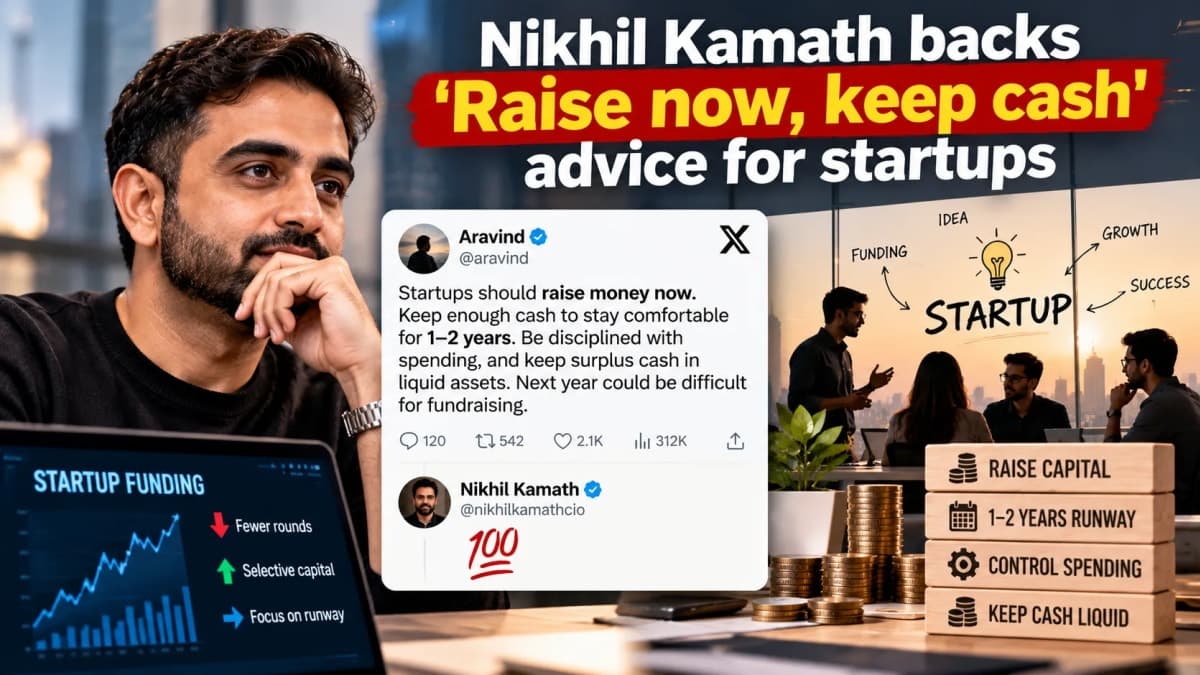
Nikhil Kamath Backs Cautious Funding Strategy for Startups
Zerodha co-founder Nikhil Kamath has signalled strong agreement with advice encouraging startup founders to raise capital while funding remains available and preserve enough cash to withstand a potentially tougher environment.
The discussion began with a post on X by a user identified as Aravind, who advised startups and companies seeking capital to raise money soon.
The post argued that businesses should secure enough cash to remain comfortable for roughly one to two years, remain disciplined about spending and keep unused capital in liquid assets.
It also warned that the fundraising environment next year could become difficult.
Kamath responded with a “100” reaction, widely used online to indicate strong agreement.
Importantly, the original advice was not written by Kamath himself. His role in the discussion was to endorse it.
What Was the ‘Raise Now, Keep Cash’ Advice?
The central argument behind the post was straightforward: companies that expect to need outside capital should consider raising it before market conditions potentially become less favourable.
The advice contained several broad ideas:
Raise capital while investors are still willing to deploy money.
Build enough cash reserves to provide roughly one to two years of financial comfort.
Remain disciplined about expenses.
Keep surplus funds in liquid assets rather than unnecessarily locking up cash.
Prepare for the possibility of a more challenging fundraising environment.
Kamath's “100” response indicated agreement with that overall message.
It was not, however, a detailed funding forecast or a guarantee that capital markets will deteriorate next year.
Why the Comment Is Getting Attention
Kamath's reaction carries additional weight within India's startup ecosystem because he is both an entrepreneur and investor.
He co-founded Zerodha, one of India's largest stockbroking platforms, and is also associated with investment initiatives including True Beacon, NKSquared and WTFund.
His investment activities have increasingly brought him into contact with early-stage founders and emerging businesses.
That makes his endorsement of a more defensive capital strategy noteworthy at a time when founders are balancing growth ambitions against uncertainty around future funding availability.
India's Startup Funding Market Shows Mixed Signals
The broader funding environment is more complicated than a simple funding boom or funding winter.
According to data cited by The Economic Times, India recorded 1,134 funding rounds during the first nine months of 2026, compared with 1,838 rounds during the corresponding period a year earlier.
That represents a significant decline in the number of transactions.
At the same time, aggregate funding has not necessarily moved in the same direction, as larger rounds can push total capital raised higher even when fewer startups receive funding.
This creates an uneven market in which capital may remain available but becomes concentrated among a smaller group of companies.
Fewer Deals Do Not Necessarily Mean No Money
The distinction between deal count and total capital is important.
A startup ecosystem can record substantial overall investment even while early-stage or less-established companies find fundraising increasingly difficult.
If investors concentrate more capital into companies they consider stronger, founders outside that group may face longer fundraising cycles, tougher negotiations or greater pressure on valuations.
That helps explain why maintaining a longer cash runway can become strategically important even when headline funding figures appear healthy.
Why Cash Runway Matters for Startups
A startup's cash runway broadly describes how long it can continue operating before requiring additional capital, assuming its current spending and revenue patterns continue.
For a company that depends heavily on external funding, a short runway can create significant pressure.
If a startup approaches investors when it has only a few months of cash remaining, its negotiating position may weaken.
Investors know that the company has limited time to secure financing, which can affect valuation, dilution and investment terms.
By contrast, a company with substantial cash reserves has more flexibility to decide when, how and from whom it raises additional capital.
That is the logic behind the recommendation to maintain enough funding for a longer period.
Raising More Money Also Has a Cost
The strategy is not automatically beneficial for every startup.
Equity financing usually requires founders and existing shareholders to give up part of their ownership.
Raising significantly more capital than necessary can therefore result in unnecessary dilution.
It can also create pressure to pursue faster expansion simply because additional money is available.
For some businesses—particularly those with strong revenue, positive cash flow or a realistic path toward profitability—raising additional equity may not be the most efficient option.
The appropriate decision depends on the company's financial position, growth plans, valuation and expected future capital requirements.
Kamath Has Previously Favoured Capital Discipline
The latest endorsement is particularly interesting when viewed alongside Kamath's broader comments about entrepreneurship.
He has previously argued that founders do not necessarily need enormous funding rounds to build successful businesses.
In an earlier discussion with the World Economic Forum about WTFund, Kamath said he would like more startups to remain bootstrapped where possible, build profitably and avoid becoming excessively dependent on large funding rounds.
That position is not necessarily inconsistent with his latest reaction.
The two ideas can coexist: founders may benefit from avoiding unnecessary dependence on outside money, while companies that know they will require funding may be better served by raising it before they reach a vulnerable cash position.
AI Is Changing the Startup Funding Equation
The rise of artificial intelligence is also reshaping the environment in which new companies raise money.
AI has lowered some barriers to building software products, allowing smaller teams to develop prototypes and launch businesses more quickly.
But that can also increase competition.
When many startups can build similar products faster, investors may become more selective about which companies have genuine differentiation, proprietary technology, distribution advantages or defensible business models.
The result could be a market where creating a startup becomes easier while raising large amounts of capital for an undifferentiated business becomes harder.
Investors Are Paying More Attention to Fundamentals
The startup investment environment has gradually shifted away from an era in which rapid user growth alone could justify aggressive valuations.
Investors increasingly examine revenue quality, unit economics, customer retention, cash burn and the path toward sustainable profitability.
This does not mean growth is no longer important.
Rather, companies may face greater pressure to demonstrate that growth can eventually translate into a financially sustainable business.
Holding sufficient cash can give founders more time to make that transition without immediately returning to investors.
Why ‘Keep Cash’ Can Be as Important as ‘Raise Now’
The second half of the funding advice—preserving the capital after raising it—may be just as important as the fundraising itself.
A large funding round provides little protection if a startup rapidly increases its burn rate.
During periods of abundant capital, companies sometimes expand teams, marketing budgets and infrastructure on the assumption that another funding round will be available later.
If financial conditions change, those fixed costs can become difficult to reduce quickly.
Maintaining spending discipline can therefore extend runway and reduce dependence on future financing.
Liquid Assets and Startup Treasury Management
The original post also suggested keeping surplus cash in liquid assets.
For startups, treasury management involves balancing three priorities: preserving capital, maintaining access to funds and earning some return on idle cash.
Liquidity can be particularly important because operating expenses such as salaries, cloud infrastructure and vendor payments continue regardless of fundraising conditions.
However, investment decisions involving company cash require appropriate risk management.
A startup's operating capital is fundamentally different from money intended for speculative investment.
The objective is generally to maintain access and protect the company's ability to operate rather than chase higher returns.
Could Next Year Really Be Worse for Fundraising?
That remains uncertain.
The warning that next year “could be bad” is a prediction contained in the original social-media post, not an established outcome.
Startup funding can be affected by interest rates, public-market valuations, economic growth, geopolitical developments, technology trends and investor risk appetite.
Changes in any of these factors could make fundraising easier or harder.
For that reason, Kamath's endorsement is better interpreted as support for financial preparedness rather than a definitive forecast of a coming funding downturn.
What Founders Can Take From the Debate
The broader lesson is less about predicting exactly when funding conditions will change and more about reducing dependence on that prediction.
A startup with a healthy cash runway has more options.
It can delay fundraising if valuations become unattractive, continue investing in its product during a difficult market and negotiate with investors without facing an immediate liquidity deadline.
At the same time, founders must weigh those advantages against dilution and the cost of raising capital earlier than necessary.
There is therefore no universal amount of money that every startup should raise.
Balanced Analysis
Nikhil Kamath's endorsement of the “raise now, keep cash” argument highlights a recurring tension in startup finance.
Waiting to raise capital can allow a company to improve its metrics and potentially secure a better valuation later. But waiting too long can leave founders vulnerable if funding conditions suddenly deteriorate.
Raising early provides financial security, but it can also increase dilution and tempt companies into unnecessary spending.
The most useful element of the advice may therefore be its emphasis on runway and spending discipline, rather than the assumption that every startup should immediately raise as much capital as possible.
The current Indian funding environment also requires nuance. A decline in the number of funding rounds suggests investors are becoming more selective, but substantial capital continues to flow into parts of the market.
Kamath's “100” reaction should consequently be understood as an endorsement of preparedness—not proof that a funding downturn is inevitable.
For founders, the underlying question remains straightforward:
If fresh capital became significantly harder to obtain tomorrow, how long could the company continue operating on the cash it already has?